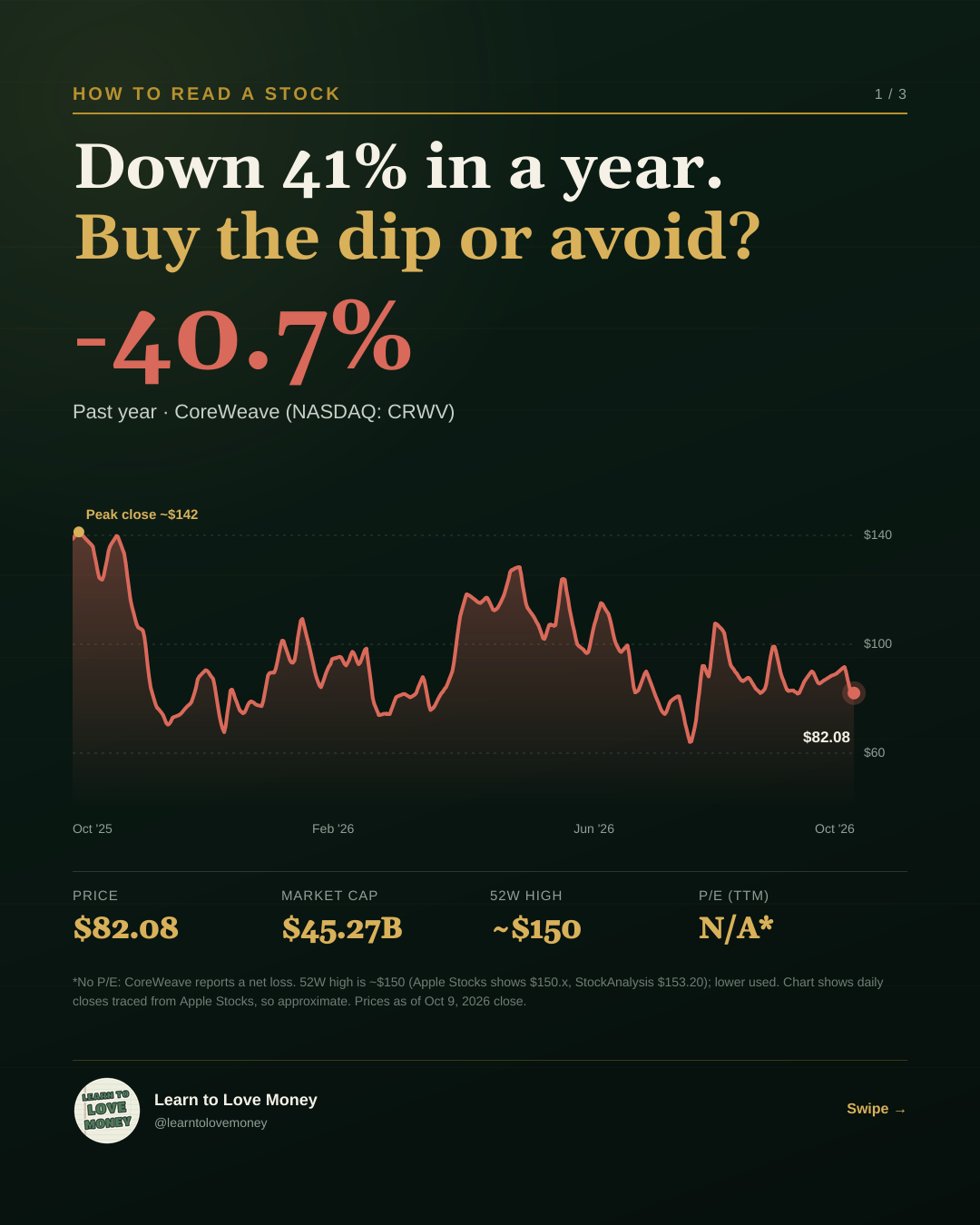
CoreWeave is down about 41% in a year, yet revenue grew 112% last quarter and signed backlog is around $104 billion. Analysts mostly rate it a Buy. Our AI leans the other way. Here's why, and what would prove it wrong.
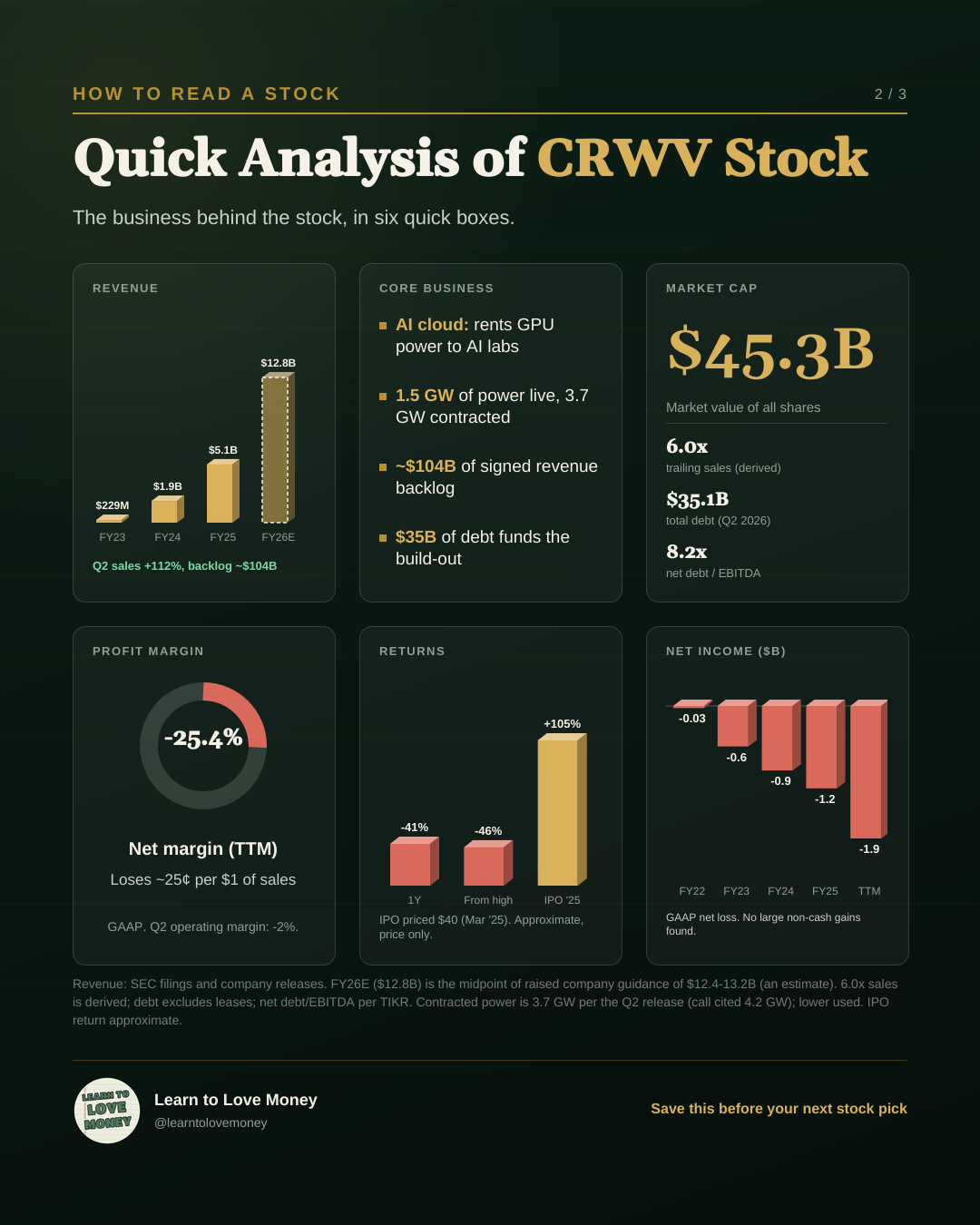
What CoreWeave actually does
CoreWeave is an AI cloud: it rents GPU computing power to AI labs and other big customers. It has about 1.5 gigawatts of power live and 3.7 gigawatts contracted, and about $104 billion of signed revenue backlog. Building all of that capacity costs a lot, and roughly $35 billion of debt funds it.
Growth: revenue and earnings
Revenue grew from $229 million in fiscal 2023 to $1.9 billion in 2024 and $5.1 billion in 2025. The company's raised guidance of $12.4 to $13.2 billion points to roughly $12.8 billion in fiscal 2026, an estimate and not a result. Second-quarter sales grew 112%.
Revenue ($B)
The profit side is the problem. CoreWeave has lost money every year, and the losses are growing: about $1.9 billion over the trailing twelve months, a net margin of -25.4%. That means it loses roughly 25 cents for every $1 of sales. Last quarter alone it paid about $640 million in interest.
Net income ($B)
Is it actually cheap?
Price
$82.08
Market cap
$45.27B
52-week high
~$150
P/E (TTM)
N/A
There is no P/E to compare, because CoreWeave reports a net loss. The market cap is about 6.0 times trailing sales, and net debt is 8.2 times EBITDA. Total debt was $35.1 billion as of Q2 2026 (leases excluded).
The stock is down about 46% from its high, but it is still up about 105% from its $40 IPO price in March 2025. A drop does not make a stock cheap when the business is still losing money and owes this much.
Moat and leadership
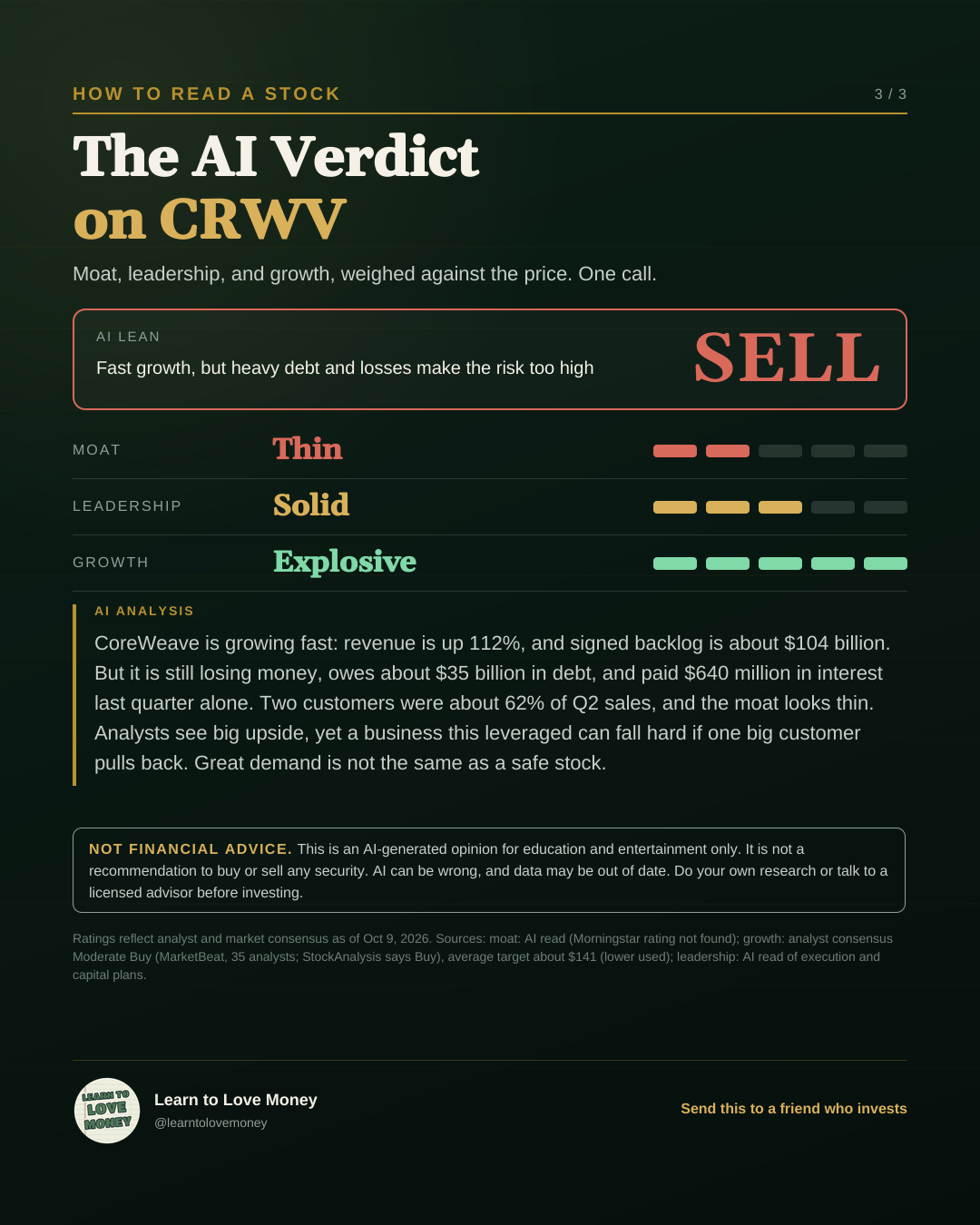
We rate the moat thin. Renting GPUs is a business where customers can shop around, and CoreWeave depends heavily on a few of them: two customers made up about 62% of second-quarter sales. Morningstar's moat rating was not available, so this is an AI read.
Leadership looks solid. Management has signed a huge backlog and expanded power fast. But execution on that scale is funded by borrowing, which leaves little cushion if growth slows.
The risk that flips the call
The risk to our SELL lean is that demand stays strong and the backlog converts to profits faster than expected. If big customers keep paying and margins turn positive, the debt becomes manageable and the stock could recover. That is what the bulls are betting on.
The AI verdict
AI lean
Fast growth, but heavy debt and losses make the risk too high
SELL
Weighing moat (thin), leadership (solid), and growth (explosive) against the price, our AI leans Sell. The growth is real, but heavy debt, ongoing losses, and customer concentration make this a risky business. Great demand is not the same as a safe stock. Analysts are more bullish, so weigh both views.
More in this series: Marvell, Bloom Energy, Sandisk, and TSMC. And for the AI side, our free AI Explained course covers what AI is and where it can go wrong.
NOT FINANCIAL ADVICE. This is an AI-generated opinion for education and entertainment only. It is not a recommendation to buy or sell any security. AI can be wrong, and data may be out of date. Do your own research or talk to a licensed advisor before investing.
Sources
- SEC EDGAR: CoreWeave filings — quarterly results, debt, and customer concentration (Q2 2026)
- Apple Stocks app: one-year price history and market cap (no public link)
- StockAnalysis — 52-week high, analyst ratings, and average target
- MarketBeat — analyst consensus (35 analysts)