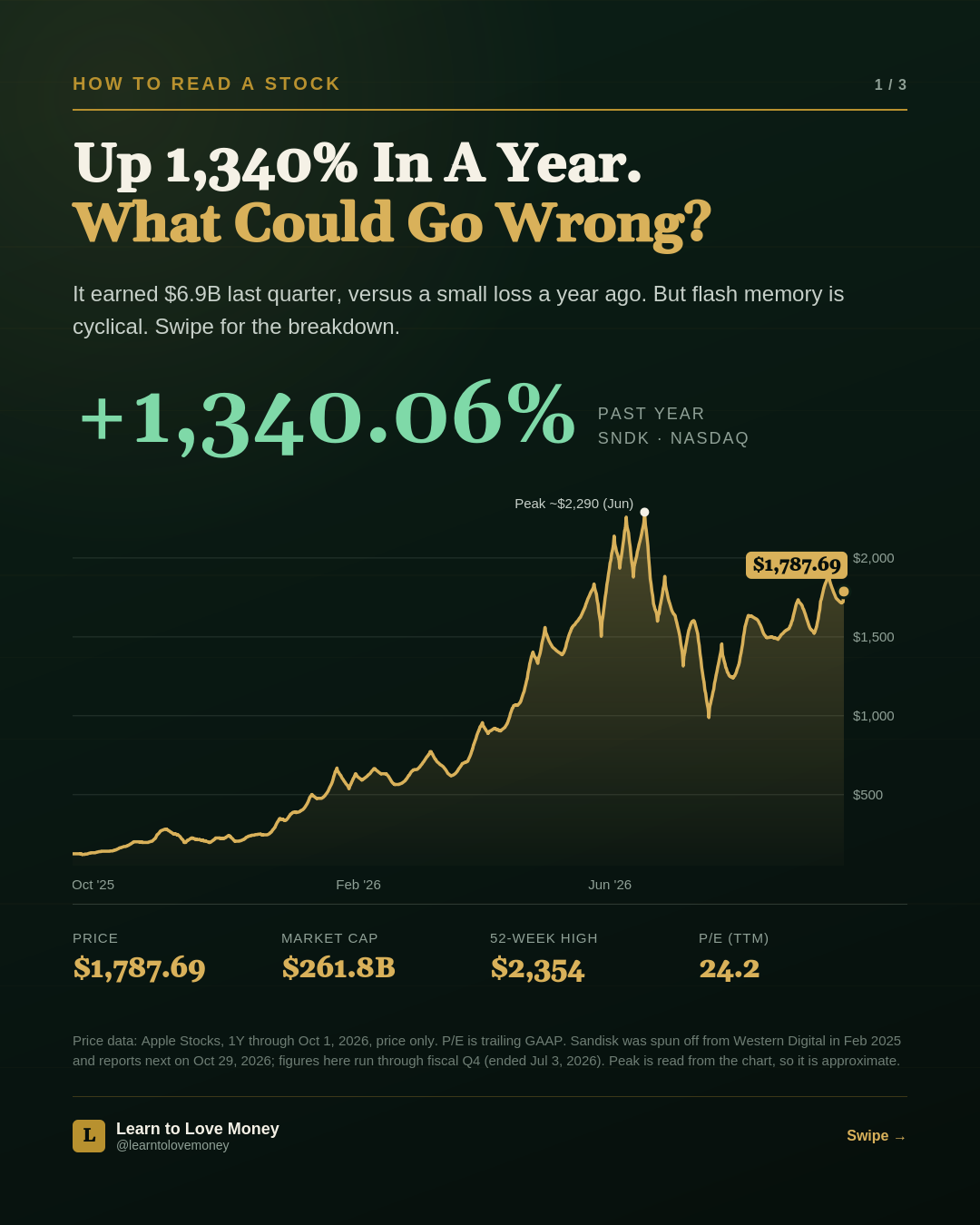
Sandisk is up more than 1,300% in a year, earned $6.9 billion last quarter versus a small loss a year ago, and trades at a P/E of just 24. Analysts mostly rate it a Buy. Our AI leans the other way. Here's why, and what would prove it wrong.
What Sandisk actually does
Sandisk makes NAND flash, the memory that stores data in phones, PCs, memory cards, drives, and increasingly AI servers. It sells nothing else, and it makes its chips with Kioxia in Japan. The company was spun off from Western Digital in February 2025.
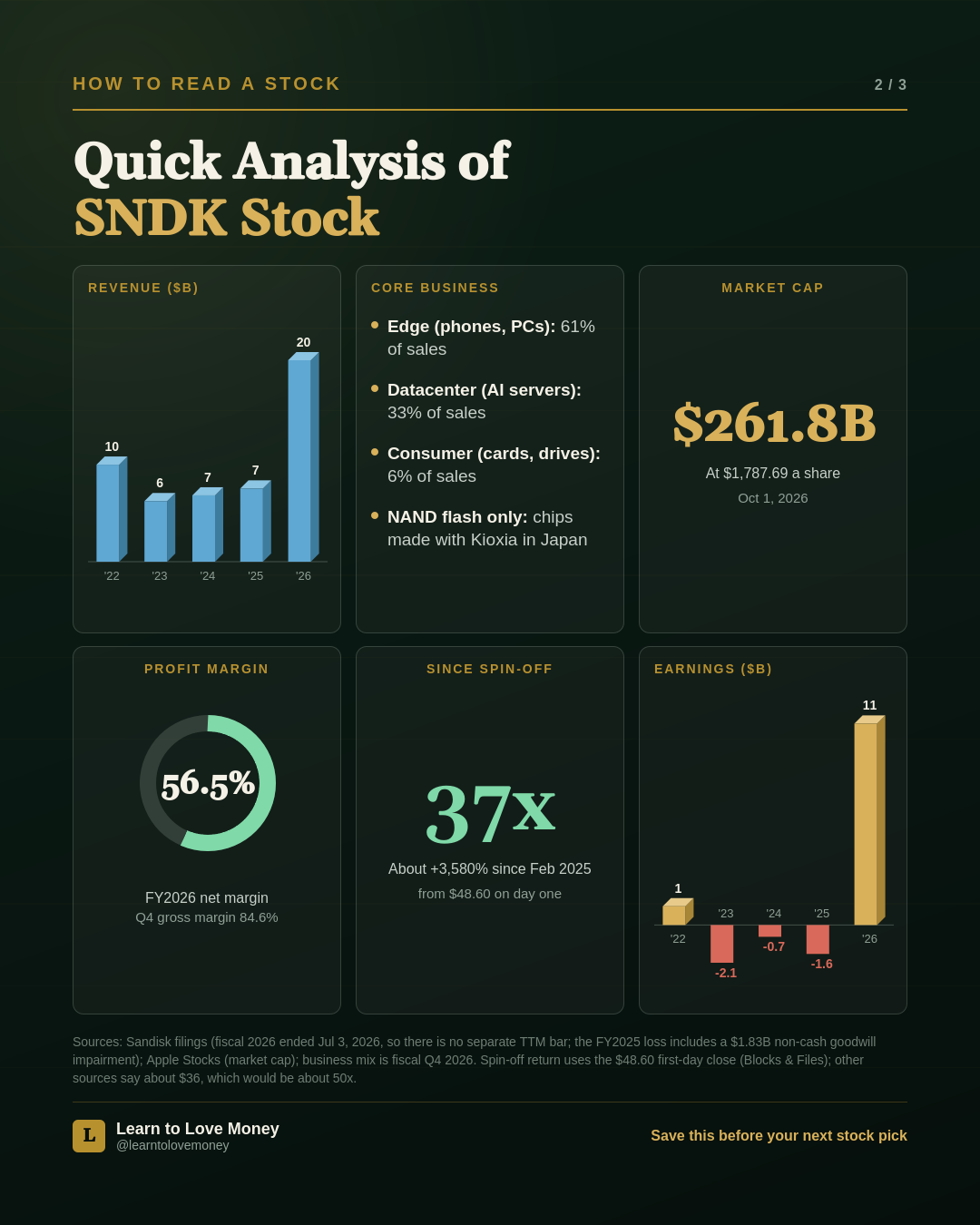
By sales, edge devices (phones and PCs) are 61%, the data center (AI servers) is 33%, and consumer products (cards and drives) is 6%. The data center slice is the one driving the excitement, and the one that depends most on the AI boom lasting.
Where sales come from
Growth: revenue and earnings
Revenue was $10B in fiscal 2022, fell to $6B in 2023, held near $7B for two years, then jumped to $20B in fiscal 2026. Last quarter revenue grew 372% at an 85% gross margin.
Revenue ($B)
Earnings tell the same boom-and-bust story. Sandisk lost money three years in a row, then earned $11B in fiscal 2026, a net margin of 56.5%. That's an extraordinary figure for a business that was losing money 12 months earlier, and it's the kind of margin commodity makers rarely hold.
Earnings ($B)
Is it actually cheap?
Price
$1,787.69
Market cap
$261.8B
52-week high
$2,354
P/E (TTM)
24.2
A 24.2 P/E looks cheap, but only because earnings are at a peak. A P/E divides price by trailing earnings, so when profits are unusually high the ratio looks unusually low. At a cycle top, a low P/E can be a warning rather than a bargain sign.
The price is also about 1.8 times Morningstar's $1,000 fair value, a rating that carries very high uncertainty. Analysts are far more bullish: 21 of 25 rate the stock a Buy, with an average target of about $2,137. Since the spin-off the stock is up about 37x, from the $48.60 first-day close. Other sources use a lower starting price near $36, which would make the gain about 50x.
Moat and leadership
This is where our AI's concern is sharpest. Morningstar sees no moat at Sandisk and rates the stock 2 stars. Flash memory is a commodity: buyers can switch suppliers on price, and no one keeps pricing power forever. Morningstar expects prices to peak in early 2028.
There's one real cushion. New multi-year customer contracts add some protection if prices soften. Leadership has also executed well through the surge, so we rate it solid, but good management can't repeal the memory cycle.
The risk that flips the call
The risk to our SELL lean is simple: prices holding up longer than expected. If AI demand keeps flash scarce for years, profits could stay near today's levels and the stock could keep climbing. That's what the bulls are betting on, which is why this is a judgment call and not a certainty.
The AI verdict
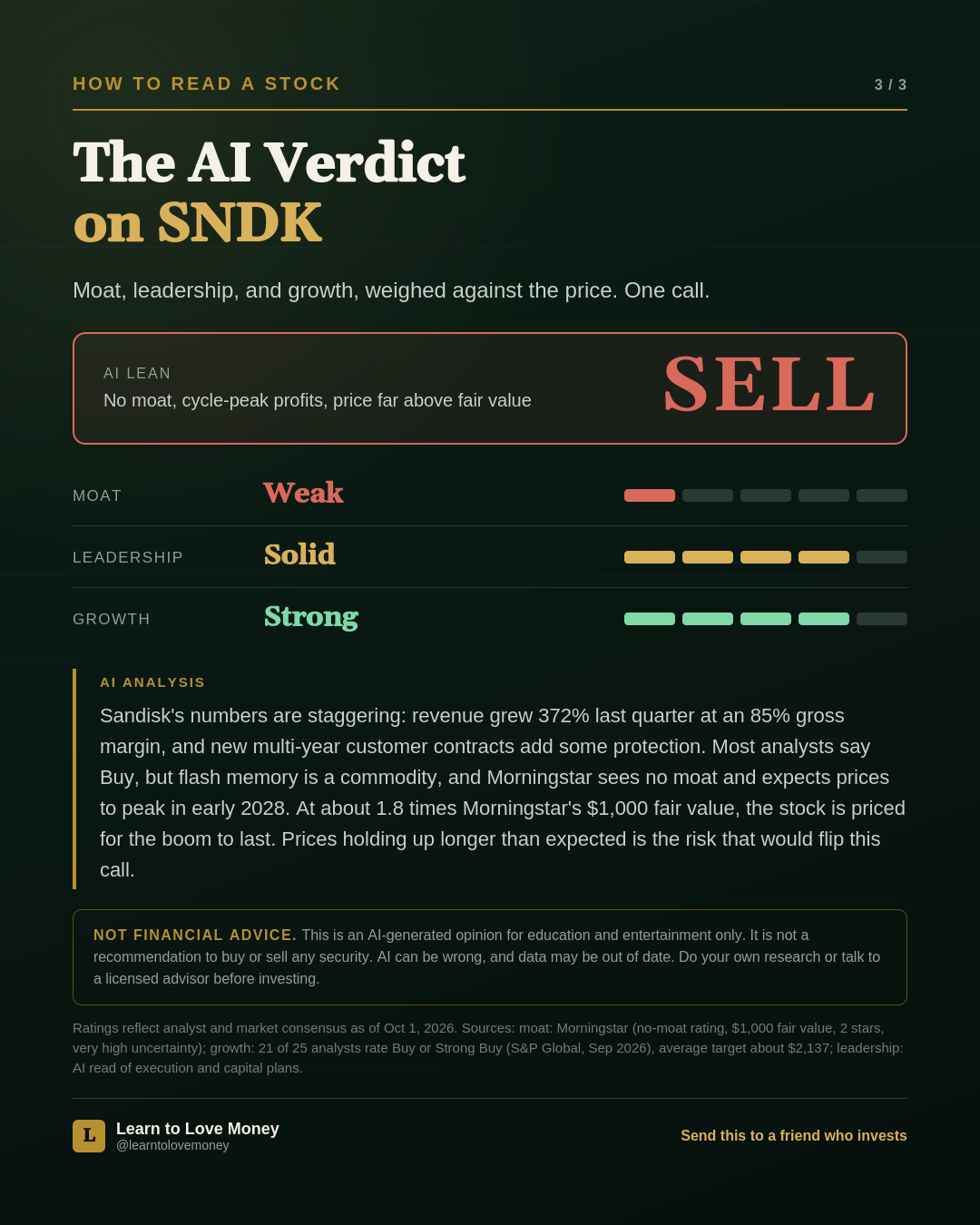
AI lean
No moat, cycle-peak profits, price far above fair value
SELL
Weighing moat (weak), leadership (solid), and growth (strong) against the price, our AI leans Sell. The growth is real, but a commodity business at peak margins and a price well above fair value is a risky combination. Most analysts disagree, so weigh both views.
More in this series: our Micron analysis covers the same memory cycle, plus TSMC, Alphabet, and Amazon. And for the AI side, our free AI Explained course covers what AI is and where it can go wrong.
NOT FINANCIAL ADVICE. This is an AI-generated opinion for education and entertainment only. It is not a recommendation to buy or sell any security. AI can be wrong, and data may be out of date. Do your own research or talk to a licensed advisor before investing.
Sources
- SEC EDGAR: Sandisk filings — fiscal 2026 results through Q4 (ended Jul 3, 2026)
- Apple Stocks app: one-year price history and market cap (no public link)
- Morningstar — no-moat rating, $1,000 fair value estimate, and 2-star rating
- S&P Global — analyst ratings (21 of 25 rate Buy or Strong Buy, Sep 2026) and average target
- Blocks & Files — the $48.60 first-day close used for the since-spin-off return