Micron is up more than 500% in a year, trades at a P/E of just 24, and analysts overwhelmingly rate it a Buy. This is the one time in our series where our AI disagrees. Here's why, and what would prove it wrong.
What Micron actually does
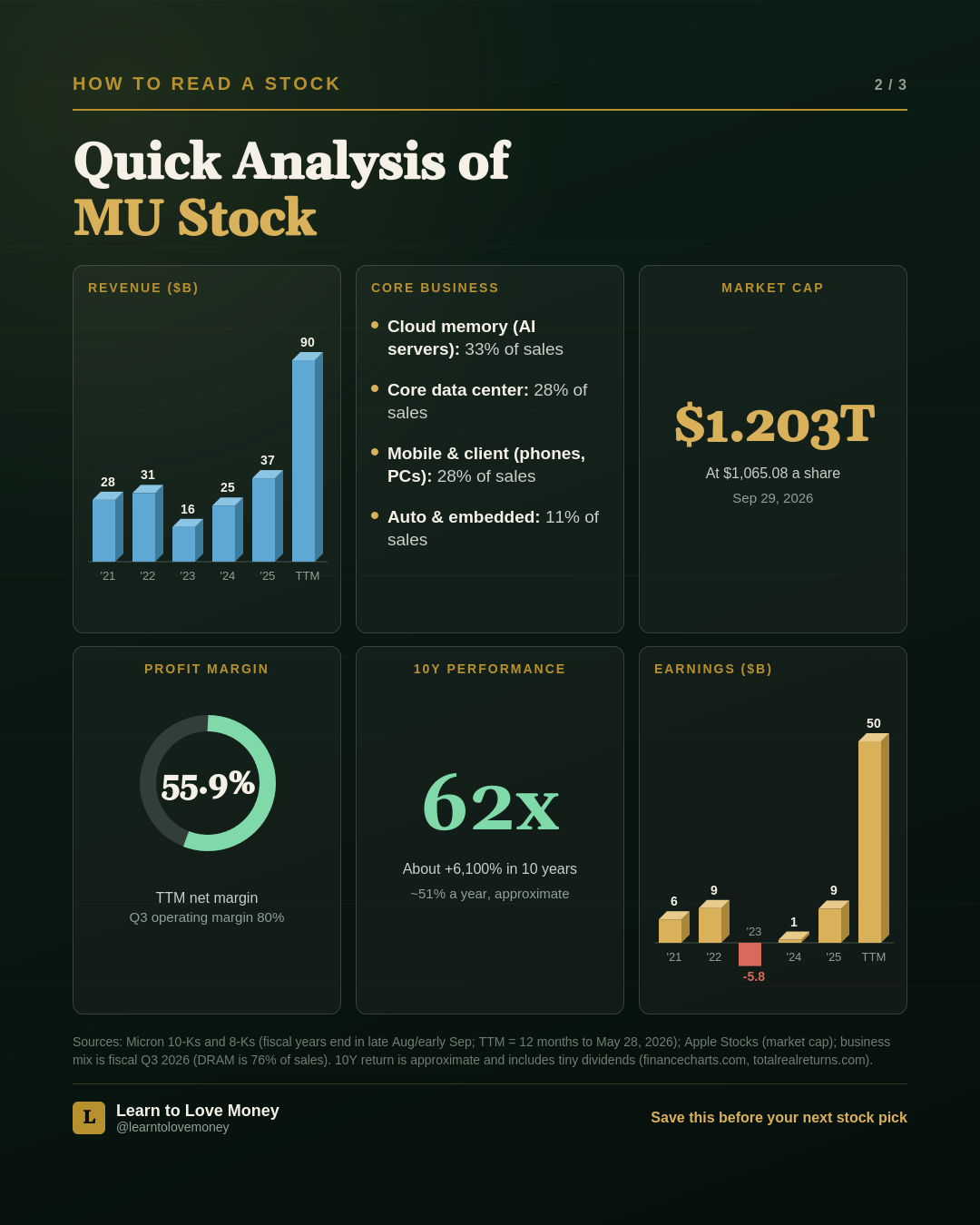
Micron makes memory chips, mostly DRAM, which is 76% of its sales. The chips go into cloud memory for AI servers (33% of sales), the core data center (28%), phones and PCs (28%), and auto and embedded products (11%).
The catch is that memory is a commodity. One maker's DRAM is largely interchangeable with another's, so buyers choose on price, and prices swing hard with supply and demand.
Where sales come from
Growth: revenue and earnings
The recent growth is spectacular. Revenue reached $90B over the last twelve months (TTM), up from $37B in 2025. Last quarter revenue rose 346% at an 85% gross margin, and the TTM net margin is 55.9%.
Revenue ($B)
But look at the history. In 2023 revenue fell almost in half, from $31B to $16B, and Micron lost $5.8B. Earnings then climbed from $1B in 2024 to $50B over the last twelve months. That whipsaw is what a cyclical business looks like, and today's numbers sit at the top of the swing.
Earnings ($B)
Is it actually cheap?
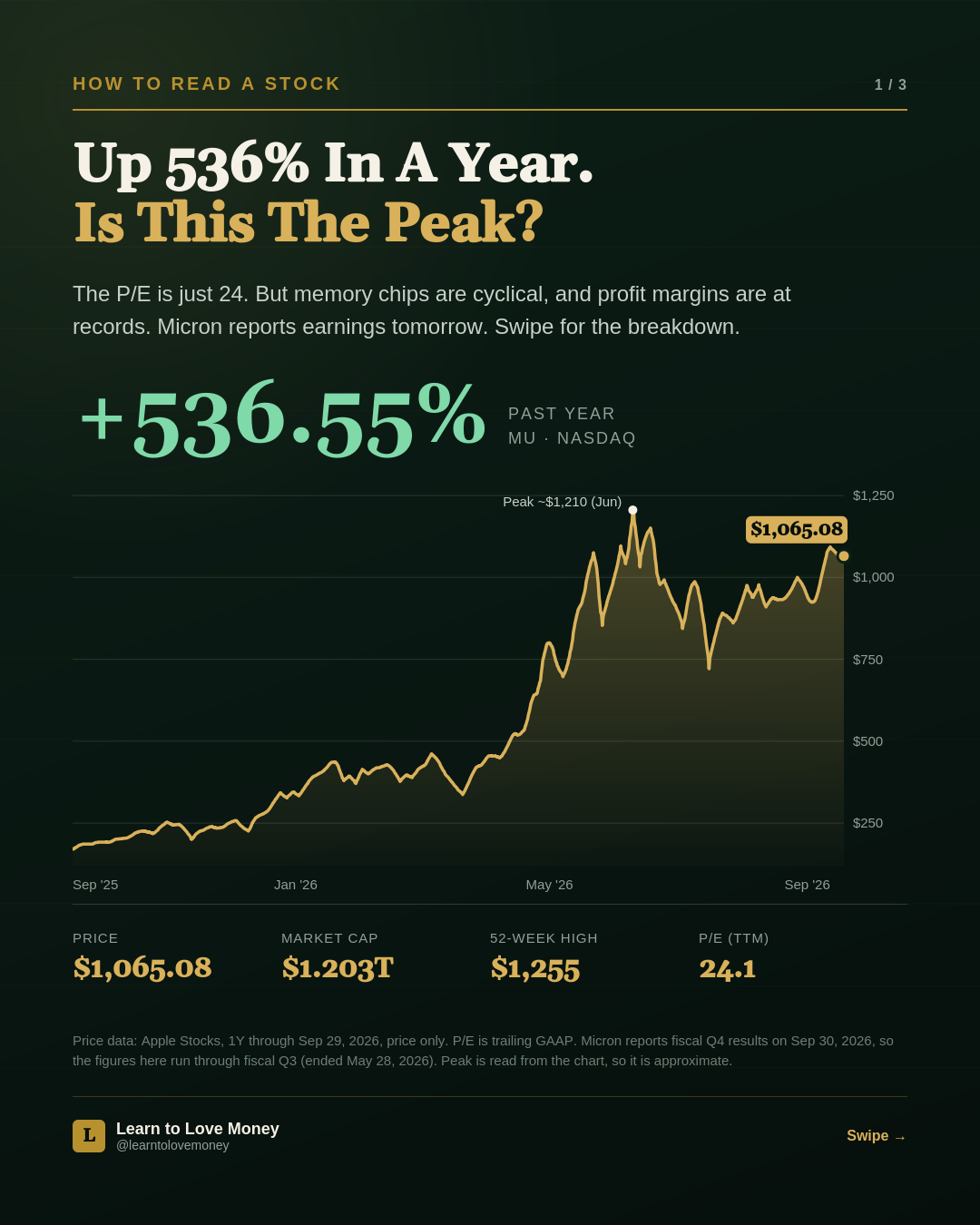
Price
$1,065.08
Market cap
$1.203T
52-week high
$1,255
P/E (TTM)
24.1
A 24.1 P/E looks cheap, but only because profits are at a peak. A P/E divides price by trailing earnings, and when earnings are unusually high the ratio looks unusually low. Q3's operating margin was 80%, far above what a commodity maker can normally sustain.
The price also sits about 25% above Morningstar's $850 fair value, which leaves little cushion. Analysts see it differently: 44 of 48 rate the stock a Buy, with an average target of about $1,513. Over the last decade the stock has returned roughly 62x, or about 51% a year, so anyone who bought early has been richly paid.
Moat and leadership
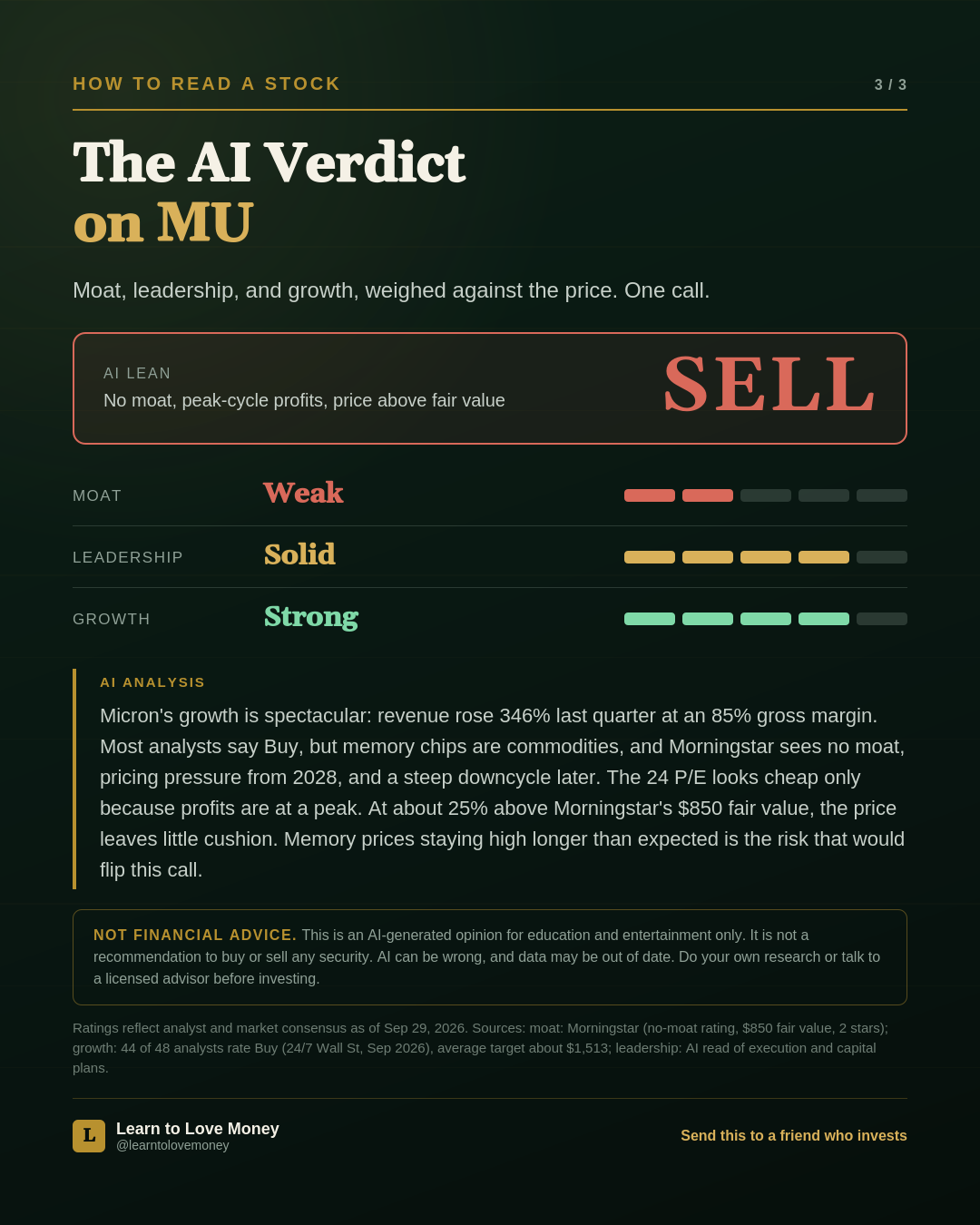
This is where our AI's concern is sharpest. Morningstar sees no moat at Micron, and rates the stock 2 stars. When buyers can swap suppliers easily, no company keeps its pricing power for long. Morningstar expects pricing pressure from 2028 and a steep downcycle later.
Leadership is a real strength: Micron has executed well through the AI surge. We rate it solid, but good management can't repeal the memory cycle.
The risk that flips the call
The risk to our SELL lean is simple: memory prices staying high for longer than expected. If AI demand keeps chips scarce for years, profits could stay near today's levels and the stock could keep climbing. That's exactly what the bulls are betting on, and it's why this is a judgment call, not a certainty.
The AI verdict
AI lean
No moat, peak-cycle profits, price above fair value
SELL
Weighing moat (weak), leadership (solid), and growth (strong) against the price, our AI leans Sell. The growth is real, but a commodity business at peak margins and a price above fair value is a risky combination. Most analysts disagree, so weigh both views.
More in this series: our TSMC, Alphabet, and Amazon analyses. And for the AI side, our free AI Explained course covers what AI is and where it can go wrong.
NOT FINANCIAL ADVICE. This is an AI-generated opinion for education and entertainment only. It is not a recommendation to buy or sell any security. AI can be wrong, and data may be out of date. Do your own research or talk to a licensed advisor before investing.