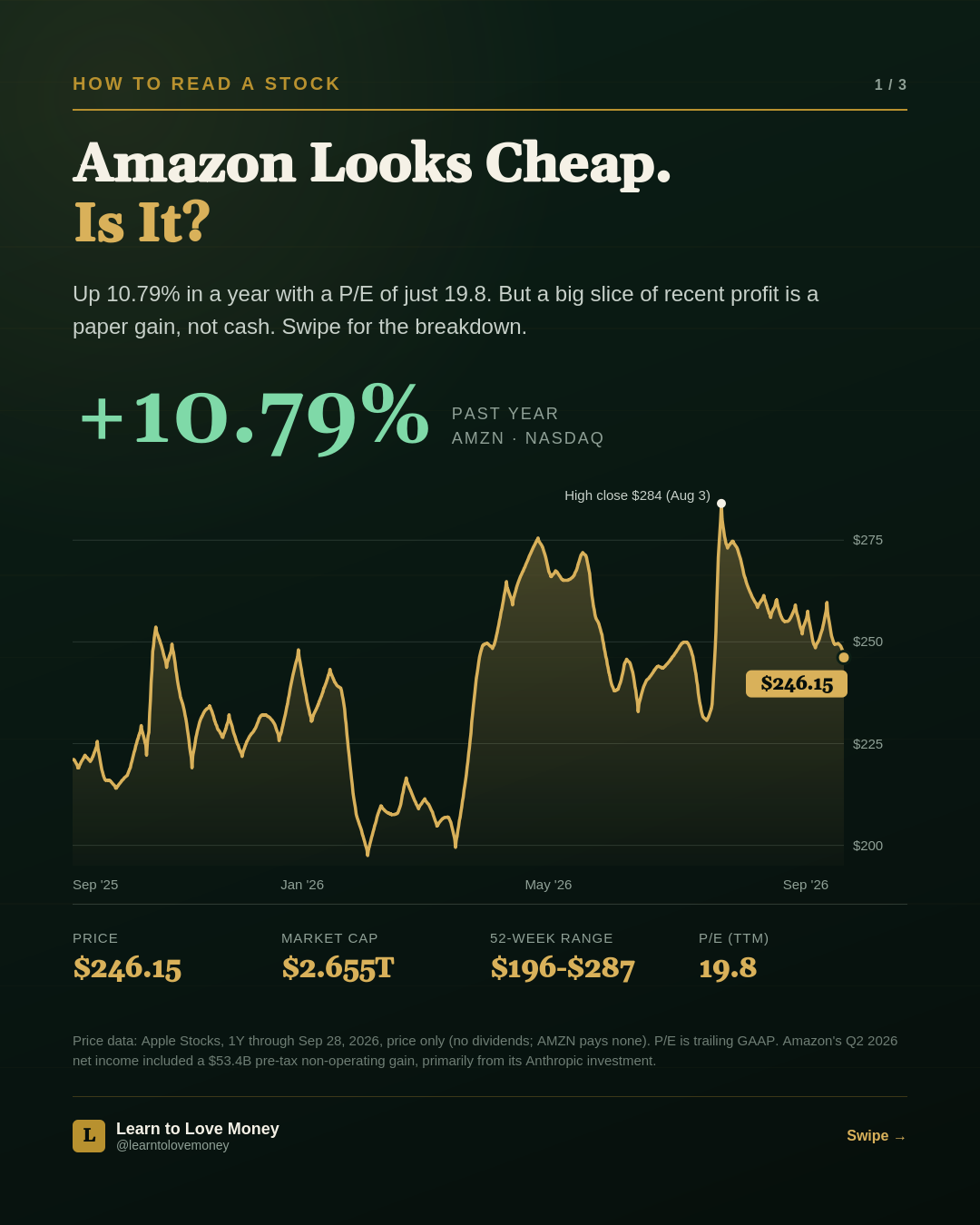
Amazon is up about 11% over the past year and trades at a P/E under 20. On paper, that's cheap for one of the biggest companies on earth. Here's what's underneath that number, and where our AI read lands.
What Amazon actually does
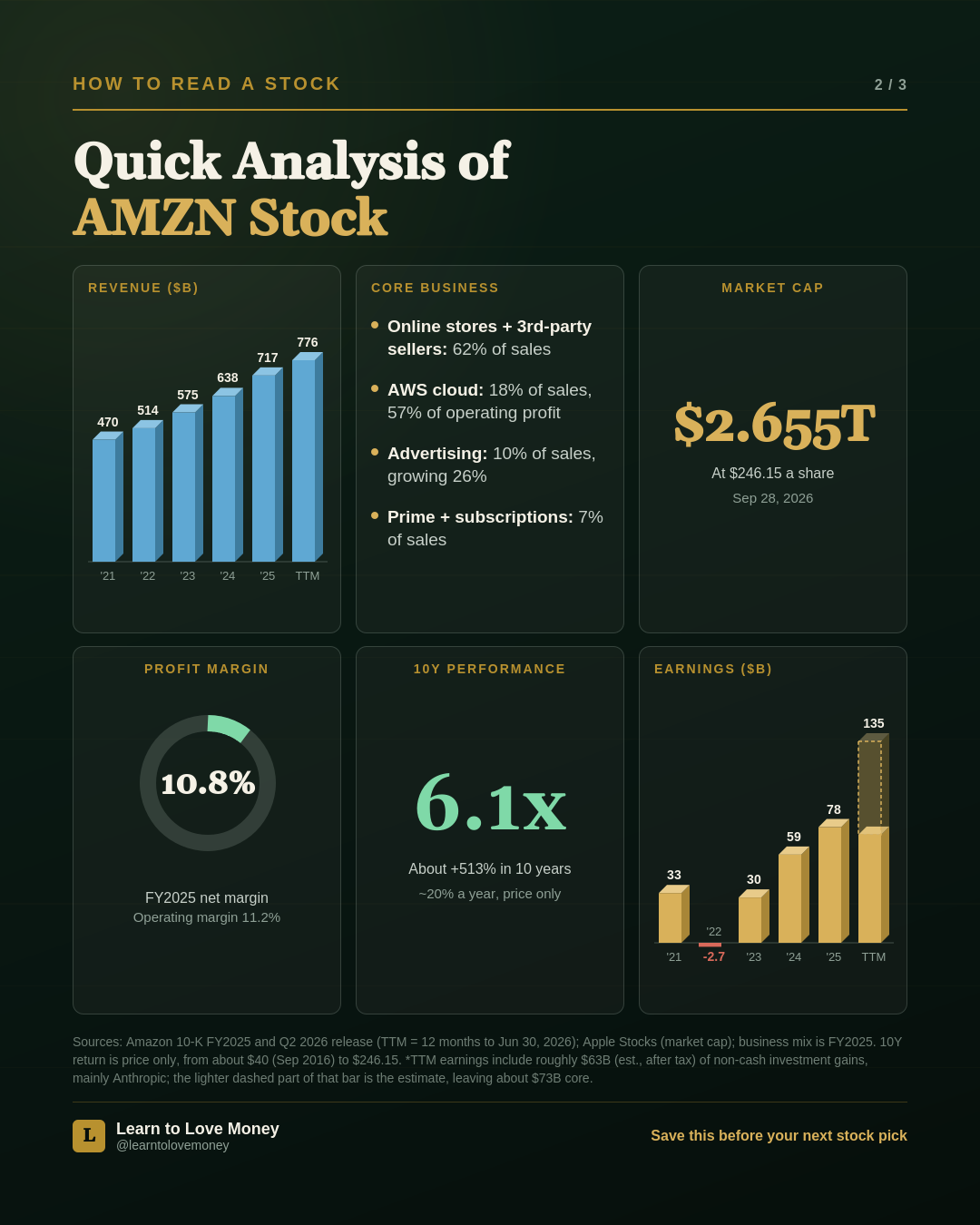
Amazon is really four businesses under one name. The online store and third-party sellers make up 62% of sales. AWS, the cloud arm, is only 18% of sales. Advertising is 10% of sales and growing 26%, and Prime and subscriptions add another 7%.
The catch is where the money comes from. AWS produces 57% of Amazon's operating profit from less than a fifth of its sales. The store brings in the customers and the revenue; the cloud does most of the earning.
Where sales and profit come from
Growth: revenue and earnings
Revenue has climbed from $470B in 2021 to $717B in 2025, and $776B over the last twelve months (TTM). That works out to roughly 11% a year from 2021 to 2025.
Revenue ($B)
Earnings have been bumpier. Amazon lost $2.7B in 2022, then rebuilt to $78B in 2025. FY2025 net margin was 10.8% and operating margin was 11.2%.
The TTM bar looks like a leap to $135B, but about $63B of that is estimated, non-cash gains on investments, mainly Amazon's stake in Anthropic. Strip that out and core earnings are closer to $73B.
Earnings ($B)
Is it actually cheap?
Price
$246.15
Market cap
$2.655T
52-week range
$196–$287
P/E (TTM)
19.8
A 19.8 P/E looks like a bargain, but it's flattered by those same non-cash Anthropic gains. Using core earnings per share of about $6.65, the P/E is closer to 37x. That's a very different picture.
Still, there's a case for the price. Morningstar puts fair value at $300, roughly 22% above today's price, and 59 of 61 analysts rate the stock Buy or Strong Buy. Over the last decade the stock has gone from about $40 to $246, roughly 6.1x, or about 20% a year on price alone.
Moat and leadership
Morningstar rates Amazon a wide moat, and it's easy to see why. The marketplace works because shoppers and sellers both need it. AWS is hard to leave, because moving a company's systems off a cloud provider is slow and costly. And the ad business sits right where people already shop.
On leadership, CEO Andy Jassy has roughly doubled the operating margin since 2021, which is the clearest sign of discipline. We rate it solid rather than exceptional because of the size of the spending plans below.
The risk that flips the call
Amazon is spending about $220B, largely on AI and data center capacity, and free cash flow has turned negative as a result. The bet is reasonable: AWS is now growing 37% on a $496B contract backlog. But if that growth slows while the spending continues, the price stops looking cheap, even on generous assumptions.
The AI verdict
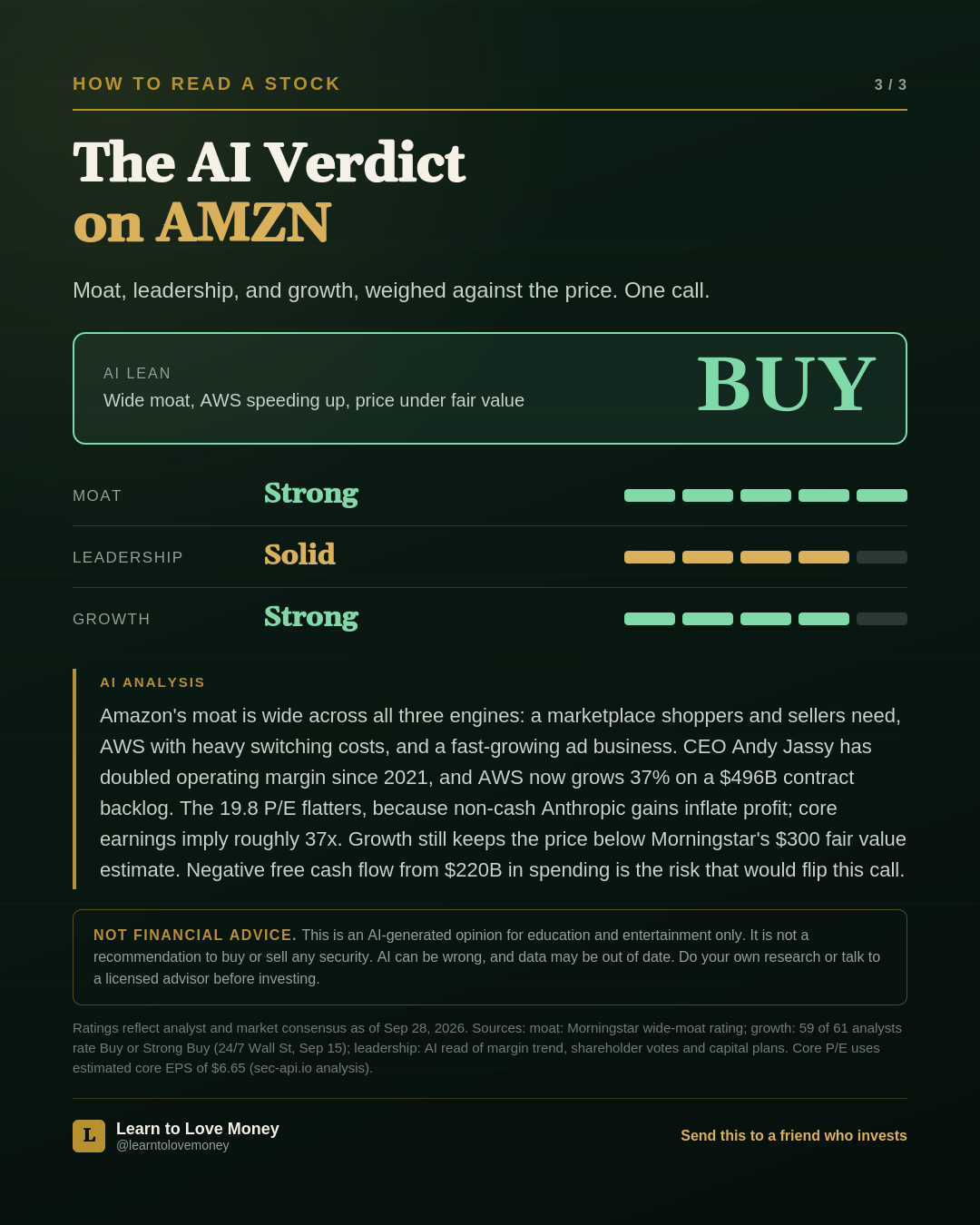
AI lean
Wide moat, AWS speeding up, price under fair value
BUY
Weighing moat (strong), leadership (solid), and growth (strong) against the price, our AI leans Buy. The honest caveat is that this only holds if AWS growth keeps paying for the spending. Watch free cash flow and AWS growth each quarter.
New to the AI side of this? Our free AI Explained course covers what AI is and where it can go wrong, which is why every number here is sourced.
NOT FINANCIAL ADVICE. This is an AI-generated opinion for education and entertainment only. It is not a recommendation to buy or sell any security. AI can be wrong, and data may be out of date. Do your own research or talk to a licensed advisor before investing.