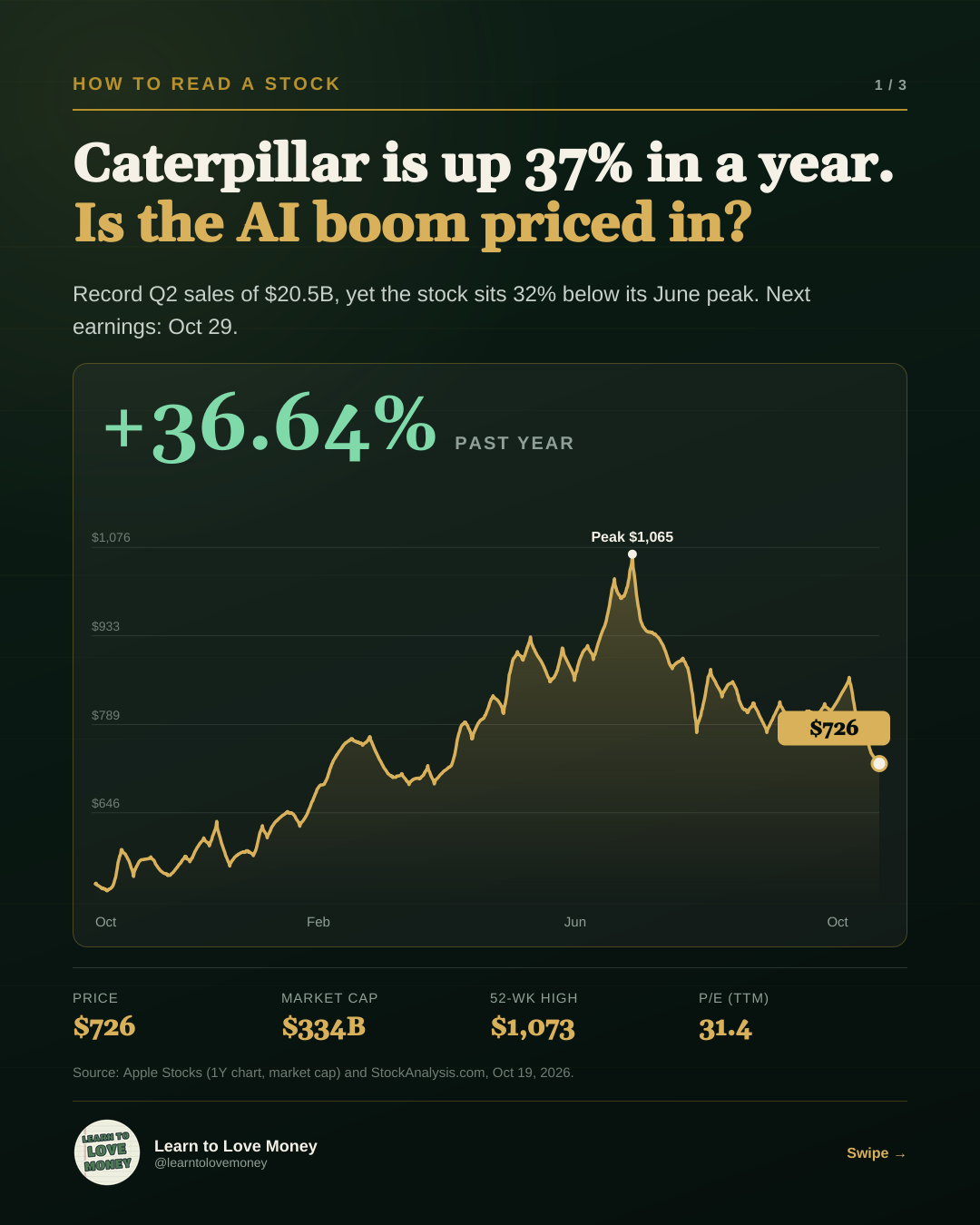
Caterpillar is up 37% in a year and just posted record second-quarter sales of $20.5 billion, up 24%. But the stock sits about 32% below its June peak, and it trades at about 31 times earnings. Our AI leans Sell. Here's why, and what would prove it wrong.
What Caterpillar actually does
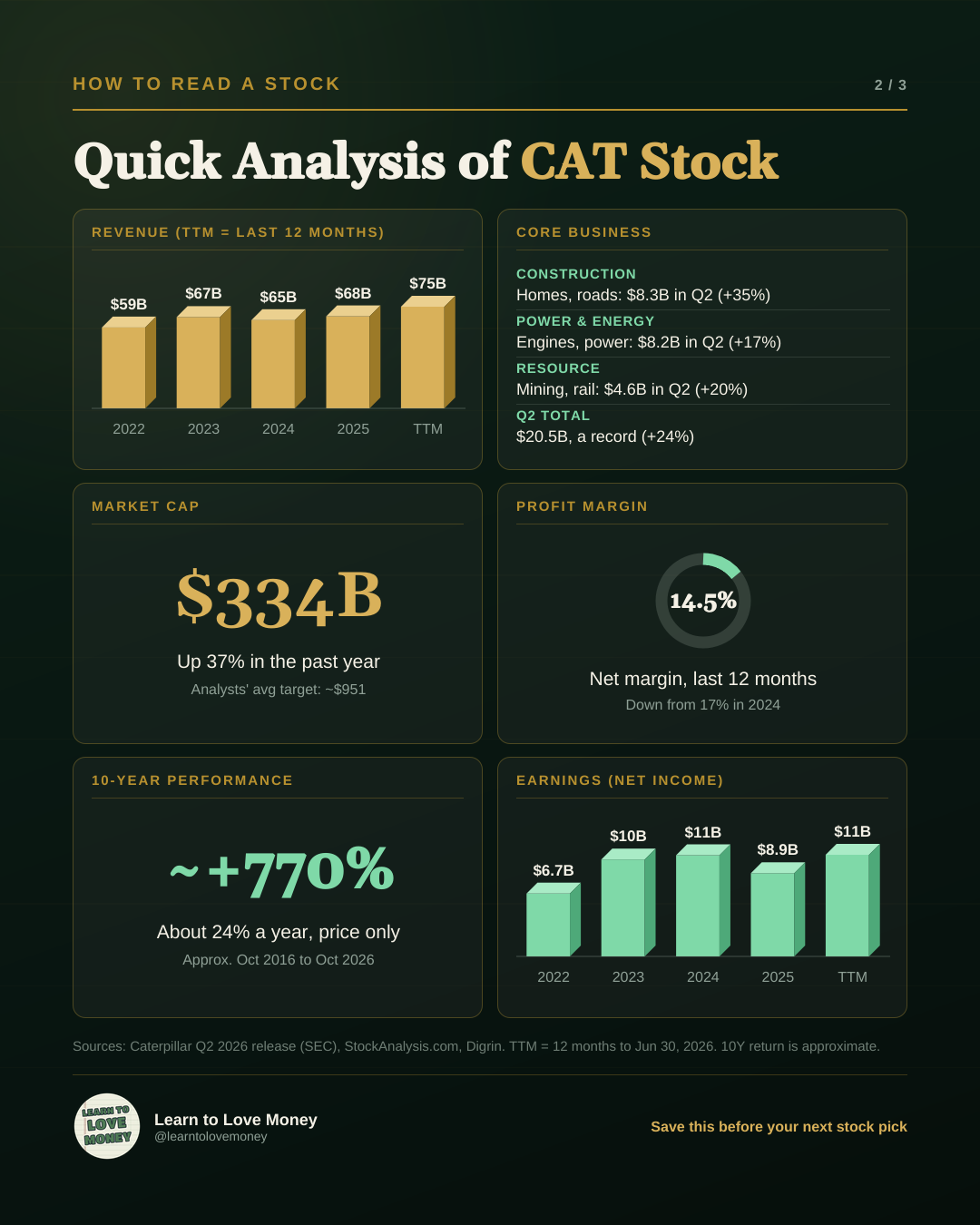
Caterpillar sells heavy machinery and the engines behind it. Its Q2 sales of $20.5 billion came from three segments: Construction (homes and roads) at $8.3 billion, up 35%; Power & Energy (engines and power equipment) at $8.2 billion, up 17%; and Resource (mining and rail) at $4.6 billion, up 20%.
The AI link is Power & Energy: engines and generators that power data centers. Investors have priced that demand in.
Growth: revenue and earnings
Revenue was flat for years, at $59 billion in 2022, $67 billion in 2023, $65 billion in 2024 and $68 billion in 2025. Over the last twelve months (TTM) it reached about $75 billion.
Revenue ($B, TTM = last 12 months)
Profits have not kept pace with the record sales. Net income was $11 billion in 2024, fell to $8.9 billion in 2025, and is back to about $11 billion over the last twelve months. The net margin is 14.5%, down from 17% in 2024.
Net income ($B)
Is it actually cheap?
Price
$726
Market cap
$334B
52-week high
$1,073
P/E (TTM)
31.4
A P/E of 31.4 is a growth-stock price on a cyclical business. Machinery makers usually earn their best profits at the top of a cycle, and Caterpillar's margins sit near peak levels. A high multiple on peak earnings leaves little room for a slowdown.
Analysts' average target is about $951, well above today's $726, but Truist recently cut its target over concerns about how long spending lasts. The stock is up about 770% over ten years, roughly 24% a year, price only (approximate).
Moat and leadership
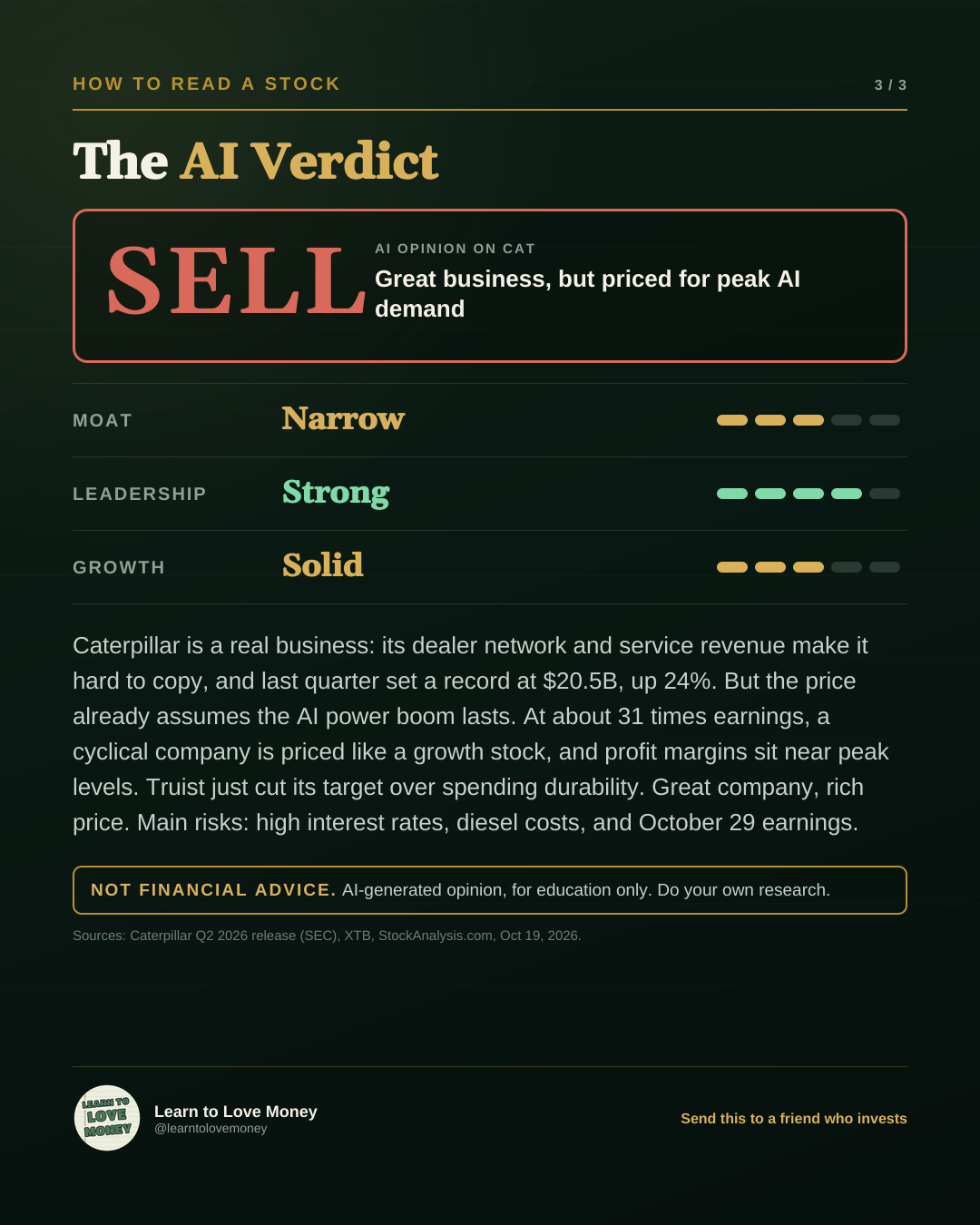
We rate the moat narrow. Caterpillar's dealer network and service revenue make it hard to copy, but machinery is still a cyclical business. Leadership is strong: the company set a sales record and has grown power and energy sales fast.
The risk that flips the call
The risks are high interest rates, diesel costs, and the October 29 earnings report. The risk to our SELL lean is that the AI power boom lasts longer and grows bigger than expected. If data-center demand keeps accelerating, the stock could climb back toward its June peak.
The AI verdict
AI lean
Great business, but priced for peak AI demand
SELL
Weighing moat (narrow), leadership (strong), and growth (solid) against the price, our AI leans Sell. Great company, rich price: a cyclical business is valued like a growth stock, with margins near peak. Analysts are more bullish, so weigh both views.
More in this series: Eli Lilly, Bloom Energy, Marvell, and Micron. And for the AI side, our free AI Explained course covers what AI is and where it can go wrong.
NOT FINANCIAL ADVICE. This is an AI-generated opinion for education and entertainment only. It is not a recommendation to buy or sell any security. AI can be wrong, and data may be out of date. Do your own research or talk to a licensed advisor before investing.
Sources
- SEC EDGAR: Caterpillar filings — Q2 2026 results and sales by segment
- Apple Stocks app: one-year price history, P/E, and market cap (no public link)
- StockAnalysis — P/E, market cap, and analyst target
- XTB — analyst target changes (Truist)
- Digrin — 10-year return