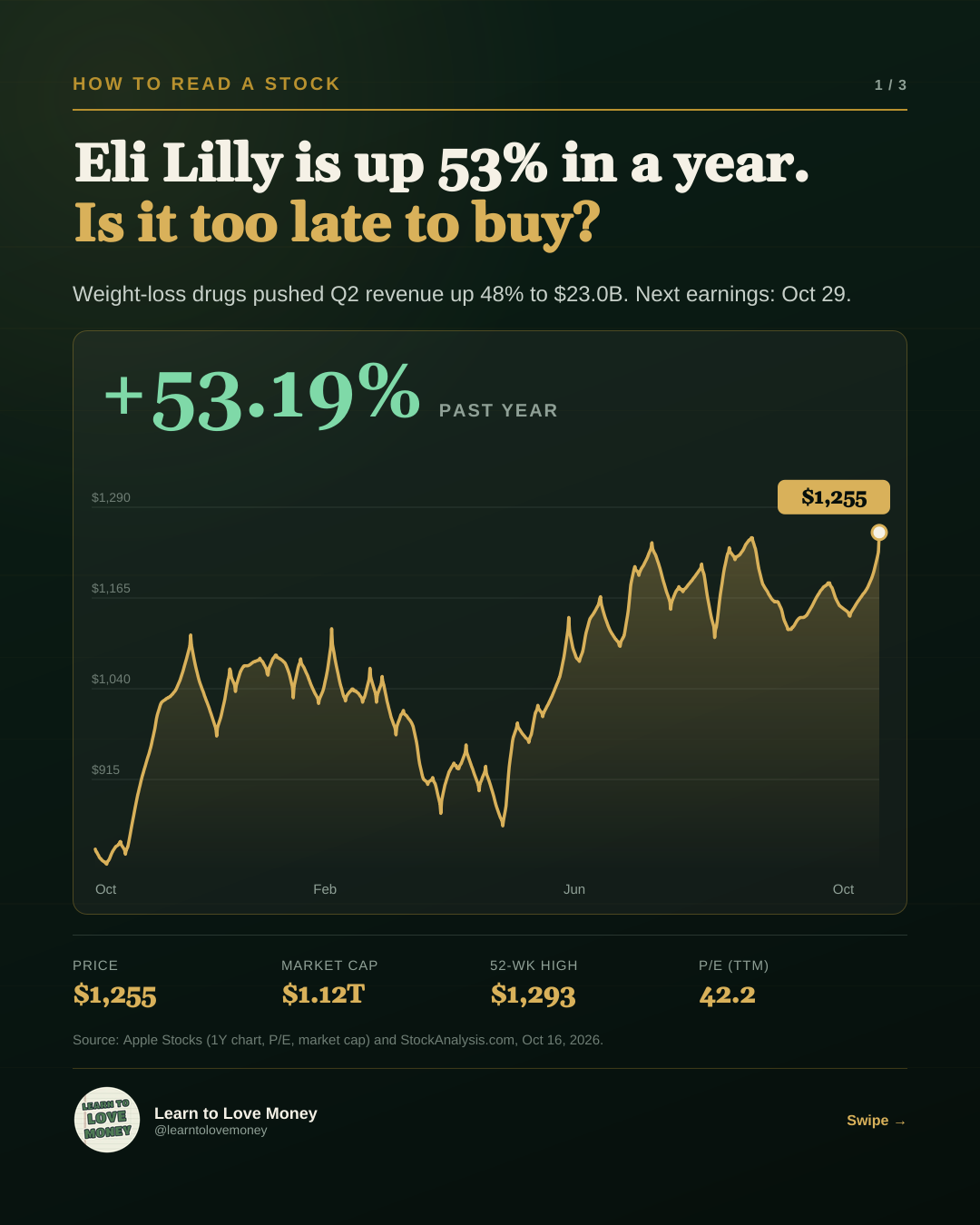
Eli Lilly is up 53% in a year. Weight-loss and diabetes drugs pushed second-quarter revenue up 48% to $23.0 billion, and net income over the last twelve months hit $27 billion. Our AI leans Buy, with a caveat about price. Here's why, and what would prove it wrong.
What Lilly actually does
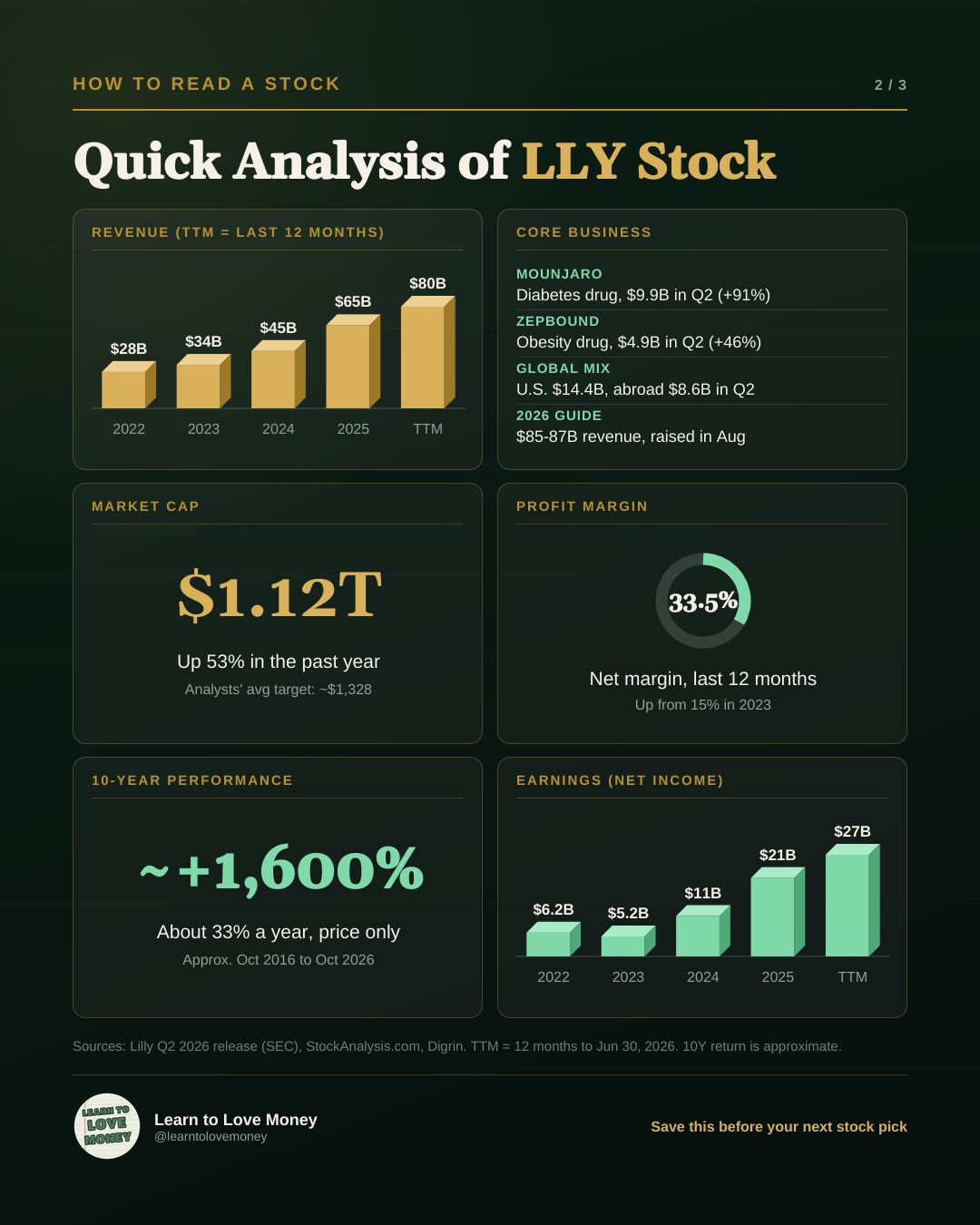
Lilly leads the GLP-1 market for diabetes and weight loss. Mounjaro, its diabetes drug, brought in $9.9 billion in the second quarter (up 91%). Zepbound, its obesity drug, brought in $4.9 billion (up 46%). Together they bring in about $15 billion every quarter.
By geography, the U.S. made $14.4 billion in Q2 and the rest of the world $8.6 billion. Lilly raised its 2026 revenue guidance in August to $85 to $87 billion.
Growth: revenue and earnings
Revenue over the last twelve months (TTM) is about $80 billion, up from $28 billion in 2022. That is close to a three-fold increase in under four years.
Revenue ($B, TTM = last 12 months)
Profits have grown even faster. Net income rose from $6.2 billion in 2022 to about $27 billion over the last twelve months, and the net margin is 33.5%, up from 15% in 2023. That is a rare combination of fast growth and high margins.
Net income ($B)
Is it actually cheap?
Price
$1,255
Market cap
$1.12T
52-week high
$1,293
P/E (TTM)
42.2
Not cheap, but not crazy. The P/E is 42.2 on trailing earnings, and the stock trades at roughly 32 times next year's expected earnings. For a business growing this fast, that is a full price and not an extreme one.
The price is also well above Morningstar's $900 fair value (May 2026), so there is little margin of safety. Analysts' average target is about $1,328. Over ten years the stock is up about 1,600%, roughly 33% a year, price only (approximate).
Moat and leadership
Morningstar sees a wide moat. Making and selling these drugs at scale is hard, and Lilly's lead shows in the numbers. Leadership is strong: the company keeps raising guidance and has grown profit faster than sales.
The risk that flips the call
The main risks are falling drug prices, new rivals, and a high bar for the next earnings report on October 29. If prices drop faster than volume grows, or a competitor takes share, a stock priced for elite growth could fall hard.
The AI verdict
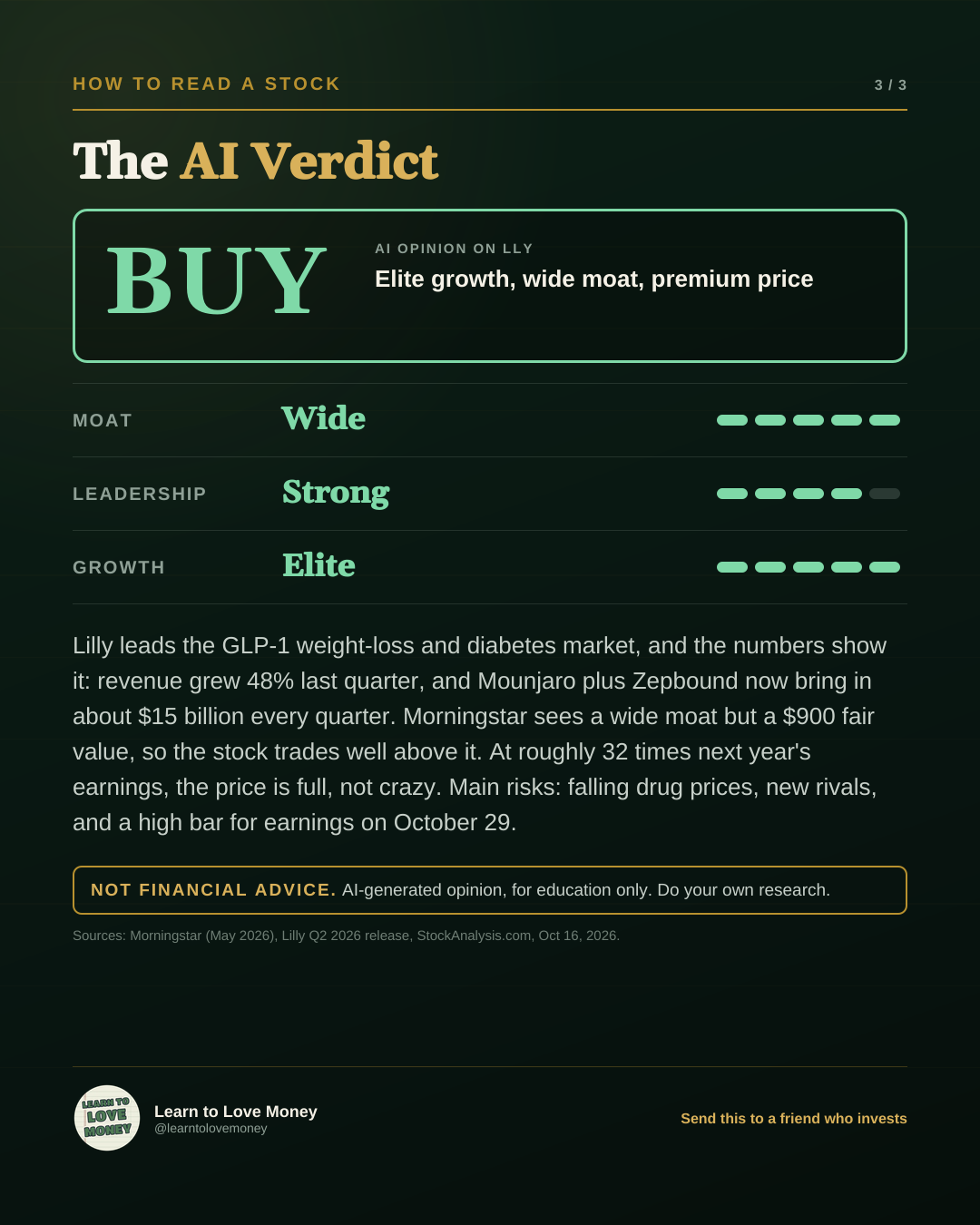
AI lean
Elite growth, wide moat, premium price
BUY
Weighing moat (wide), leadership (strong), and growth (elite) against the price, our AI leans Buy. The price is full but not crazy, and the business is exceptional. The risks are real, so weigh both sides.
More in this series: CoreWeave, Marvell, Amazon, and Alphabet. And for the AI side, our free AI Explained course covers what AI is and where it can go wrong.
NOT FINANCIAL ADVICE. This is an AI-generated opinion for education and entertainment only. It is not a recommendation to buy or sell any security. AI can be wrong, and data may be out of date. Do your own research or talk to a licensed advisor before investing.
Sources
- SEC EDGAR: Eli Lilly filings — Lilly Q2 2026 results and revenue by drug
- Apple Stocks app: one-year price history, P/E, and market cap (no public link)
- StockAnalysis — P/E, market cap, and analyst target
- Morningstar — wide-moat rating and $900 fair value (May 2026)
- Digrin — 10-year return