Hey everyone,
This is the fourth post in our Investing Themes series. We've covered the power and cooling behind AI, cybersecurity, and biotech. This one is about a part of the AI buildout that went from boring to a bottleneck almost overnight: memory and storage. Every AI chip needs data fed to it, every answer an AI gives has to be stored somewhere, and right now the industry cannot make enough of either. Prices have jumped, the three companies in this post have posted some of the best numbers in their history, and their stocks have moved like it. In this post I'll walk through why the shortage exists, how the pieces fit together, and how I'd judge a memory stock, which is a very different exercise from judging a software one.
A quick heads up on how this post works: parts 1 to 6 are open to everyone. Parts 7 and 8, where I go deep on my three picks (what each company does, the bull case, the bear case, and what I'd watch next) and walk through the risks, are free too, but you'll need to enter your email to unlock them. It takes about five seconds, costs nothing, and there's no password or credit card.
1. Why AI is so hungry for memory
An AI chip is a very fast calculator, but a calculator is useless if it's waiting for numbers. Training a model means moving enormous amounts of data through the chip over and over. Answering a question (what the industry calls inference) means loading the model's billions of settings and the conversation so far, and doing it for millions of users at once. In both cases the speed limit is often not how fast the chip can think but how fast data can reach it. People in the industry call this the memory wall.
That's why the chips that power AI are sold with memory attached. The special memory sitting right next to the processor is called HBM (high-bandwidth memory): stacks of memory chips layered on top of each other so they can move data at extreme speeds. It is harder to make than the regular memory in your laptop, it takes more factory capacity per bit of storage, and it sells for far more.
The key idea for this theme: AI doesn't just need chips. It needs a lot of memory and storage per chip, and the amount needed keeps growing as models get bigger, answers get longer, and companies keep more data around to train on.
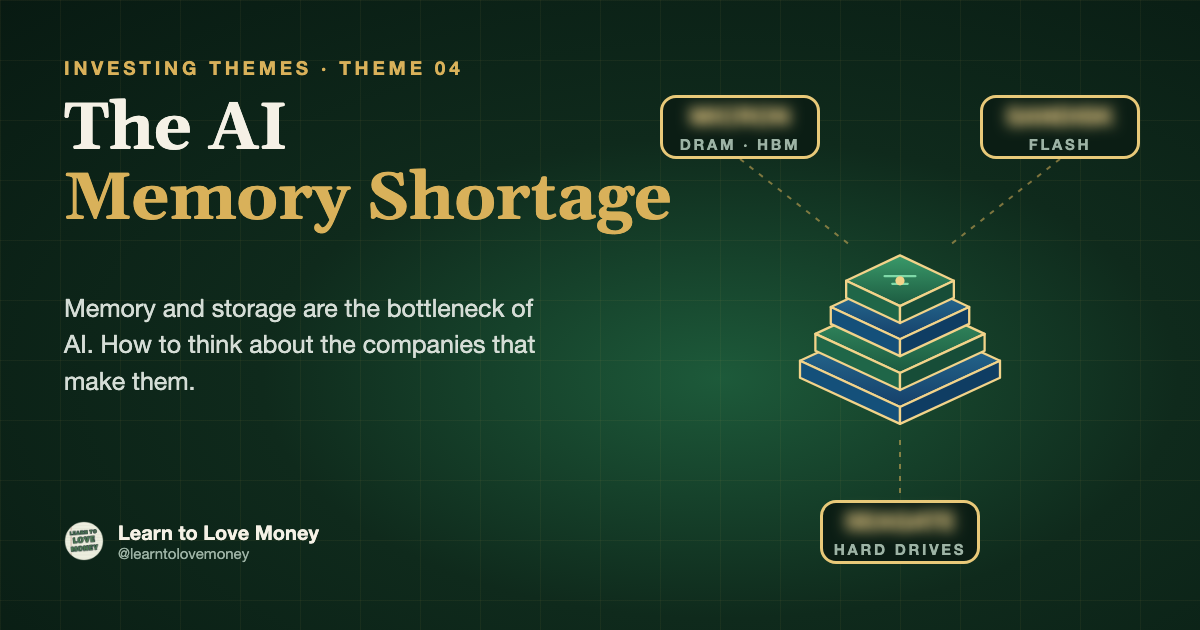
2. Memory vs. storage: the ladder the data climbs
People use "memory" and "storage" loosely, so here's the simple version. Data lives on a ladder. The higher the rung, the faster and more expensive it is, and the less of it you can afford.
- HBM and DRAM (the working desk). Where data sits while the chip is actively using it. Very fast, but it forgets everything when the power goes off. Micron is the main U.S. maker.
- NAND flash (the filing cabinet within arm's reach). Solid-state storage, the stuff inside your phone and in the SSDs that data centers use for data they need quickly. It keeps data with the power off. Sandisk is a pure play on it.
- Hard disk drives (the warehouse). Spinning magnetic platters. Much slower than flash but far cheaper per terabyte, which makes them the home for the huge piles of data AI is trained on and generates. Seagate is one of the three companies that make them.
I chose one company from each rung. They don't move in perfect sync, but they all feel the same force: when AI data centers need more of everything, the shortage shows up on every level of the ladder.
3. Why there's a shortage, and why it's lasting longer than usual
- Very few suppliers. Three companies (Samsung, SK hynix, and Micron) make roughly 90% of the world's DRAM and are the only ones producing HBM at scale. Flash and hard drives are similarly concentrated.
- HBM crowds out everything else. A factory that makes HBM can't make as many regular memory chips, so building the premium product tightens supply of the ordinary one too.
- New factories take years. Memory fabs cost billions and take years to build and ramp. Samsung's new Pyeongtaek fab and SK hynix's Yongin expansion aren't expected to add meaningful volume until 2027 or later.
- Demand keeps outrunning supply. One industry estimate (Counterpoint) says the shortage would only ease if production grew about 12% a year through 2027, while current plans add closer to 7.5%.
The result shows up in prices. Research firm TrendForce projected conventional DRAM contract prices to rise roughly 90% to 95% in the first quarter of 2026, and NAND contract prices up 70% to 75% in the spring quarter. Those are not typical numbers for an industry that normally fights over a few percent.
4. The part everyone gets wrong: memory is cyclical
Here is the most important lesson in the post. Memory chips are commodities. A gigabyte of DRAM from one maker is close enough to a gigabyte from another that customers mostly shop on price. That has produced the same pattern for decades:
- Shortage: prices spike, profits explode, everyone announces new factories.
- Glut: the new factories arrive, supply overshoots, prices collapse, and profits can swing to losses.
- Repeat.
Stocks in cyclical industries often look cheapest at the top of the cycle, because earnings are at their peak, and most expensive at the bottom, when earnings are depressed. A low P/E in a memory stock can mean "bargain" or it can mean "the market thinks these profits won't last." Telling the difference is the whole game.
What's different this time, at least on paper, is that customers are signing long-term agreements to lock in supply. Seagate says most of its nearline hard drive capacity is already allocated into calendar 2028. Sandisk has reportedly signed multi-year agreements with eight customers worth at least $93.9 billion. Micron has been announcing strategic customer agreements that cover over a third of its expected revenue through 2030, with customers putting up financial commitments. If those hold up, they soften the cycle. They don't repeal it.
5. The three layers, and who plays where
The three companies in this post are each the clearest way I know to own one layer:
| Layer | What it does | Who dominates | My pick |
|---|---|---|---|
| HBM / DRAM | Working memory next to the AI chip | Samsung, SK hynix, Micron | Micron |
| NAND flash | Fast storage in servers and devices | Samsung, SK hynix, Kioxia / Sandisk, Micron | Sandisk |
| Hard drives | Cheap bulk storage for AI data | Seagate, Western Digital, Toshiba | Seagate |
Micron is the only large U.S. company in memory, which matters to some investors who like their supply chains close to home. Sandisk is the purest bet in the group, since flash is its whole business. Seagate is the spillover play: when flash gets expensive, data centers lean harder on cheaper hard drives for the data they don't need instantly.
6. How I'd judge a memory stock
The usual tools work differently here. This is the toolkit I'd use:
- Gross margin vs. history. Memory margins normally swing between thin and decent. When a company is printing 85% or more, you are looking at a once-in-a-cycle number and should ask how much of it is price rather than real growth.
- Price vs. bits. Revenue growth comes from selling more bits or from each bit costing more. Growth from price alone can reverse fast. Growth from bits (and from richer products like HBM) lasts longer. Sandisk's management said about two-thirds of last quarter's growth was price.
- Peak-earnings P/E. Annualize the latest quarter and ask what the stock would trade at if the cycle never turned, then ask what you'd pay if profits fell by half. That range is more honest than one P/E.
- Contract coverage. How much of the next year or two is already sold under long-term agreements, and at what prices. More coverage means a softer landing.
- Capex and supply additions. Rising factory spending today is next year's oversupply. Watch the industry, not just your company.
- Price trackers. Firms like TrendForce publish contract-price forecasts every quarter. When the growth rate of price increases starts shrinking, that's the early warning.
- Distance from the high. All three stocks are well off their 52-week highs. That can be a better entry or the market sniffing out the top. Our DCF course and P/E explainer help here.
7. My top three picks in the theme
Here are the three companies I'd put at the center of this theme, one per layer. For each one I walk through what it does, the numbers I check first, why it could work, what could go wrong, and what I'd watch next. Prices and stats are from the week of October 21, 2026 and are also in the slides below.
| Micron | Sandisk | Seagate | |
|---|---|---|---|
| Ticker | MU | SNDK | STX |
| Layer | HBM / DRAM | NAND flash | Hard drives |
| Price | $913.67 | $1,378.22 | $696.89 |
| 1-year return | +360.4% | +837.9% | +224.1% |
| P/E | 12.3 | n/a | n/a |
| Market cap | $1.03T | $199.2B | $158.5B |
| Latest gross margin | ~87% | 84.6% | 52.7% |
| From 52-week high | -27% | -41% | -39% |
| Analyst target vs. price | +54% | +54% | +40% |
Micron (MU): the only big U.S. memory maker
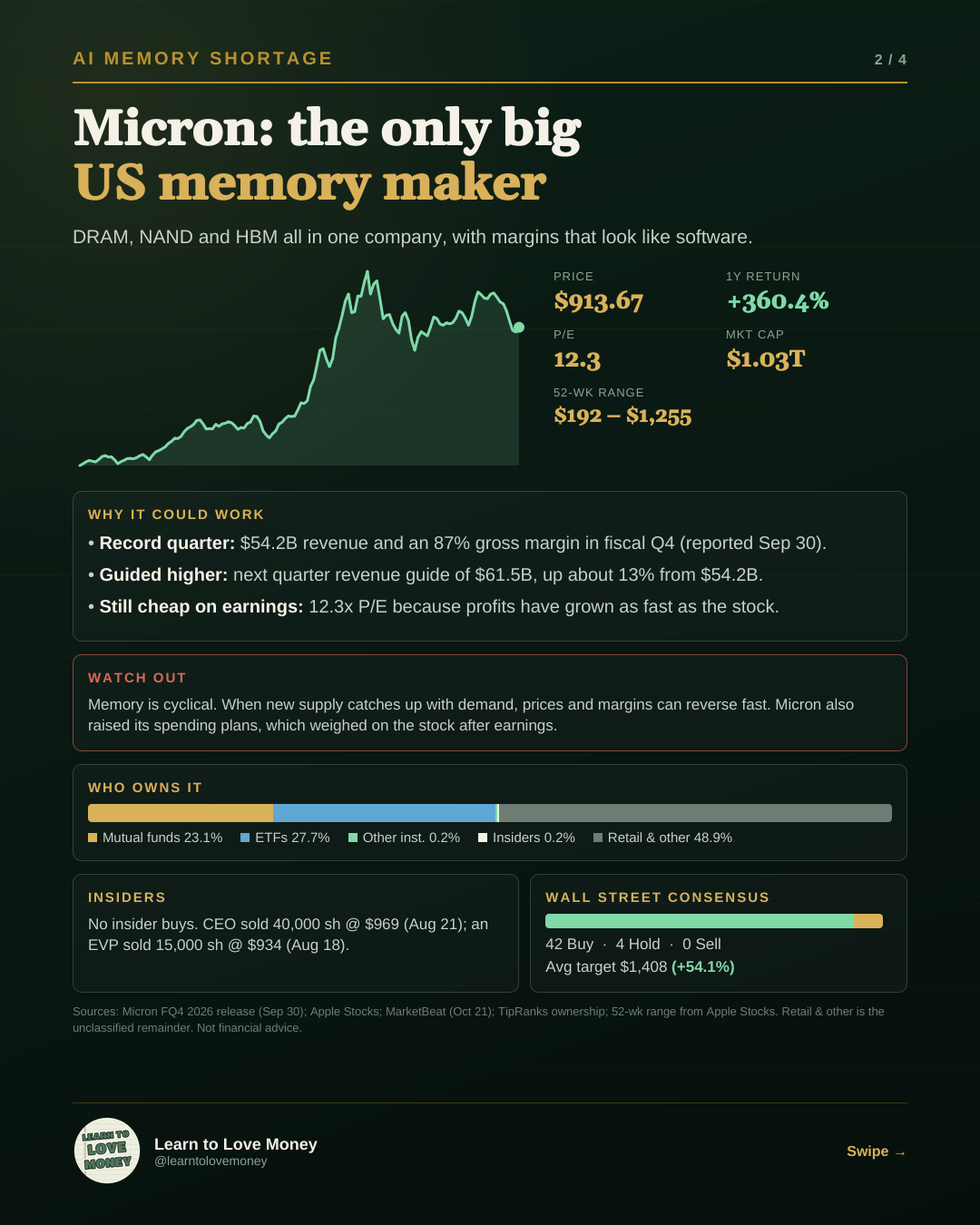
What it does. Micron makes DRAM, NAND, and HBM, the full memory stack, and sells it to cloud giants, AI chip designers, phone and PC makers, and carmakers. It's one of only three companies on earth that can produce HBM at scale, and its fiscal Q4 (reported Sep 30) was a record: $54.2B of revenue, up from $41.5B the quarter before, with a gross margin around 87%. For the full fiscal year, revenue was $133.2B.
Where the money comes from. Micron now reports by customer type. Core Data Center brought in about $18.0B in the quarter at a roughly 90% gross margin, Cloud Memory (largely HBM) added about $16.3B, and Mobile and Client contributed about $13.1B. Put simply, nearly two-thirds of the quarter came from data center and cloud buyers, and those are the highest-margin dollars.
Price
$913.67
1-year return
+360.4%
P/E
12.3
Market cap
$1.03T
The bull case.
- Guidance is still climbing. Management guided next quarter's revenue to about $61.5B, roughly 13% above the quarter just reported.
- Supply is spoken for. One analysis of the results says most of 2027's HBM supply is already contracted at higher prices, and Micron cites strategic customer agreements covering over a third of expected revenue through 2030.
- It generates enormous cash. Full-year operating cash flow was about $89.7B against $27.4B of capital spending, which is how it funds new fabs without leaning on debt.
- The multiple is modest. At 12.3 times trailing earnings, the stock is far cheaper than most AI winners. If you annualize the latest quarter's non-GAAP earnings ($33.42 a share), the stock trades at roughly 7 times, which tells you the market is treating these profits as temporary.
Watch out. That cheap multiple is the cycle talking. Memory is cyclical, and if new supply catches up, prices and margins can reverse quickly. Micron also raised its spending plans, which weighed on the stock after earnings, and the shares are about 27% below their 52-week high of $1,255. Insiders have not bought: the CEO sold 40,000 shares around $969 (Aug 21) and an EVP sold 15,000 around $934 (Aug 18).
What I'd watch next. Whether the next quarter's gross margin holds near 87%; any change to the capex plan; how much HBM is sold under fixed contracts versus spot pricing; and whether Samsung and SK hynix keep adding HBM capacity faster than demand grows. Wall Street currently has 42 Buy, 4 Hold, and 0 Sell ratings with an average target of $1,408 (about 54% above the price).
Sandisk (SNDK): the pure play on flash storage
What it does. Sandisk makes NAND flash and the products built from it: SSDs for data centers and PCs, phone memory, memory cards, and flash drives. It was spun out of Western Digital, so the brand is old but the stock is new, and it makes its chips together with Japan's Kioxia in a joint venture that has been extended through 2034.
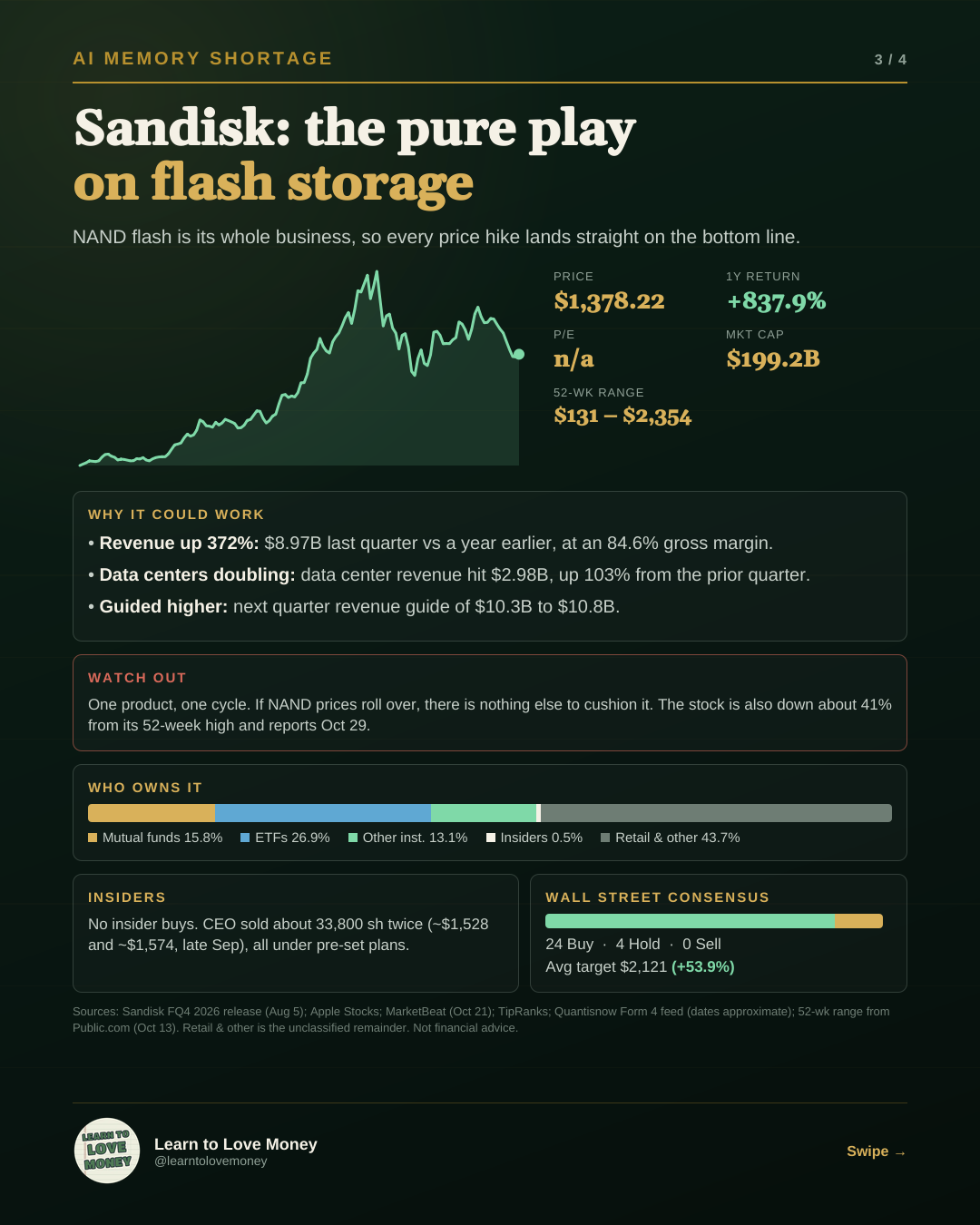
The numbers. Fiscal Q4 revenue hit $8.97B, up 51% from the prior quarter and 372% from a year ago, and fiscal 2026 revenue was $20.25B, up 175%. Gross margin reached 84.6%, versus 26.2% a year earlier. Data center revenue about doubled from the prior quarter to $2.98B. Last year at this time this was a low-margin, unloved business; that is how violent a shortage can be.
Price
$1,378.22
1-year return
+837.9%
P/E
n/a
Market cap
$199.2B
The bull case.
- Pure exposure. Every flash price increase lands straight on the bottom line, with no other segment to dilute it.
- Data centers are a new engine. AI needs fast storage for training data and for retrieving information during inference, and data center is now the fastest-growing line.
- Visibility. Sandisk has reportedly signed multi-year agreements with eight customers with at least $93.9B of contracted revenue, which would reduce how much it depends on spot prices.
- Guidance keeps rising. Next quarter's revenue is guided to $10.3B to $10.8B, and non-GAAP EPS to $44 to $46. Annualizing the midpoint puts the stock at roughly 8 times that run-rate earnings.
Watch out. One product, one cycle. If NAND prices roll over, nothing else cushions the stock. The signals are already mixed: management said about two-thirds of last quarter's growth came from price, the midpoint of next quarter's guide implies growth slowing from 51% to roughly 18%, and Kioxia reported that device makers are pushing back on price increases. TrendForce expects NAND contract prices to rise only 10% to 15% this quarter after 70% to 75% last quarter, with new supply not expected until the second half of 2027. The stock is down about 41% from its 52-week high and reports again on Oct 29. Insiders have not bought: the CEO sold about 33,800 shares twice (around $1,528 and $1,574, late September), all under pre-set plans.
What I'd watch next. The Oct 29 report: how much of the growth is bits versus price; whether the data center share of revenue keeps rising; what the Kioxia joint venture says about new capacity; and how the long-term contracts are priced compared with the spot market. Wall Street has 24 Buy, 4 Hold, and 0 Sell ratings with an average target of $2,121 (about 54% above the price). P/E shows as "n/a" because trailing profits are still catching up to the recent surge, so a trailing multiple isn't meaningful here.
Seagate (STX): the spillover play on hard drives
What it does. Seagate makes the hard drives that store the bulk of the world's data, and about 90% of the storage capacity it ships now goes to data centers. Hard drives are slower than flash but much cheaper per terabyte, so when flash gets expensive, AI data centers lean on them for the huge volumes of data that don't need to be instant.
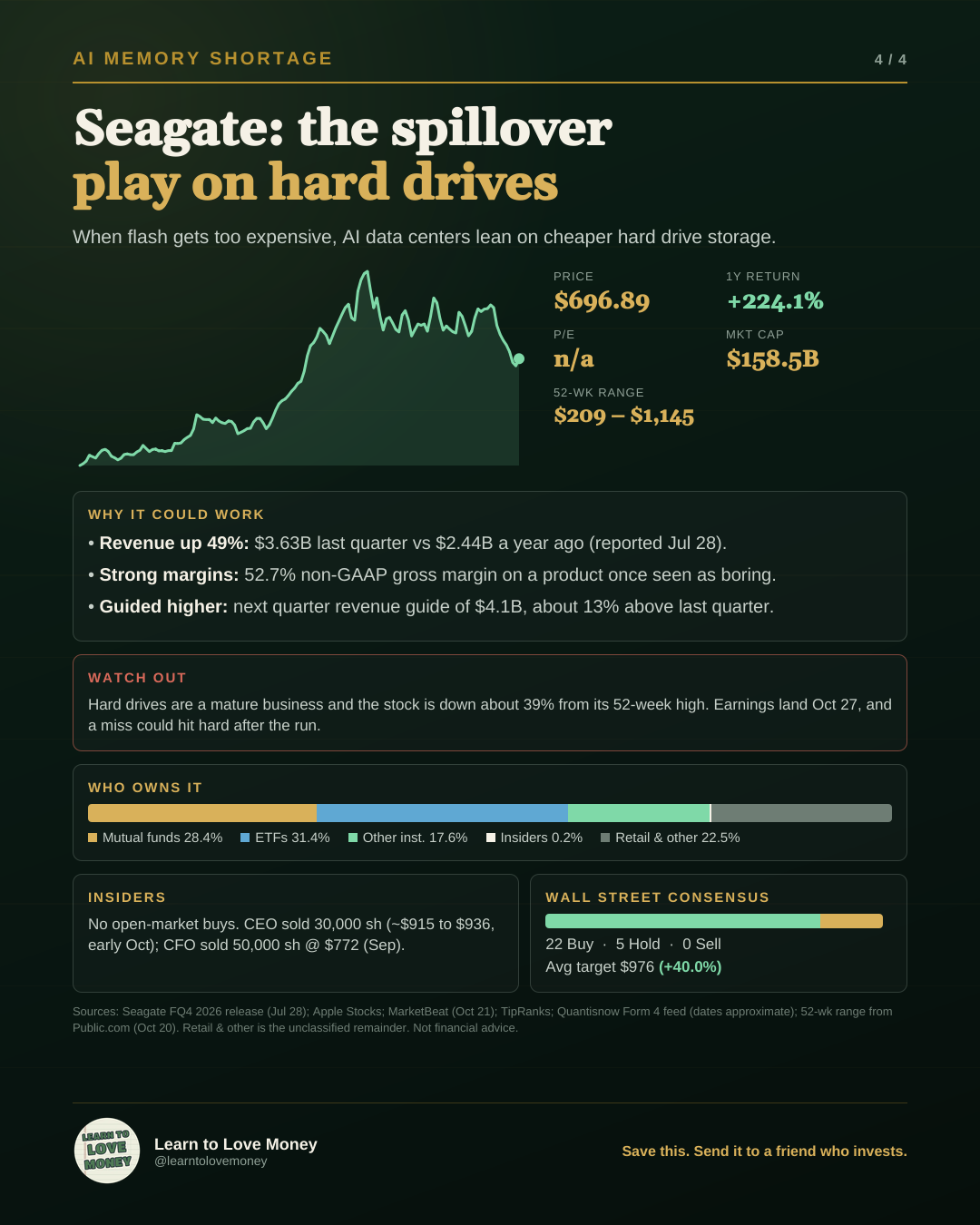
The numbers. Fiscal Q4 revenue was $3.63B versus $2.44B a year ago (up about 49%), with a 52.7% non-GAAP gross margin and a 44.6% non-GAAP operating margin. Data center revenue rose 57% to about $2.9B, and the quarter produced about $1.3B of profit. For a hard drive company, those margins are close to unheard of.
Price
$696.89
1-year return
+224.1%
P/E
n/a
Market cap
$158.5B
The bull case.
- Technology is lifting margins. Seagate's new HAMR technology (it uses a laser to heat the disk so more data fits on it) is its Mozaic platform. HAMR drives were about 40% of its nearline shipments by the end of the year, and the newest version fits up to 44TB on one drive. More terabytes per drive means more revenue per unit of cost.
- Demand is booked. Management says most of its nearline capacity is already allocated into calendar 2028 under long-term agreements, and it targets mid-20% annual growth in nearline capacity shipped.
- The next version is already on the roadmap. Mozaic 5 is targeting qualification shipments in late calendar 2027.
- Next quarter's guide is higher again. Revenue of about $4.1B (roughly 13% above this quarter) and EPS around $7.30. Annualized, that is roughly 24 times earnings, the most conventional multiple of the three.
Watch out. Hard drives are a mature business, and a 52.7% gross margin is far above what the industry has earned for most of its history. The stock is down about 39% from its 52-week high and reports Oct 27, where a miss could hit hard after the run. Seagate also has only a few customers, mostly giant cloud companies, so one big buyer pausing orders matters. Insiders have not bought on the open market: the CEO sold 30,000 shares (about $915 to $936, early October) and the CFO sold 50,000 shares at $772 in September.
What I'd watch next. The Oct 27 report: the share of shipments on HAMR drives, gross margin versus the 52.7% base, and any change in the long-term agreements. Also watch Western Digital and Toshiba, since a competitor catching up on capacity is how a hard drive shortage ends. Wall Street has 22 Buy, 5 Hold, and 0 Sell ratings with an average target of $976 (about 40% above the price).
Side by side
- Micron is the largest, the cheapest on trailing earnings, and the one with the most direct line to AI chips through HBM. It's also the most capital-hungry.
- Sandisk is the purest and most volatile: the biggest one-year gain, the biggest drop from the high, and the stock where a change in NAND pricing would show up first.
- Seagate is the one with a technology story behind its margins (HAMR) and the most conventional multiple, but also the most mature market underneath.
- What they share: all three have record results, rising guidance, sell-side Buy ratings with no Sells, no open-market insider buying, and prices that have already moved a lot. All three are also 27% to 41% below their 52-week highs, which tells you the market is already debating how long the shortage lasts.
8. The risks, and how I'd own it
- The cycle turns. Memory has always swung from shortage to glut. The new factories, plus any slowdown in AI spending, could flip pricing faster than the long-term agreements can protect.
- Peak margins. Gross margins of 85% to 87% are not a normal state for commodities. If the market decides they're peak, the multiple compresses even while earnings are still rising.
- Demand pushback. Kioxia reported that device makers are resisting price hikes, and phone and PC makers are reportedly getting less memory than they ask for. Higher prices can reduce the demand for the devices that use memory.
- Heavier spending. Micron raised its capex plans and Seagate and Sandisk are expanding too. Spending today becomes supply tomorrow.
- New competition. Chinese memory maker CXMT is growing and listed publicly in 2026, and Samsung and SK hynix are racing to add HBM capacity. Western Digital and Toshiba are the hard drive rivals.
- Customer concentration. A handful of cloud giants account for most AI demand. If a few of them pause building data centers, all three companies feel it.
- Insider selling. All three show insider sales and no open-market insider buying. It's common with stock-heavy pay (and some sales were on pre-set plans), but it's worth noticing after gains this big.
- Theme concentration and volatility. Three stocks in one theme will often fall together. The 52-week ranges are huge (Sandisk from $131 to $2,354, Seagate from $209 to $1,145, Micron from $192 to $1,255).
How I'd think about owning it:
- Start smaller than you think. Stocks that have risen 224% to 838% in a year can fall 40% in weeks, as these three already have.
- Spread across layers, and if you want only one name, ask whether you want the biggest and cheapest (Micron), the purest (Sandisk), or the most technology-driven (Seagate).
- Judge on cycle indicators, not headline revenue: contract price trends from TrendForce, gross margin direction, capex plans, and inventory levels.
- Don't anchor on P/E. Use a range of earnings outcomes, including one where profits fall by half.
- Consider a fund if you like the theme but not single-stock risk. Semiconductor funds hold companies like these alongside the chip designers they sell to.
The bottom line: the shortage is real, the numbers are extraordinary, and long-term agreements make this cycle look sturdier than past ones. But a strong theme doesn't make every stock in it a good buy at every price, and memory is the industry where "this time is different" has been wrong more than any other. That part is up to you.
More soon,
Learn to Love Money
NOT FINANCIAL ADVICE. This post is an educational opinion piece and is not a recommendation to buy, sell, or hold any security. Figures are from company filings and third-party data providers as of the week of October 21, 2026 and change daily. Analyst targets are opinions, not guarantees. Annualized earnings multiples are my own rough math, not a forecast. Do your own research or talk to a licensed advisor before investing. This post was prepared with AI assistance; see our AI Disclosure.
Sources
- Shortage and pricing: The Register on TrendForce DRAM forecasts, Tech Wire Asia on the 2027 supply gap, eeNews Europe on the memory price surge
- Micron results coverage: Pulse 2.0, The Next Platform
- Sandisk and Kioxia coverage: Blocks & Files, Morningstar on Kioxia
- Seagate results coverage: Barchart (earnings release), MarketBeat (call highlights)
- Company filings (SEC EDGAR, 8-K): Micron, Sandisk, Seagate
- Insider trades, analyst ratings and price targets (MarketBeat): Micron, Sandisk, Seagate
- Ownership and holdings (TipRanks): Micron, Sandisk, Seagate
- Price, P/E, market cap and 1-year charts: Apple Stocks (redrawn from screenshots); 52-week ranges for Sandisk and Seagate from Public.com.