
Hey everyone,
This is the first post in our Investing Themes series, where I take one big idea and walk through how I'd actually think about owning it. The theme: the picks and shovels of AI infrastructure. Instead of guessing which AI model or chip designer wins, I want to own the things every AI data center has to buy no matter who wins: the energy, the power equipment, and the cooling. And I want to build it from the bottom up.
A quick heads up on how this post works: parts 1 to 5 are open to everyone. Parts 6 to 8, where I go through my three picks, the risks, and how I'd own it, are free too, but you'll need to enter your email to unlock them. It takes about five seconds, costs nothing, and there's no password or credit card.
1. Why picks and shovels
During the California Gold Rush, plenty of miners went broke, while many of the people who made steady money sold the tools and supplies everyone needed. That is the "picks and shovels" idea: when a boom is hard to call, own the suppliers to the boom instead of the bet itself.
AI fits the pattern. Nobody knows which model, app, or chip company ends up on top, and the winners may change more than once. But every one of them needs a building full of servers, and every building needs electricity in and heat out. That demand is real and measurable. The International Energy Agency estimated that data centers used roughly 415 terawatt-hours of electricity in 2024, about 1.5% of global demand, and projects that could roughly double to around 945 terawatt-hours by 2030.
It is not a risk-free idea. Suppliers can still be overpriced, and if AI spending slows they feel it too. We will get to that. First, the map.
2. The stack, from the bottom up
I think about AI infrastructure as three layers that sit underneath the chip:
- Layer 1: Energy. Someone has to generate the power. Gas turbines, grid equipment, and the machinery that turns fuel into electricity.
- Layer 2: Power supply. Electricity from the grid can't just plug into a server rack. It has to be stepped down, switched, protected, and backed up inside the data center.
- Layer 3: Cooling. Nearly all of that electricity ends up as heat. Dense AI racks run so hot that air alone often isn't enough, so liquid cooling and thermal systems matter more every year.
Bottom up means starting where the electrons come from and working toward the chip. It also helps you see where each company sits, so you don't accidentally buy three versions of the same bet. The three I'm looking at are GE Vernova (GEV) for energy, Eaton (ETN) for power supply, and Vertiv (VRT) for cooling.
3. Why power and cooling are the bottleneck
A chip is only useful if it can be powered and kept at a safe temperature. As AI hardware gets denser, both of those get harder, and neither can be solved by software.
- Power has to come from somewhere. A new data center can need more electricity than the local grid was built to deliver, so someone has to generate it and someone has to carry it there. Big equipment like gas turbines and grid gear is ordered long in advance.
- Power has to be conditioned. Electricity from the grid is stepped down, switched, protected, and backed up before it reaches a server. That equipment sits inside every build.
- Heat has to go somewhere. Nearly all the electricity a server uses ends up as heat, and dense AI racks produce far more of it than traditional ones, which is pushing the industry toward liquid cooling.
That is why I treat energy, power supply, and cooling as three separate layers rather than one vague "infrastructure" bucket.
4. Why suppliers can be steadier than the AI bet itself
- They get paid whoever wins. A utility, a cloud giant, and a start-up all need the same switchgear and cooling, so the supplier doesn't have to guess which model comes out on top.
- Demand shows up early. Orders and backlogs are visible months or years before the revenue, which gives investors something concrete to track.
- Customers beyond AI. Utilities, factories, and the broader electrification of the economy buy much of the same equipment.
- But it's still cyclical. If the biggest spenders cut their budgets, orders slow quickly. Steadier is not the same as safe.
5. How I'd judge these businesses
Because these are industrial companies selling into a boom, I lean on a few specific signals:
- Backlog and book-to-bill. Backlog is work already ordered but not yet delivered. Book-to-bill above 1.0 means orders are coming in faster than revenue is going out.
- Order growth vs. revenue growth. Orders are the leading indicator. When order growth cools, revenue growth usually follows.
- Margins and free cash flow. Rising margins suggest pricing power. Strong free cash flow means the growth is paying for itself.
- Dependence on a few customers. The more a company relies on a handful of AI spenders, the more exposed it is to their budgets.
- The price paid. A great business can still be a poor investment at the wrong price. Our DCF course and P/E explainer help with that.
6. My three picks, one per layer
Here are the three companies I'd put at the center of this theme, one for each layer. All figures are from early October 2026 and come from the slides below.
| GE Vernova | Eaton | Vertiv | |
|---|---|---|---|
| Layer | 1 · Energy | 2 · Power supply | 3 · Cooling |
| Ticker | GEV | ETN | VRT |
| Price | $985.60 | $438.80 | $257.12 |
| 1-year return | +63.4% | +15.5% | +57.9% |
| P/E | 28.3 | 44.6 | 58.2 |
| Market cap | $262.5B | $170.4B | $99.0B |
| 52-week range | $530 – $1,196 | $312 – $478 | $148 – $380 |
| Analyst consensus | Moderate Buy | Buy | Moderate Buy |
Prices and ratings as of early October 2026 (see Sources). They change daily.
GE Vernova (GEV), layer 1: energy
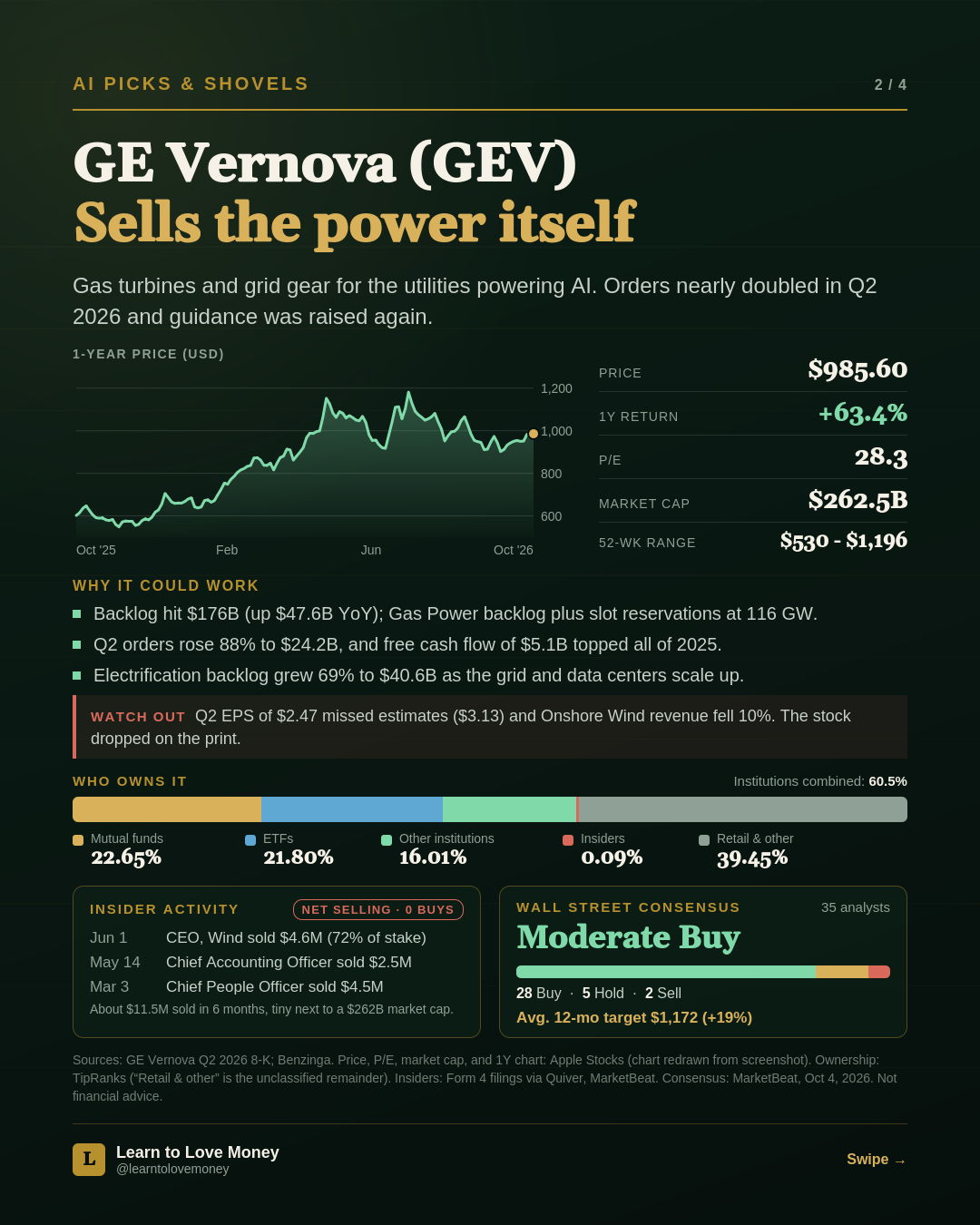
EnergyGE Vernova sells the power itself: gas turbines, grid equipment, and electrification gear for the utilities that are racing to supply AI. If a data center needs more electricity than the local grid can deliver, a lot of the solutions start with equipment like this.
Price
$985.60
1-year return
+63.4%
P/E
28.3
Market cap
$262.5B
- The backlog is huge. It hit $176B, up $47.6B year over year, and Gas Power backlog plus slot reservations reached 116 gigawatts.
- Orders are accelerating. Q2 orders rose 88% to $24.2B, and free cash flow of $5.1B in the quarter topped all of 2025.
- The grid side is growing too. The electrification backlog grew 69% to $40.6B as the grid and data centers scale up.
Watch out. Q2 EPS of $2.47 missed estimates of $3.13, Onshore Wind revenue fell 10%, and the stock dropped on the report. Even great demand doesn't protect a stock that has run this far.
On ownership, institutions hold about 60.5% of the stock, which is the highest of the three. Insiders have been sellers: roughly $11.5M sold over six months, including the CEO of the Wind segment selling about 72% of their stake. That's tiny next to a $262B market cap, but it is not a vote of confidence. Wall Street consensus is Moderate Buy (28 Buy, 5 Hold, 2 Sell across 35 analysts) with an average 12-month target of $1,172, about 19% above the price.
Eaton (ETN), layer 2: power supply
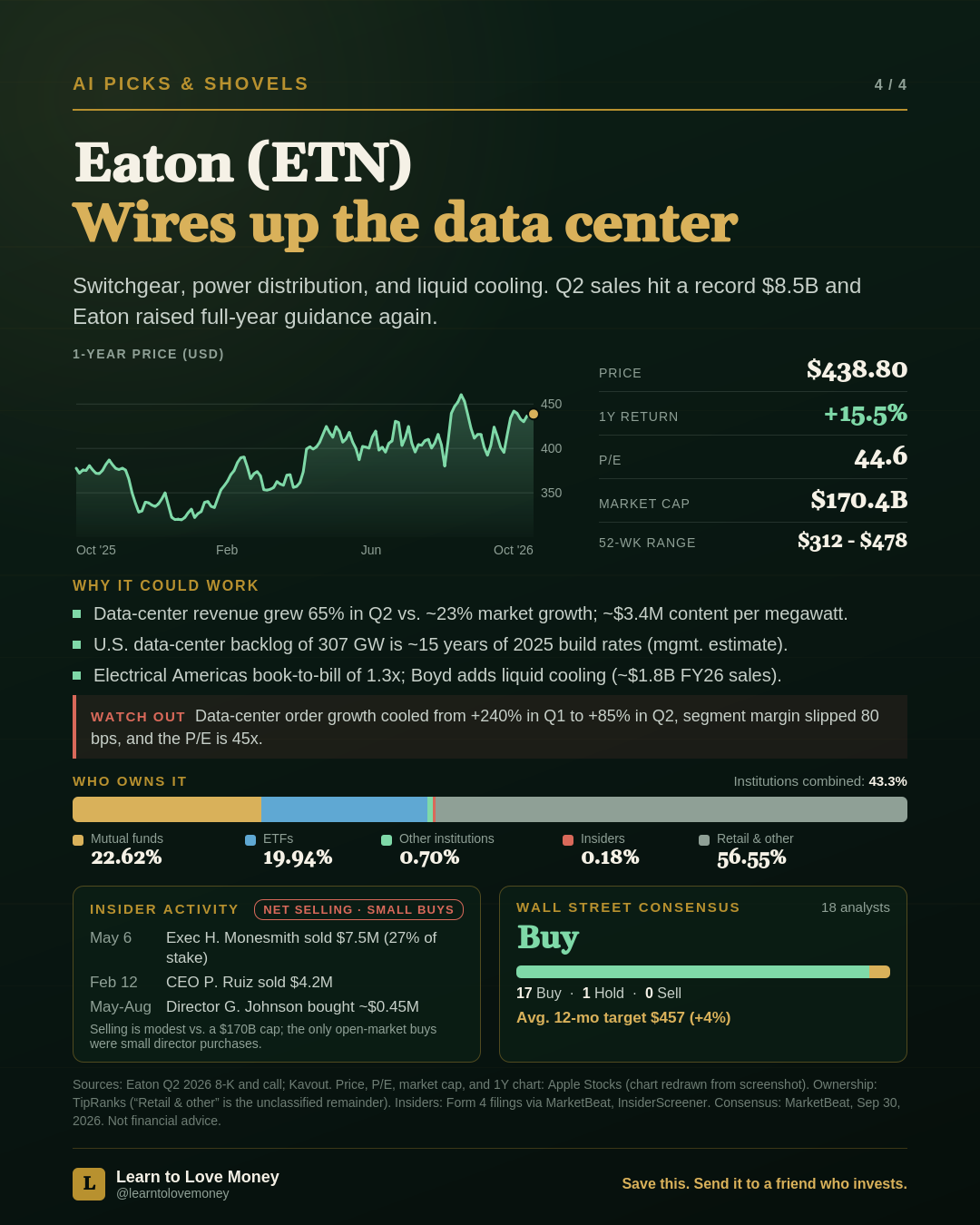
Power supplyOnce power reaches the building, Eaton's job begins: switchgear, power distribution, and increasingly liquid cooling. Think of it as the plumbing for electricity inside the data center. It's less glamorous than a turbine, but it sits in every build.
Price
$438.80
1-year return
+15.5%
P/E
44.6
Market cap
$170.4B
- Data centers are the growth engine. Data-center revenue grew 65% in Q2 versus roughly 23% market growth, and Eaton captures about $3.4M of content per megawatt.
- A long runway. The U.S. data-center backlog of 307 GW is about 15 years of 2025 build rates, according to management's estimate.
- Orders are healthy. Electrical Americas book-to-bill was 1.3x, and the Boyd acquisition adds liquid cooling, about $1.8B of FY26 sales. Q2 sales hit a record $8.5B and full-year guidance was raised again.
Watch out. Data-center order growth cooled from +240% in Q1 to +85% in Q2, segment margin slipped 80 basis points, and the P/E is about 45x.
Eaton is the least volatile of the three: it is up the least over the year (+15.5%), and analysts see the least upside, with an average target of $457, only about 4% above the price. Consensus is Buy (17 Buy, 1 Hold, 0 Sell across 18 analysts). Insider activity is mixed: an executive sold $7.5M (27% of their stake) and the CEO sold $4.2M, but a director bought about $0.45M. Institutions own roughly 43.3%.
Vertiv (VRT), layer 3: cooling
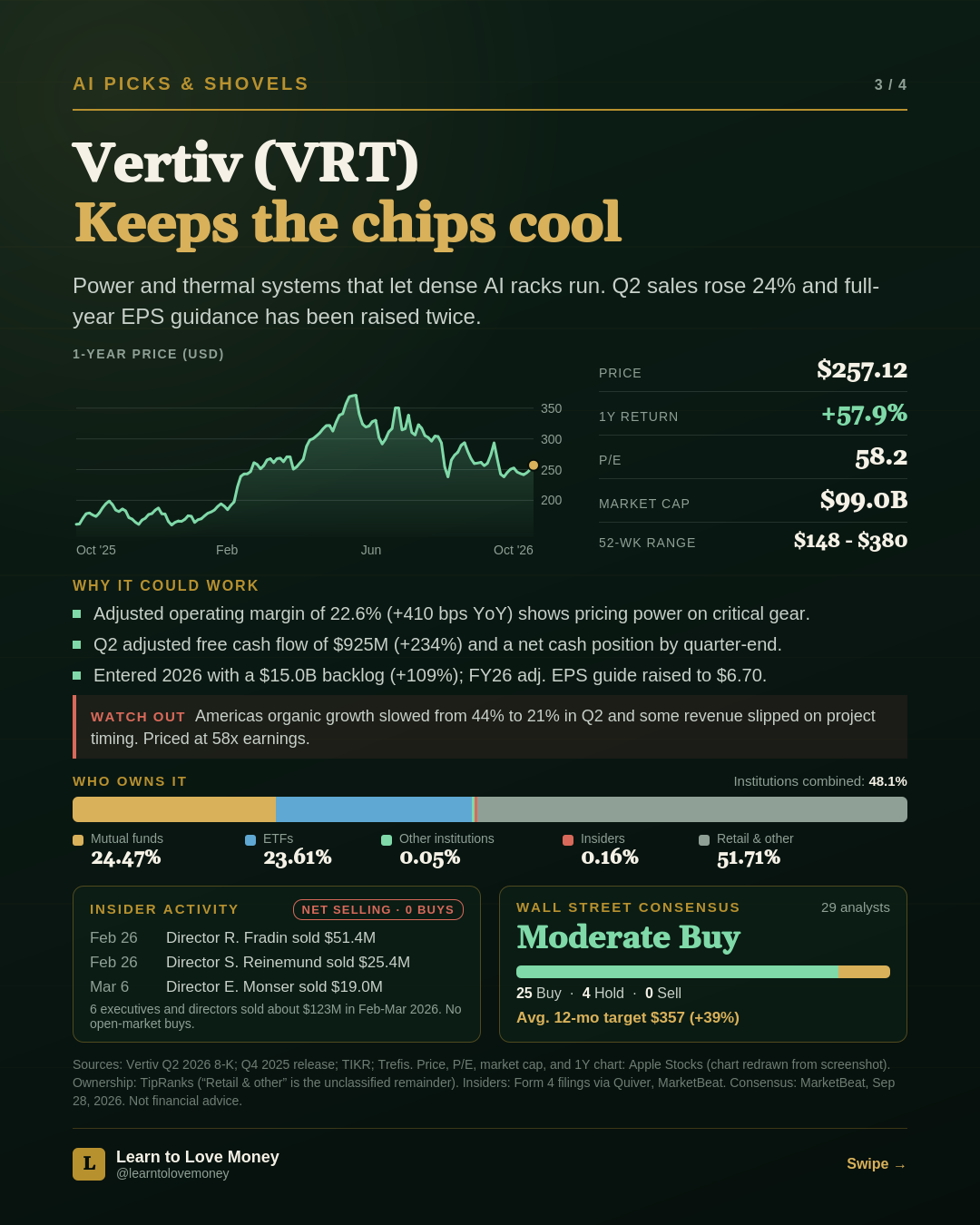
CoolingVertiv builds the power and thermal systems that let dense AI racks run without melting. As chips get hotter, cooling stops being an afterthought and becomes a design constraint, and Vertiv sits right at that constraint.
Price
$257.12
1-year return
+57.9%
P/E
58.2
Market cap
$99.0B
- Growth plus pricing power. Q2 sales rose 24%, and the adjusted operating margin of 22.6% is up 410 basis points year over year.
- Cash is flowing. Q2 adjusted free cash flow of $925M was up 234%, and the company reached a net cash position by quarter-end.
- Visibility. It entered 2026 with a $15.0B backlog (up 109%), and full-year adjusted EPS guidance has been raised twice, most recently to $6.70.
Watch out. Americas organic growth slowed from 44% to 21% in Q2, some revenue slipped on project timing, and the stock trades around 58x earnings, the richest multiple of the three.
Vertiv has the most upside in analyst eyes: an average target of $357, about 39% above the price, with a Moderate Buy rating (25 Buy, 4 Hold, 0 Sell across 29 analysts). It also has the most insider selling, about $123M sold by six executives and directors in February and March 2026, with no open-market buys. Institutions hold about 48.1%.
Side by side
- GE Vernova is the cheapest on earnings (P/E 28.3) with the biggest one-year move (+63.4%). It's the heaviest machinery and the one most tied to utilities and large capital projects.
- Eaton is the steadiest. The smallest run-up and the least analyst upside, but record sales and a wide range of customers beyond data centers.
- Vertiv is the purest AI play. The fastest-growing story and the highest multiple (P/E 58.2), which leaves the least room for disappointment.
They also share a pattern: every one of them is up over the year, none of them is cheap, and all three show net insider selling. That doesn't make them bad businesses. It does mean you're paying for a lot of good news that's already known.
7. What could prove this wrong: the risks
- AI spending slows. These companies are suppliers to a capital-spending boom. If the hyperscalers cut budgets, orders cool fast, and we're already seeing growth rates slow from their peaks (Eaton's data-center orders, Vertiv's Americas growth).
- Valuation. At 28x to 58x earnings, a good quarter can still send a stock down, as GE Vernova's Q2 showed.
- Backlogs aren't revenue. Orders can be delayed, pushed out, or cancelled, and project timing is a real source of misses.
- Competition and technology shifts. New cooling methods or more efficient chips could change how much equipment each megawatt needs.
- Concentration. Three stocks tied to one theme will move together when the theme gets hit. See our Industrial Revolution post for why great technology can still be a poor investment at the wrong price.
8. How I'd think about owning it
Believing in a theme isn't a plan. If I wanted to own this stack, here is the thinking I'd use:
- Own the layers, not just the story. Energy, power supply, and cooling each respond differently. Spreading across layers is better than buying one name three times over.
- Size it for being wrong. These are volatile stocks. Decide in advance how much of your portfolio you can afford to see fall 30% or more.
- Mind the price. Use valuation tools like P/E and our free DCF course to judge what's already priced in.
- Consider the fund route. If you like the theme but not single-stock risk, diversified industrial or infrastructure funds hold companies like these.
- Track the signals. Watch order growth, margins, backlog conversion, and whether the biggest AI spenders keep raising budgets.
The takeaway: AI can't run without power and cooling, and that need is real. Whether these particular stocks are good investments at today's prices is a separate question that only you can answer for your own situation.
More soon,
Learn to Love Money
NOT FINANCIAL ADVICE. This post is an educational opinion piece and is not a recommendation to buy, sell, or hold any security. Figures are from company filings and third-party data providers as of early October 2026 and change daily. Analyst targets are opinions, not guarantees. Do your own research or talk to a licensed advisor before investing. This post was prepared with AI assistance; see our AI Disclosure.
Sources
- IEA: Energy and AI (data center electricity demand)
- Investor relations: GE Vernova, Vertiv
- Company filings (SEC EDGAR, 8-K): GE Vernova, Eaton, Vertiv
- Insider trades, analyst ratings and price targets (MarketBeat): GE Vernova, Eaton, Vertiv
- Ownership and holdings (TipRanks): GE Vernova, Eaton, Vertiv
- Price, P/E, market cap and 1-year charts: Apple Stocks (redrawn from screenshots).