Hey everyone,
This is the third post in our Investing Themes series. The first was about the power and cooling behind AI, and the second about keeping it secure. This one is about a different kind of theme: biotech. I find it fascinating because the science is genuinely changing lives, and because the investing side works nothing like the rest of the market. One regulatory decision or trial result can swing a stock by double digits in a day. In this post I'll walk through how drugs reach the market, why the FDA matters so much, and how I'd judge a biotech stock.
A quick heads up on how this post works: parts 1 to 5 are open to everyone. Parts 6 to 8, where I go through my three picks, the risks, and how I'd own it, are free too, but you'll need to enter your email to unlock them. It takes about five seconds, costs nothing, and there's no password or credit card.
1. Why biotech is different from every other theme
Most themes are about a trend that lifts a whole industry. Biotech is about individual bets. A single drug can turn a small company into a giant or wipe out years of work, and the outcome is decided by a trial result or a regulator, not by how the economy is doing.
- The upside is real. A successful drug for a serious disease can sell for years, often with legal protection from competitors while its patents last.
- The demand is durable. People need treatment whether the market is up or down, and populations are getting older.
- The outcomes are binary. Approved or rejected. Trial worked or it didn't. There's often no middle ground, and the stock price reflects that.
- The science is hard to judge. Even professionals disagree about which trials will succeed, so humility is a requirement here.
2. How a drug gets to market
Understanding the path explains almost everything about how these stocks behave.
- Discovery and preclinical work. Researchers find a target and test a candidate in the lab and in animals.
- Phase 1. A small first test in people, mostly to check safety.
- Phase 2. A larger group, to see whether the drug seems to work and to find the right dose.
- Phase 3. Large, expensive trials meant to prove the drug works and is safe enough to approve.
- Filing and FDA review. The company submits its data (an NDA or BLA) and the FDA reviews it. The agency sets a target decision date, called the PDUFA date. The goal for a standard review is about ten months, and about six months for priority review of drugs that could significantly improve treatment of serious conditions. It's a goal, not a promise, and the FDA can act early, on time, or later.
- Launch. Even after approval, the company has to get doctors to prescribe it and insurers to pay for it.
The odds are long. A widely cited industry study from BIO, Informa, and QLS Advisors found that only about 7.9% of drug candidates entering Phase 1 between 2011 and 2020 ended up approved. That's why a company with a drug in late-stage trials can be worth billions, and why one failed trial can erase most of that.
3. Why FDA decisions move stocks so hard
For a company that depends on one or two drugs, a decision date is the most important day of the year. A few things to understand:
- The decision is only part of the story. The exact wording of the approval, called the label, decides which patients can get the drug. A narrow label means a smaller market, so an approval can still disappoint.
- Good news is often priced in. When everyone expects approval, the stock may already reflect it, and it can drop on "sell the news."
- A rejection hits hard. A complete response letter, which asks for more data instead of approving, can take away a big share of a company's value in a day.
- It isn't just the FDA. Regulators in other countries, like Japan, also decide, and so do insurers, through what they agree to cover.
Because of this, I never treat a biotech as something to "set and forget." I want to know the calendar of decisions and trial readouts coming up, and how much of the company's value rides on each.
4. Four kinds of biotech company
Not all biotechs carry the same risk. I sort them roughly like this:
- The profitable giant. An established company with products already earning large profits, which funds new research. Lower risk, slower growth, and a valuation you can measure with normal tools like P/E.
- The commercial-stage grower. It has approved products growing fast, but profit is still developing or uneven, so the stock depends on how long the growth lasts.
- The new launcher. A recently approved drug is ramping, the company is usually losing money while it builds a sales force, and the stock leans on future sales estimates.
- The pre-revenue developer. No approved product yet; the value is all in trial results. This is the riskiest type, and the one I'd generally avoid owning as a single stock.
The three companies I picked cover the first three types, so you can see how the risk changes as you move down the list. The fourth type is where the science is most uncertain, so I left it out.
5. How I'd judge a biotech stock
- Product revenue and its trend. Is the main drug growing, and is the growth speeding up or slowing down quarter to quarter?
- Guidance. What the company expects for the year. A cut can hurt far more than a miss in a single quarter.
- Cash. How much the company has, how fast it spends, and whether it can fund its pipeline without selling more shares.
- The catalyst calendar. Upcoming FDA decisions, foreign approvals, and trial readouts, and how much each could move the stock.
- Concentration. How much of the business depends on one drug, and when its patents run out.
- Peak sales vs. price. Management often shares a peak-sales goal. Treat it as a hope, and ask what the market already assumes.
- Profit quality. P/E only works for profitable companies. For the rest, look at revenue growth and cash use instead. Our DCF course and P/E explainer go deeper.
6. My three picks, one for each type
Here are the three companies I'd put at the center of this theme. They differ a lot in size, profit, and risk. All figures are from early October 2026 and come from the slides below.
| Vertex | Alnylam | Insmed | |
|---|---|---|---|
| Ticker | VRTX | ALNY | INSM |
| Type | Profitable giant | Grower | New launcher |
| Price | $503.50 | $219.89 | $103.83 |
| 1-year return | +25.0% | -51.4% | -34.4% |
| P/E | 29.3 | 37.1 | n/m |
| Market cap | $127.6B | $29.4B | $22.7B |
| Analyst target vs. price | +13% | +67% | +97% |
Vertex (VRTX): the profitable giant
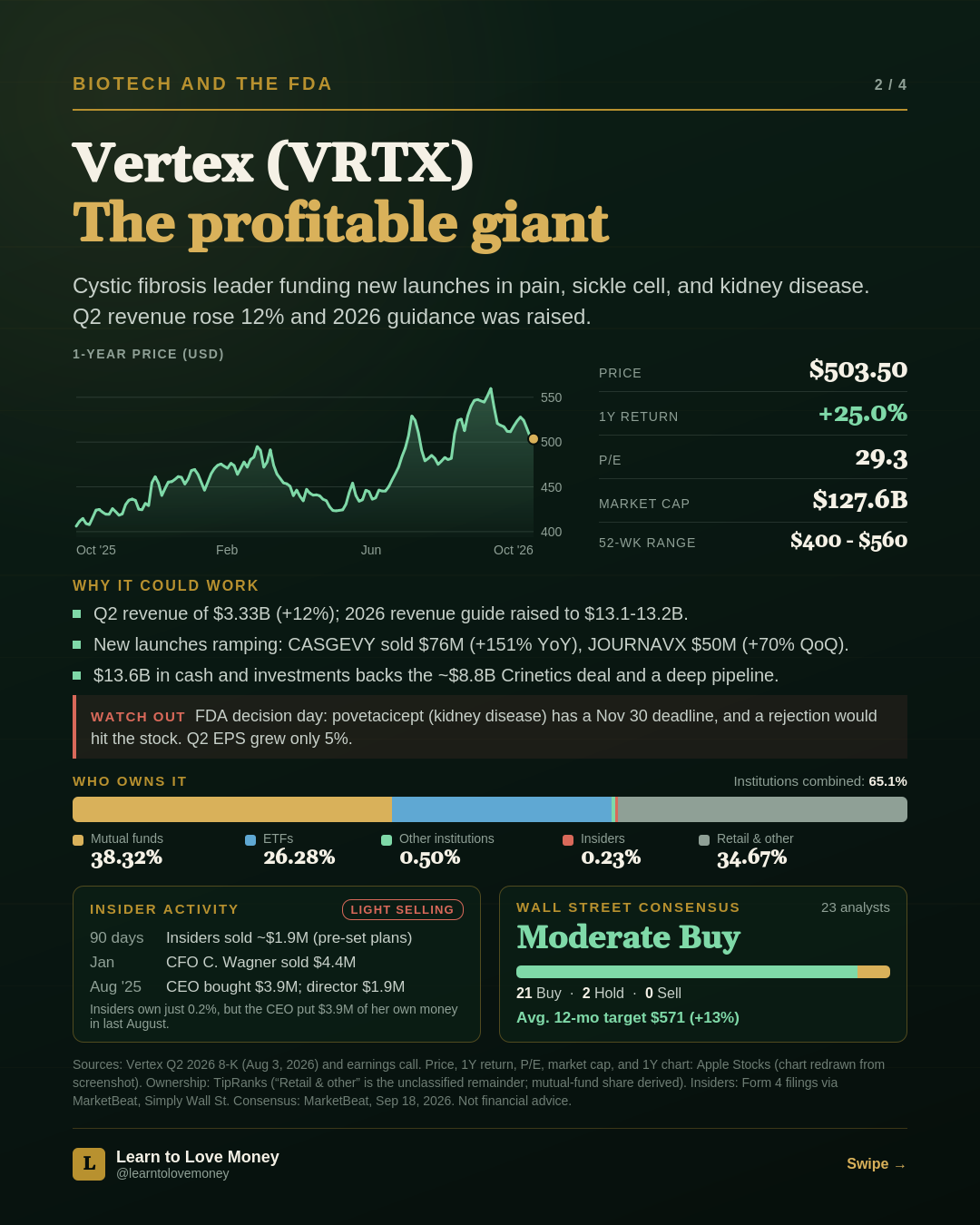
Vertex leads in cystic fibrosis, and those profits fund new launches in pain, sickle cell disease, and kidney disease. Q2 revenue was $3.33B (up 12%) and the 2026 revenue guide was raised to $13.1B to $13.2B. The new launches are ramping: CASGEVY sold $76M (up 151% from a year ago) and JOURNAVX sold $50M (up 70% from the prior quarter). With $13.6B in cash and investments, it can pay for the roughly $8.8B Crinetics deal and a deep pipeline.
Price
$503.50
1-year return
+25.0%
P/E
29.3
Market cap
$127.6B
Watch out. FDA decision day: povetacicept, a kidney disease drug, has a November 30 deadline, and a rejection would hit the stock. Q2 EPS grew only 5%. Insiders sold about $1.9M over 90 days (under pre-set plans) and the CFO sold $4.4M in January, though the CEO bought $3.9M of stock last August.
Alnylam (ALNY): growth at a heavy price
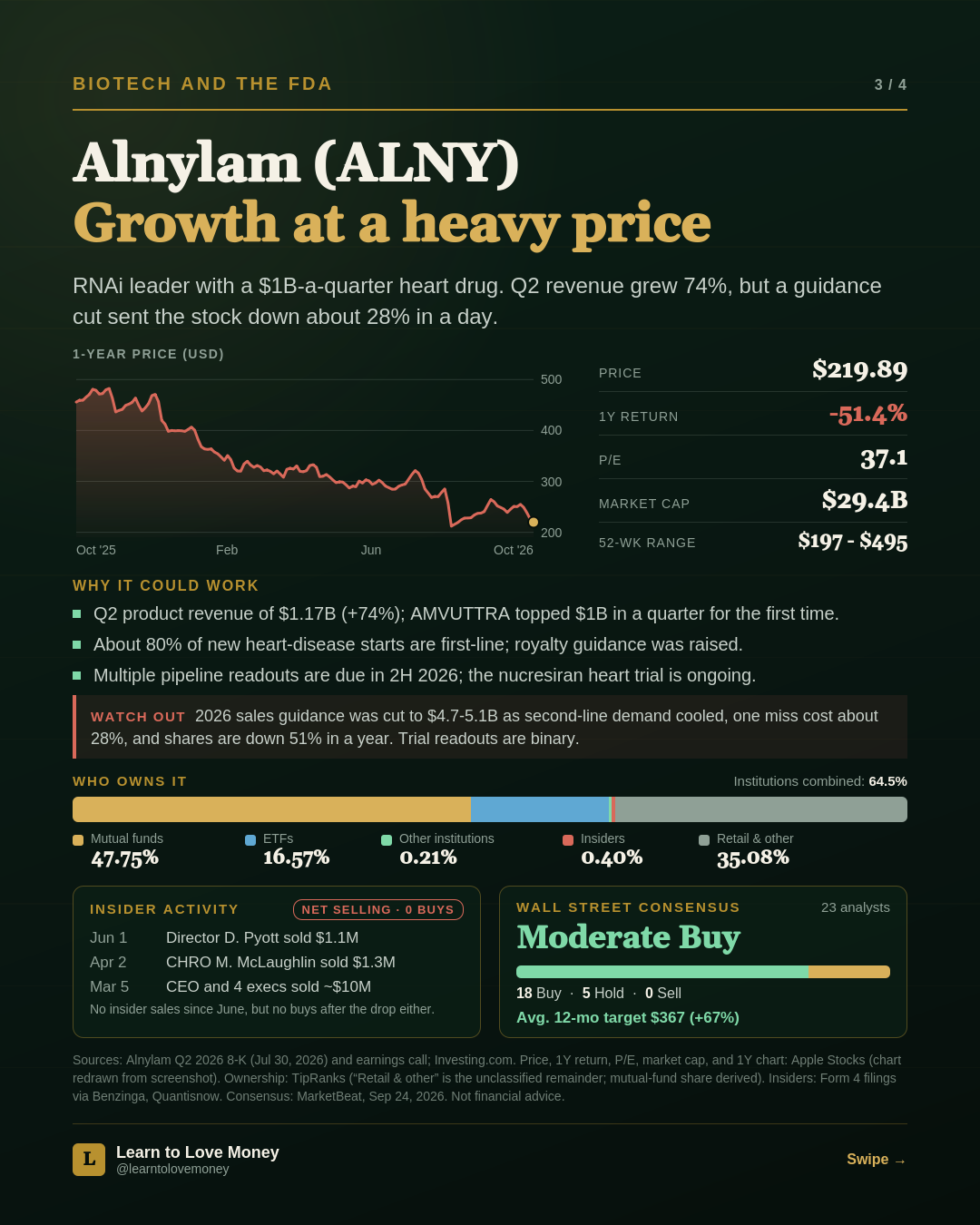
Alnylam is the leader in RNAi, a way of switching off disease-causing genes, and its heart drug AMVUTTRA topped $1B in a quarter for the first time. Q2 product revenue was $1.17B (up 74%), about 80% of new heart-disease starts are first-line, and royalty guidance was raised. Several pipeline readouts are due in the second half of 2026, and the nucresiran heart trial is ongoing.
Price
$219.89
1-year return
-51.4%
P/E
37.1
Market cap
$29.4B
Watch out. 2026 sales guidance was cut to $4.7B to $5.1B as second-line demand cooled, and that one miss cost the stock about 28% in a day. Shares are down 51% in a year, and trial readouts are binary. Insiders have not sold since June but have not bought after the drop either; the CEO and four executives sold about $10M in March.
Insmed (INSM): a hot launch, a big swing
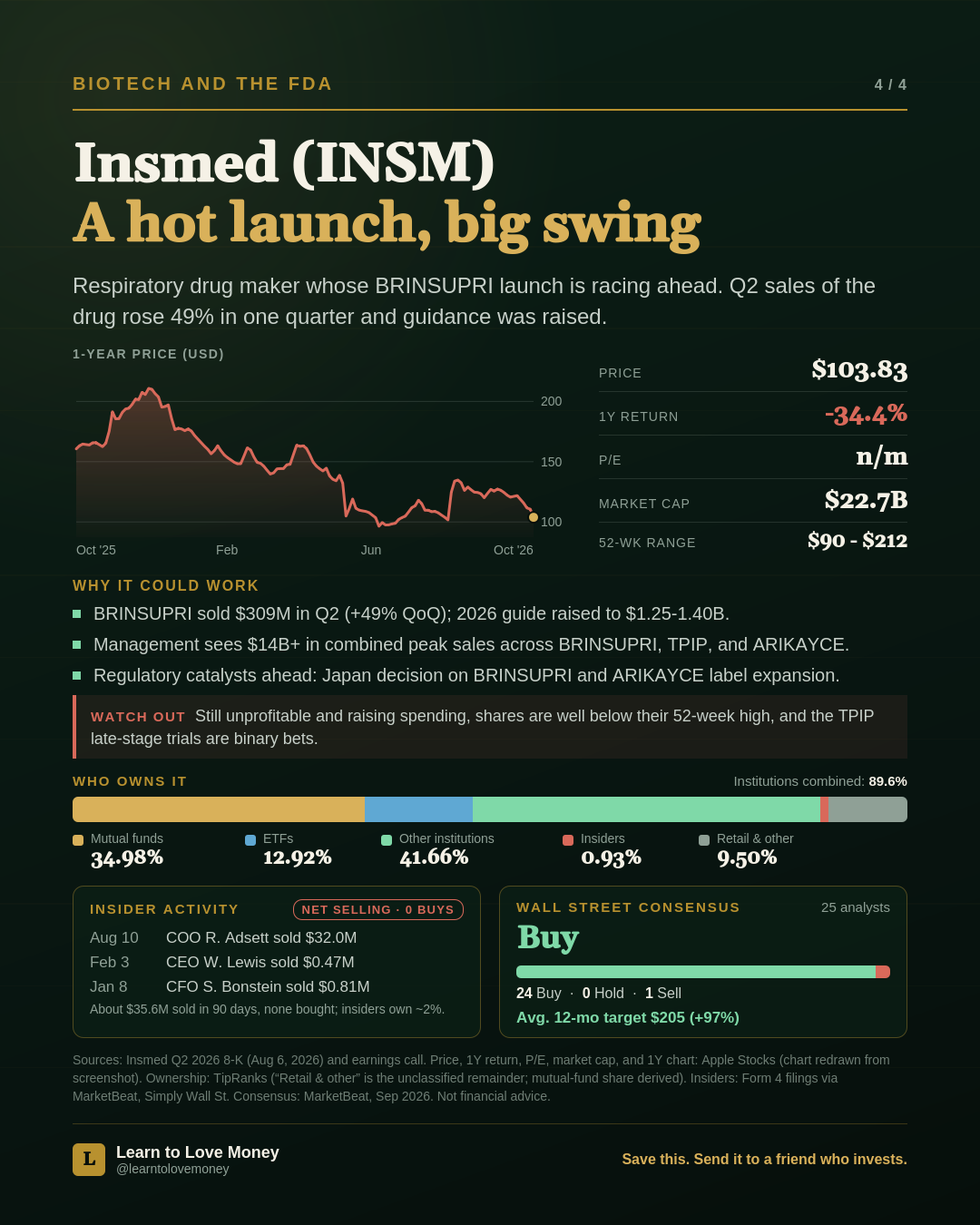
Insmed makes respiratory drugs, and its BRINSUPRI launch is racing ahead: Q2 sales were $309M (up 49% from the prior quarter) and the 2026 guide was raised to $1.25B to $1.40B. Management sees more than $14B in combined peak sales across BRINSUPRI, TPIP, and ARIKAYCE. Regulatory catalysts ahead include a Japan decision on BRINSUPRI and an ARIKAYCE label expansion.
Price
$103.83
1-year return
-34.4%
P/E
n/m
Market cap
$22.7B
Watch out. Insmed is still unprofitable and raising spending, shares are well below their 52-week high, and the late-stage TPIP trials are binary bets. Insiders sold about $35.6M over 90 days, including $32.0M by the COO, and none bought.
Side by side
- Vertex is the only one of the three that is up over the year, and the only one with a specific FDA date on the calendar (November 30 for the kidney drug).
- Alnylam has a $1B-a-quarter heart drug and 74% growth, but a guidance cut and a 51% fall over the year show how much expectations were baked in.
- Insmed has the highest upside in analysts' eyes (+97%) and the most uncertainty: a fast launch, but losses, heavy spending, and big insider selling.
7. What could prove this wrong: the risks
- Binary events. A rejection or failed trial can wipe out a large share of a stock's value in a day, and Vertex, Alnylam, and Insmed each have decisions or readouts ahead.
- Guidance cuts. Alnylam shows how fast a stock can fall when growth slows, even for a company with a blockbuster product.
- Launches can stall. A strong early ramp doesn't guarantee a long one, because doctors, insurers, and competing treatments all affect how fast sales grow.
- Heavy spending. Insmed is raising spending while unprofitable. If sales fall short, it may need to raise money.
- Concentration. Each company leans on a few products, so one setback matters a lot.
- Insider selling. All three show net selling in the periods covered, and Insmed's is the largest. Some of it is pre-set plans, but it's worth noticing, especially with no insider buying after the drops at Alnylam and Insmed.
- Pricing and policy. Drug prices and insurer coverage are political topics, and rules can change.
- Theme concentration. Biotech stocks often move together when investors get nervous about risk.
8. How I'd think about owning it
- Size it small and spread it out. Because single outcomes matter so much, I'd never let one biotech become a big part of a portfolio.
- Mix the types. A profitable giant, a grower, and a launcher behave differently, and that mix lowers the risk of one bad decision.
- Know the calendar. Track upcoming FDA dates and trial readouts, and decide in advance how you'll act around them.
- Check the price paid. A great drug doesn't make a stock cheap. Ask what the market already assumes.
- Consider a fund. If you like the theme but not the binary risk, diversified biotech or healthcare funds hold many companies at once.
The bottom line: the science is real and the demand is durable, but biotech investing means accepting sharp, sudden swings. Whether any of these stocks fits your plan is a question only you can answer.
More soon,
Learn to Love Money
NOT FINANCIAL ADVICE. This post is an educational opinion piece and is not a recommendation to buy, sell, or hold any security. Figures are from company filings and third-party data providers as of early October 2026 and change daily. Analyst targets are opinions, not guarantees. Biotech stocks can lose most of their value quickly. Do your own research or talk to a licensed advisor before investing. This post was prepared with AI assistance; see our AI Disclosure.
Sources
- BIO / Informa / QLS: Clinical Development Success Rates 2011-2020
- Pharmacy Times: Understanding the FDA approval process and PDUFA dates
- Company filings (SEC EDGAR, 8-K): Vertex, Alnylam, Insmed
- Insider trades, analyst ratings and price targets (MarketBeat): Vertex, Alnylam, Insmed
- Analyst consensus (StockAnalysis): Vertex, Alnylam, Insmed
- Ownership and holdings (TipRanks): Vertex, Alnylam, Insmed
- Price, P/E, market cap and 1-year charts: Apple Stocks (redrawn from screenshots).