Exclusive Resources / Investing Glossary
Investing Glossary: 100 Terms in Plain English
Every piece of jargon you will run into, from ETF to P/E ratio, explained in a sentence or two. No finance degree required.
Get the free glossary
Enter your email and the download unlocks right here, instantly. No password, no credit card. You will also get new LTLM posts and tools. Unsubscribe anytime.
100% freeTakes 5 secondsSearchable PDF
Your glossary is ready
You are in. Welcome to Learn to Love Money.
Download the PDF, then follow the steps below. Print it or keep it on your screen.
Download the PDFLTLM-Investing-Glossary.pdf · 908 KB · Free
What it is
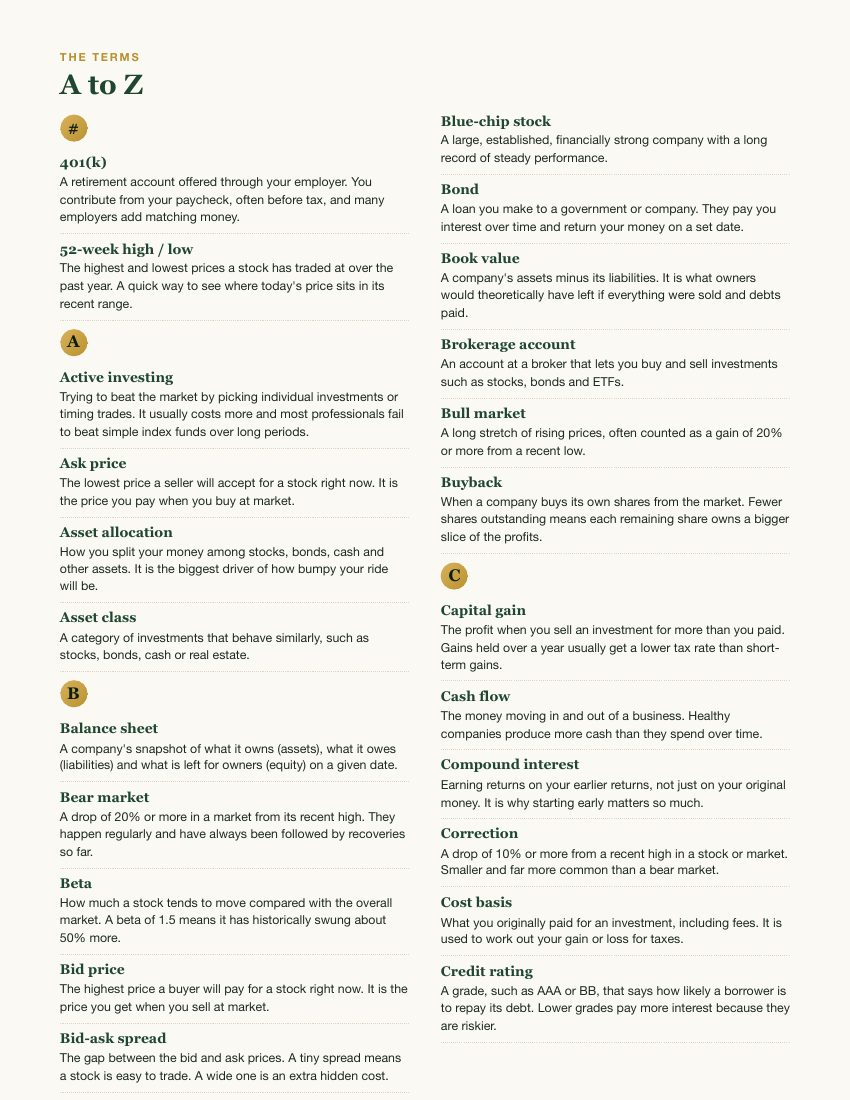
Jargon is the biggest wall between beginners and investing. This glossary breaks that wall down: 100 essential terms, each explained in plain English, with an example where it helps. Keep it open while you read articles, earnings reports or your broker app.
100 plain-English terms
From 401(k) and bear market to ROIC and yield. Each definition is one or two sentences, written for someone who has never invested.
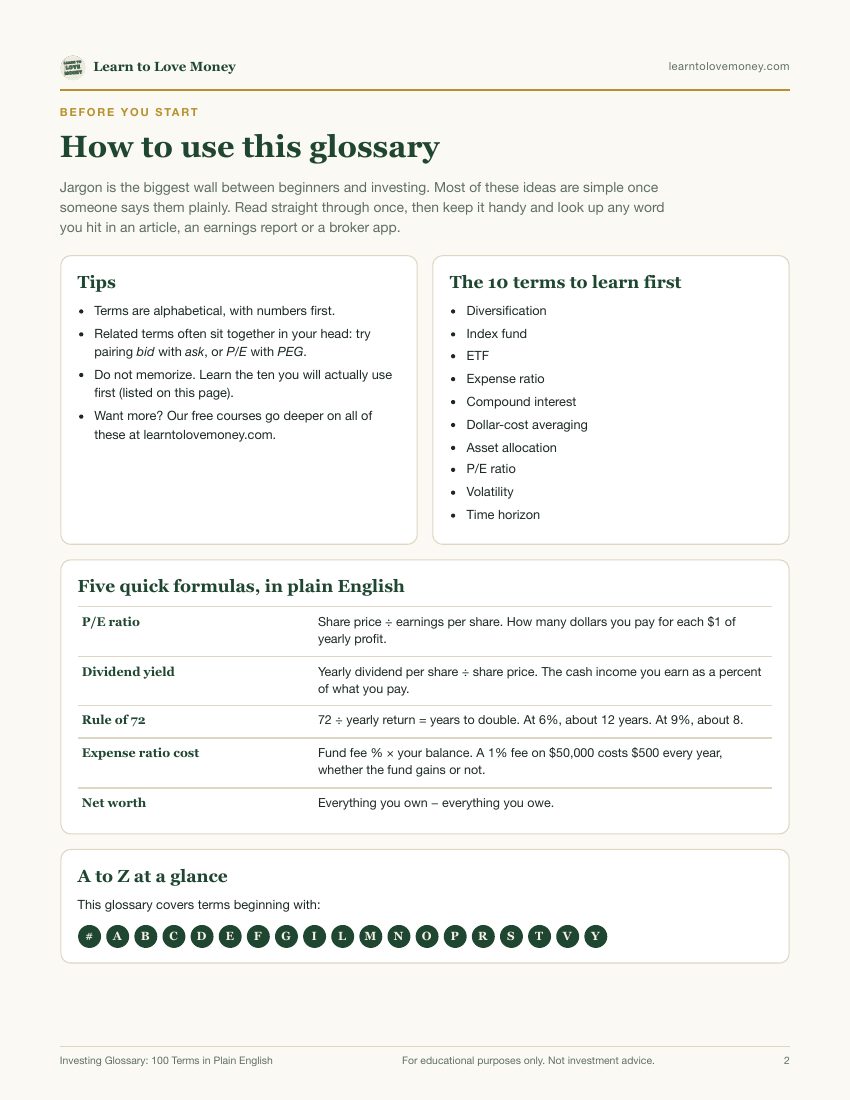
The 10 terms to learn first
Do not memorize 100 words. A short list shows which ten matter most when you are beginning.
Five formulas in plain English
P/E ratio, dividend yield, the Rule of 72, what a fund fee really costs, and net worth, each explained in one line.
Searchable
Open it on any device and use search (Ctrl or Cmd plus F) to jump straight to a term mid-article.
Prints cleanly
Letter size, designed for color or black and white, if you like a paper reference.
Where to go from here
Pointers to our free courses, stock analyses, tracker and checklist so each term turns into a skill.
A look inside
A few pages from the guide as you will receive it.
How to use it
You do not need to read it in order, but a single pass first makes everything else easier.
- Read the starter page. It lists the ten terms that matter most when you are beginning, plus five quick formulas.
- Skim the A to Z once. You will not remember everything. You are just learning what exists, so nothing is a surprise later.
- Keep it open as you read. When an article, a stock analysis or your broker uses a word you do not know, search the PDF (Ctrl or Cmd plus F).
- Test yourself. After a week, pick five terms and explain them out loud to a friend. If you can, you own them.
- Go deeper. Take our free Investing Basics course to see these terms used in a full beginner plan.
Common questions
Is it really free?
Yes. Enter your email, download the PDF and keep it. There is no payment or trial.
Are the definitions complete?
They are simplified on purpose so beginners can grasp each idea fast. They are not full textbook definitions.
Is anything in here investment advice?
No. Examples are illustrations only, and nothing is a recommendation to buy, sell or hold any security.
Which terms should I learn first?
The starter page lists ten: diversification, index fund, ETF, expense ratio, compound interest, dollar-cost averaging, asset allocation, P/E ratio, volatility and time horizon.
Can I print it?
Yes. It is letter-sized and prints cleanly in color or black and white.
It asks for my email again on another device.
The site remembers you per browser. Enter the same email once on the new device and it unlocks instantly.
Ready to start?
Get the free glossary
Enter your email and the download unlocks right here, instantly. No password, no credit card. You will also get new LTLM posts and tools. Unsubscribe anytime.
100% freeTakes 5 secondsSearchable PDF
Your glossary is ready
You are in. Welcome to Learn to Love Money.
Download the PDF, then follow the steps below. Print it or keep it on your screen.
Download the PDFLTLM-Investing-Glossary.pdf · 908 KB · Free
For educational purposes only. Definitions are simplified for clarity and examples are illustrations only. Learn to Love Money does not provide personalized financial, investment, tax or legal advice, and nothing here is a recommendation to buy, sell or hold any security. All investing involves risk, including the loss of money.