Hey everyone,
I believe clean nuclear power is one of the most important and most underrated pieces of the future energy system, and that AI is about to make the case for it much harder to ignore. This post is my take, with the numbers behind it and the things that could make me wrong.
The problem AI created
Training and running AI takes enormous amounts of electricity, and the data centers doing it can't pause when the wind dies down or the sun sets. They need power around the clock. At the same time, the big tech companies have made public commitments to cut their carbon emissions. Those two goals pull against each other, and nuclear sits right where they meet: it's low-carbon electricity that runs day and night.
The companies have noticed. According to 2026 industry reporting, Microsoft signed a 20-year deal to buy power from the restarted Crane Clean Energy Center (the former Three Mile Island Unit 1) beginning in 2027. Meta has announced agreements with Vistra, Oklo, and TerraPower covering up to 6.6 gigawatts. Amazon has a partnership with X-energy for small reactors, and Google has one with Kairos Power. When the companies spending the most on AI start signing multi-decade nuclear contracts, it tells you something about where they think the constraint is.
Why I believe in it
- It runs all the time. Nuclear plants typically operate at higher capacity factors than any other source, which makes them well suited to constant loads like data centers.
- It's low-carbon. Nuclear produces electricity with very low lifecycle emissions, comparable to wind and far below fossil fuels. "Clean" doesn't mean zero impact, since mining, construction, and waste all matter, but it does mean it can displace a lot of carbon.
- It's energy dense. A small amount of fuel and a small footprint produce a lot of power, which matters when you're trying to power a campus of servers.
- Its safety record is better than its reputation. Measured by deaths per unit of energy produced, nuclear is among the safest sources, in the same range as wind and solar. A few high-profile accidents shaped public opinion far more than the data.
- It complements renewables. I don't see this as nuclear versus solar and wind. A grid that adds massive new demand will likely need everything that works, and firm, around-the-clock power makes the intermittent sources easier to rely on.
The numbers behind the comeback
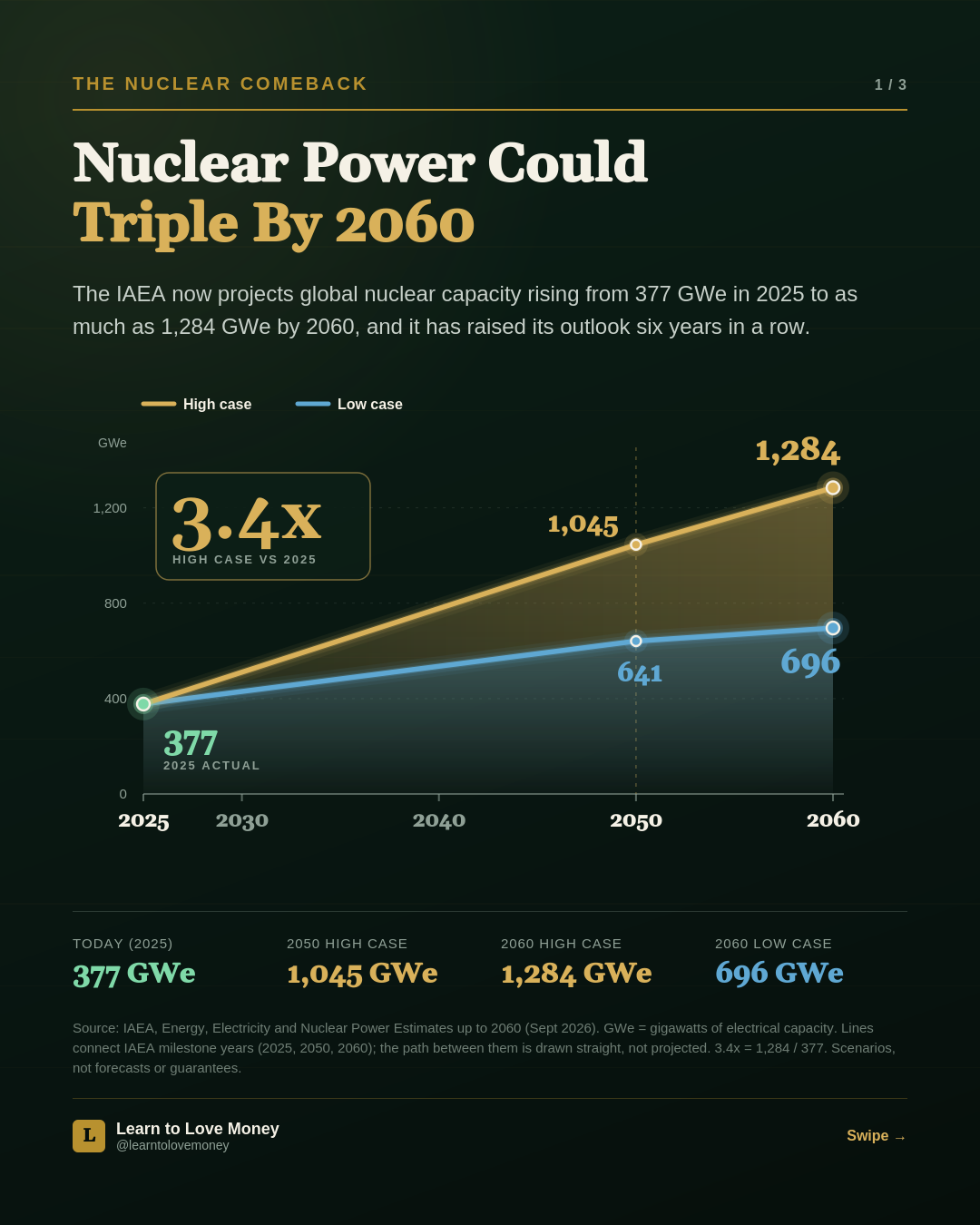
The International Atomic Energy Agency (IAEA) now projects that global nuclear capacity, 377 gigawatts of electrical capacity (GWe) at the end of 2025, could reach somewhere between 696 and 1,284 GWe by 2060. The high case is more than triple today's level. It's also the sixth year in a row the agency has raised its outlook.
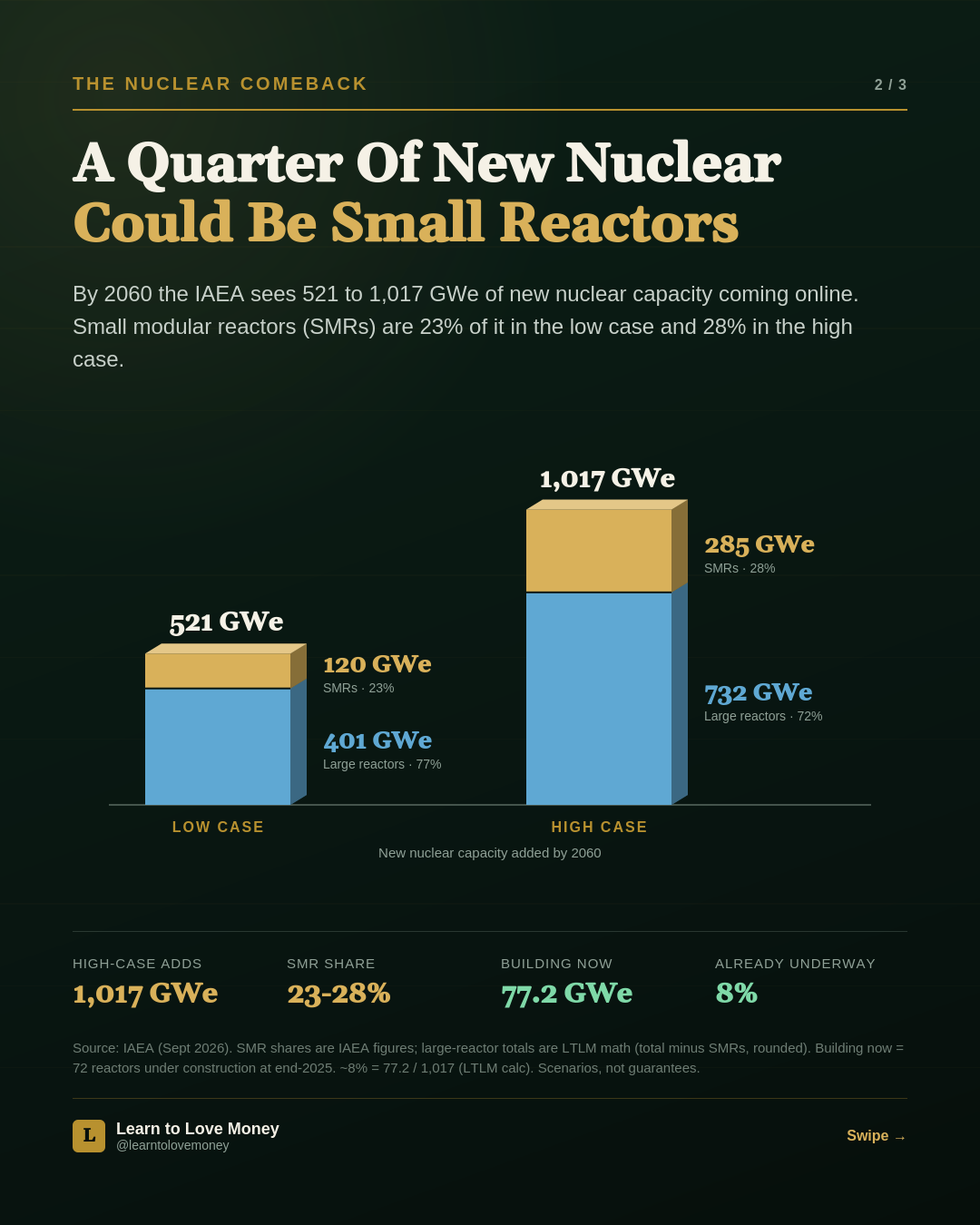
A notable part of that growth is small modular reactors, or SMRs: smaller reactors designed to be built in a factory and assembled on site, which in theory makes them faster and cheaper to deploy than the giant plants of the past. The IAEA sees SMRs making up roughly a quarter of new nuclear capacity.
The catch: it still has to get built
This is where I try to stay honest. A projection isn't a power plant. Nuclear has a long history of projects that ran over budget and behind schedule, and SMRs, in particular, are still largely unproven at commercial scale. Three numbers from the IAEA data show what has to go right.
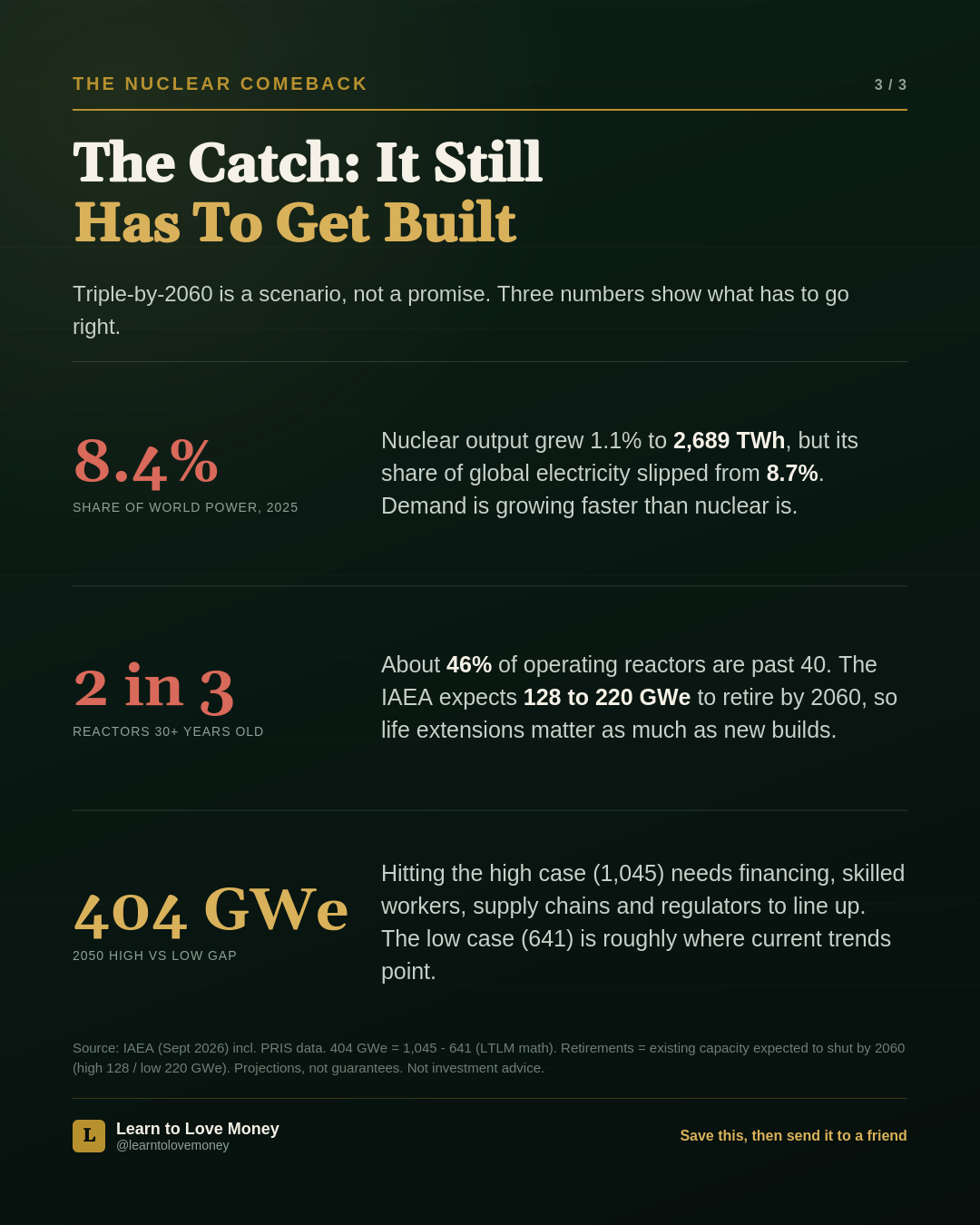
- Nuclear's share is slipping. Output grew, but its share of global electricity fell to about 8.4% from 8.7% because demand is growing faster than nuclear is.
- The fleet is aging. Most reactors are more than 30 years old, so extending the life of existing plants matters as much as building new ones.
- The range is huge. The gap between the 2050 high and low cases is 404 GWe. Reaching the high case takes financing, skilled workers, supply chains, and regulators all lining up. The low case is roughly where current trends point.
The investing angle
If you believe in this theme, the harder question is how that belief turns into an investment. I won't tell you what to buy, but here are the categories to understand:
- Existing operators and utilities. Companies that already run reactors benefit from long-term contracts with tech buyers. They tend to be established and profitable, so a metric like P/E still works on them.
- Fuel and supply chain. Uranium miners and enrichment companies are tied to demand for reactor fuel, and are typically cyclical and volatile.
- Reactor developers. SMR and advanced-reactor companies carry the most excitement and the most risk. Many are pre-revenue, which brings back the valuation problem we covered in our P/E post: you're paying for a forecast instead of earnings.
- Funds. If you like the theme but not the single-stock risk, diversified energy or utility funds spread the bet.
Excitement and returns aren't the same thing. Themes like this tend to attract investment before the economics are proven, which was true of railways in the 1840s and, as we argued in our Industrial Revolution post, is worth remembering with AI too. A great technology can still be a poor investment at the wrong price.
What could prove me wrong
- Cost and delays. If new reactors keep coming in late and over budget, cheaper options will win.
- SMRs fail to scale. The factory-built promise is still a promise.
- AI demand disappoints. If AI power use grows slower than expected, the urgency drops.
- Waste, fuel supply, and public opinion. Long-term waste storage, fuel supply chains, and local opposition remain real obstacles.
What to take from it
- AI needs reliable, low-carbon power, and nuclear fits that need better than most alternatives.
- The forecasts are rising, but they're scenarios, and the gap between low and high is enormous.
- Building it is the hard part. Watch construction progress, not press releases.
- Believing in a theme isn't a plan. Know which part of the chain you're buying, what it costs, and how much you can afford to be wrong.
If you want the basics of how to value the companies in a theme like this, our free DCF course is a good place to start.
More soon,
Learn to Love Money
NOT FINANCIAL ADVICE. This post is an opinion piece for education only and is not a recommendation to buy or sell any security. Projections are scenarios, not forecasts or guarantees. Do your own research or talk to a licensed advisor before investing.
Sources
- IAEA: Global nuclear power capacity could triple by 2060
- IAEA: Energy, Electricity and Nuclear Power Estimates for the Period up to 2060
- World Nuclear News: IAEA's projections suggest there could be 1,000 SMRs by 2060
- SMR Intel: Every nuclear-powered data center deal (2026)
- Forbes: The AI boom is making nuclear power bankable again