Hey everyone,
On September 16, WIRED reported that Chipotle is piloting a food safety platform built on Palantir's Foundry software, and Chipotle confirmed it. It's a small story on its face, a restaurant chain testing a software tool, but it involves two very different stocks, so it's worth asking what it could actually mean for each.
A note on how to read this: the analysis below is AI-generated and meant for education. The impact ratings are an opinion, not a forecast, and Chipotle hasn't disclosed the details that would let anyone size the deal.
What Chipotle is actually testing
The tool is called a Food Safety Risk Management Platform. As reported, it pulls together information such as health department scores, pest incidents, and employee illnesses to assign a food safety risk level to individual restaurants. The idea is to spot trouble early, so the company can follow up on risky locations before something turns into an outbreak. Chipotle runs more than 4,000 restaurants, so a single consistent view across all of them is the appeal.
The timing matters. The pilot surfaced weeks after Chipotle restaurants received jalapeños tied to an ongoing multistate Salmonella outbreak. Chipotle's chief corporate affairs and food safety officer told WIRED the pilot brings important information together so the company can identify trends and make more proactive decisions.
Here's what we don't know. Chipotle hasn't said how many stores are involved, when the rollout would happen, how the scoring works, what the contract is worth, or whether it's working. That's why we treat this as a read on a small, unsized pilot and not a major contract.
Two stocks, two very different stories
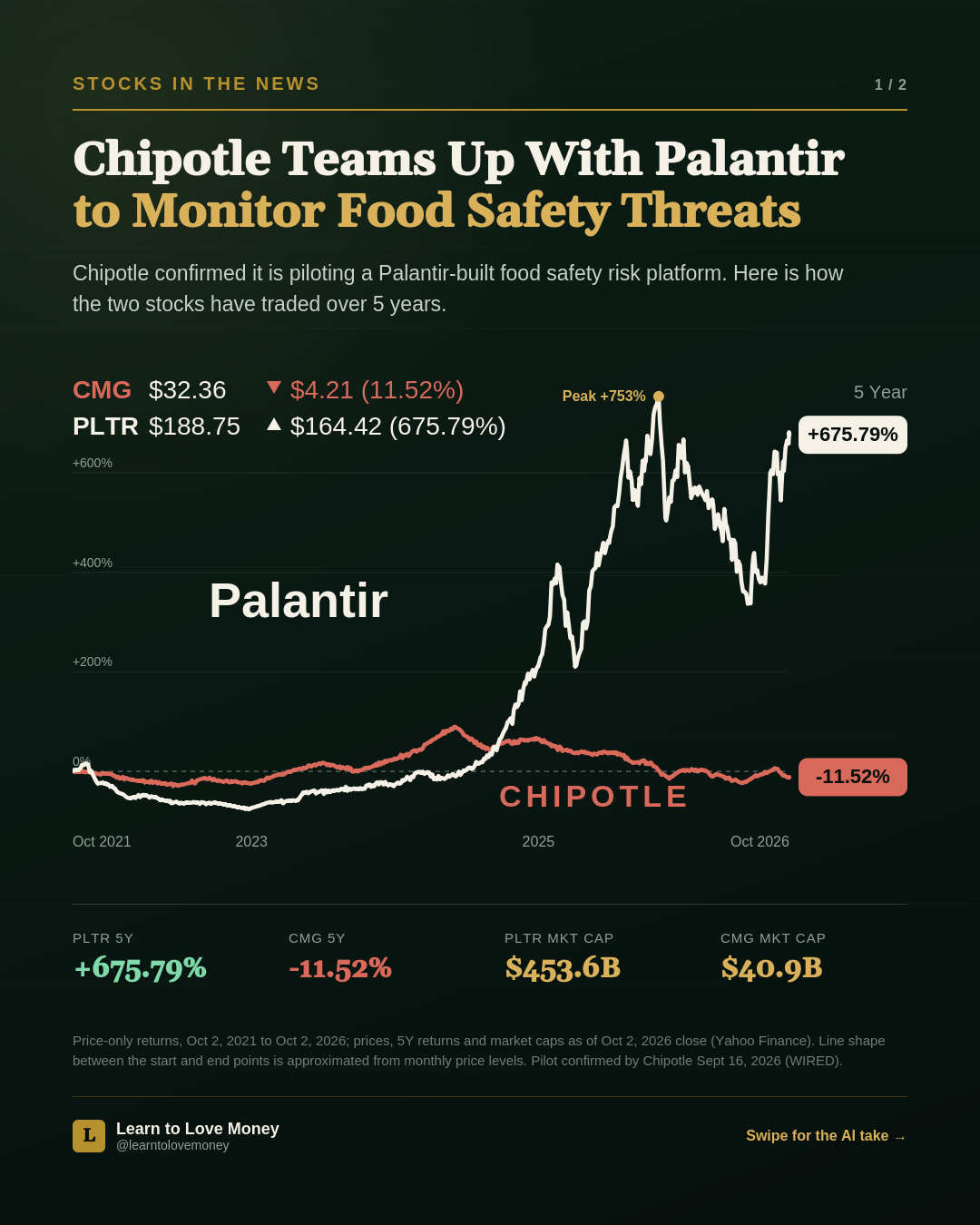
Over the last five years, Palantir is up about 676% and Chipotle is down about 12%. Palantir is now valued at roughly $454 billion, more than ten times Chipotle's roughly $41 billion. One is an AI software company the market has priced for very large growth. The other is a restaurant chain priced for steady execution.
That gap shapes how much a pilot like this can matter. For a company the size of Palantir, a restaurant pilot is a rounding error. For a restaurant chain whose business depends on customers trusting its food, avoiding a safety problem is worth a lot.
What it could mean for each
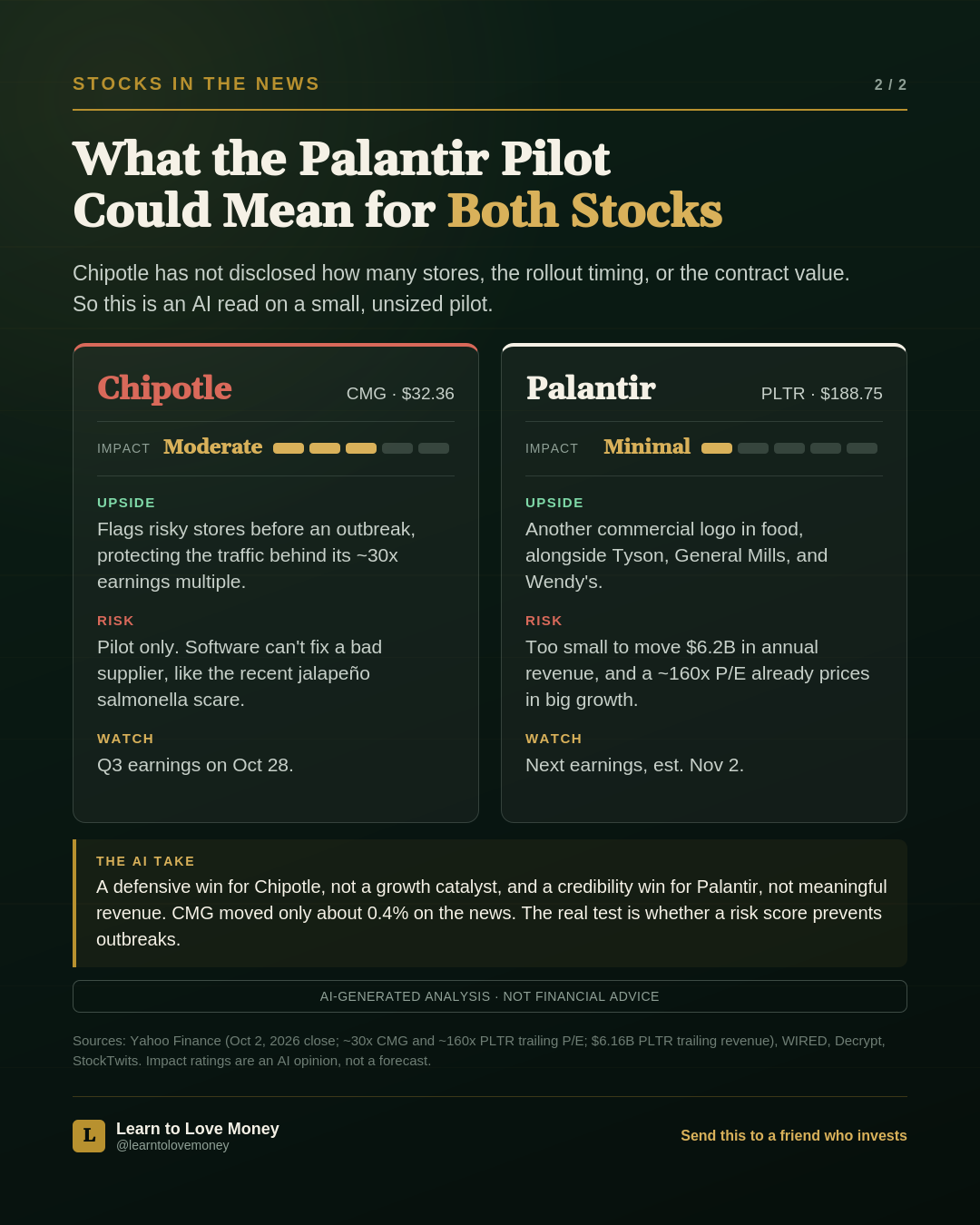
Chipotle: moderate impact. The upside is defensive. If the platform flags risky stores before an outbreak, it protects the customer traffic behind a stock trading near 30 times earnings. The risk is that it's only a pilot, and software can't fix a bad supplier, which is what the recent jalapeño problem looks like. Chipotle's shares moved only about 0.4% on the news, so the market isn't treating it as a growth catalyst.
Palantir: minimal impact. The upside is credibility. A well-known consumer brand in food joins other commercial names like Tyson, General Mills, and Wendy's. The risk is size: with about $6.2 billion in trailing annual revenue, one restaurant pilot barely registers, and a P/E near 160 means the stock already prices in big growth. If you want a refresher on why a high multiple raises the bar, see our P/E post.
Our take: this is a defensive win for Chipotle, not a growth catalyst, and a credibility win for Palantir, not meaningful revenue. The real test is whether a risk score actually prevents outbreaks.
What to watch next
- Chipotle's Q3 earnings on October 28. Listen for any detail on the pilot's scope and for how management talks about food safety costs and traffic.
- Palantir's Q3 earnings in early November. The date hasn't been confirmed; estimates vary. Watch whether commercial customer growth speeds up, which matters far more than any single restaurant deal.
- The outbreak. A resolution of the Salmonella outbreak, or a new one, will matter more to Chipotle than the software.
What to take from it
- A pilot isn't a contract. No store count, timing, or deal value has been disclosed.
- Size decides the stakes. It's potentially meaningful for a $41 billion restaurant chain and negligible for a $454 billion software company.
- Valuation sets expectations. Palantir's multiple already assumes a lot, and Chipotle's assumes steady execution.
- Don't trade headlines. The market barely moved on this. Judge each business on its fundamentals, not a single announcement.
Want a framework for evaluating companies like these? Our AI Stock Analysis series breaks down moat, leadership, and growth against the price.
More soon,
Learn to Love Money
NOT FINANCIAL ADVICE. This post is AI-generated analysis for education only and is not a recommendation to buy or sell any security. Impact ratings are an opinion, not a forecast, and market data changes daily. Do your own research or talk to a licensed advisor before investing.
Sources
- Yahoo Finance: Chipotle has 4,186 restaurants. Palantir is helping score the risk
- Restaurant Technology News: Chipotle tests technology platform to spot food safety risks
- IBTimes: Chipotle enlists Palantir to score store food-safety risk after jalapeño Salmonella scare
- Insider Monkey: Chipotle is piloting Palantir for food safety. Does it matter for investors?
- Chipotle Investor Relations: Third quarter 2026 results date