Hey everyone,
Two of the most influential people in AI have recently put dates on something that used to feel like science fiction. OpenAI's Sam Altman says his company expects to have an internal system by the end of 2026 that he'd call AGI. Anthropic's Dario Amodei says what he calls "powerful AI" arrives in 2026, maybe 2027. Meanwhile, the forecasters and researchers who study this for a living tend to put the odds of AGI in the next year or two far lower.
This post lays out what each side is saying, where the numbers come from, and why the gap matters, including for anyone looking at the AI IPOs we've been covering. One note up front: forecasts are not guarantees, and the odds charts below are our own blended estimate, not a published poll.
What AGI actually means
AGI stands for artificial general intelligence: AI that can learn and do nearly any intellectual task a person can, instead of being good at one narrow thing. OpenAI's definition is systems that outperform humans at most economically valuable work. Today's AI is strong in many areas but uneven and still guided by people.
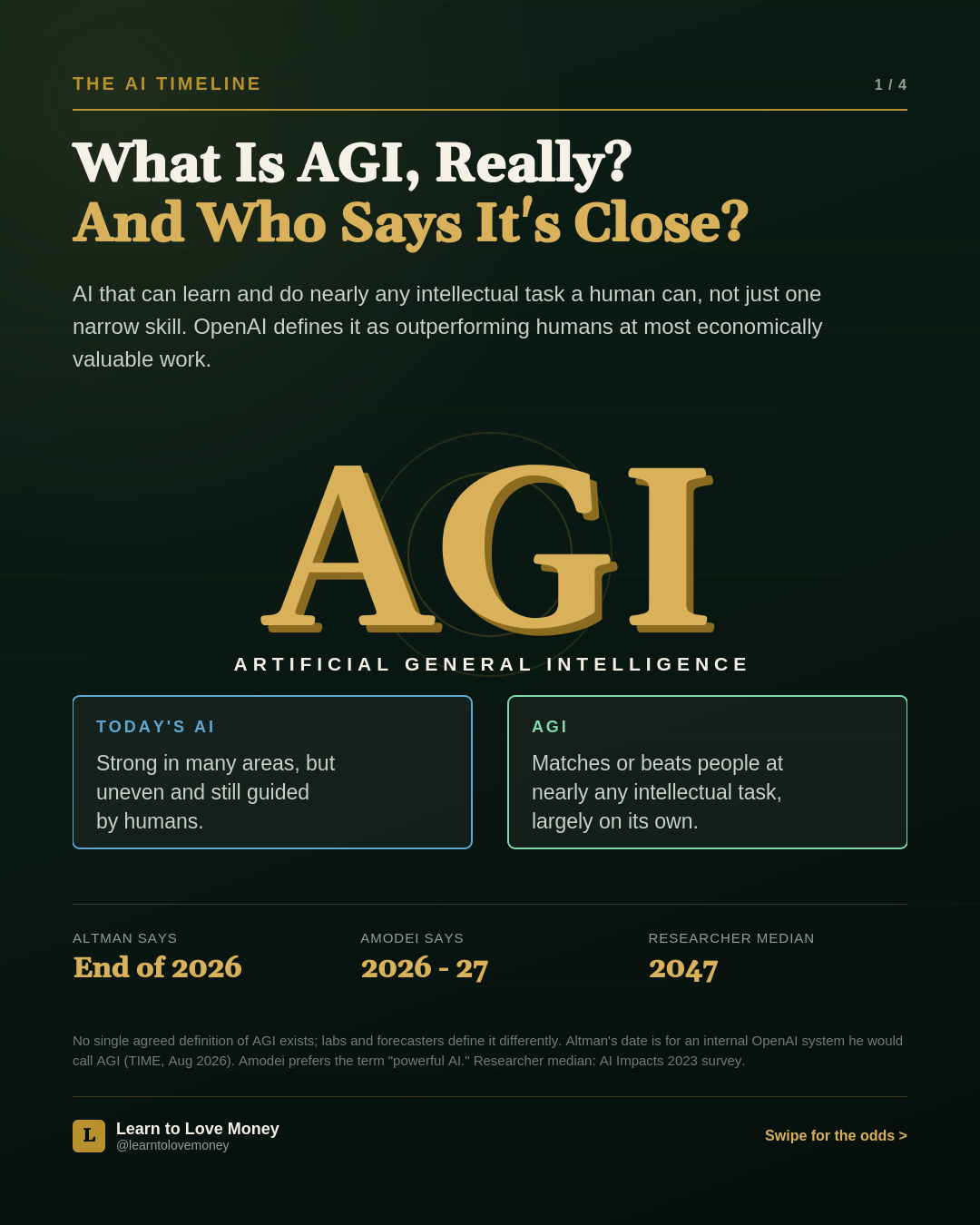
That definition problem matters. When one person says "AGI by December" and another says "not until the 2040s," they may not be describing the same finish line.
The odds, year by year
To compare the claims with outside forecasts, we blended a few sources: the forecasting platform Metaculus, prediction markets, a survey of AI researchers, and a forecasting panel. The result is a rough probability that AGI exists by each year.
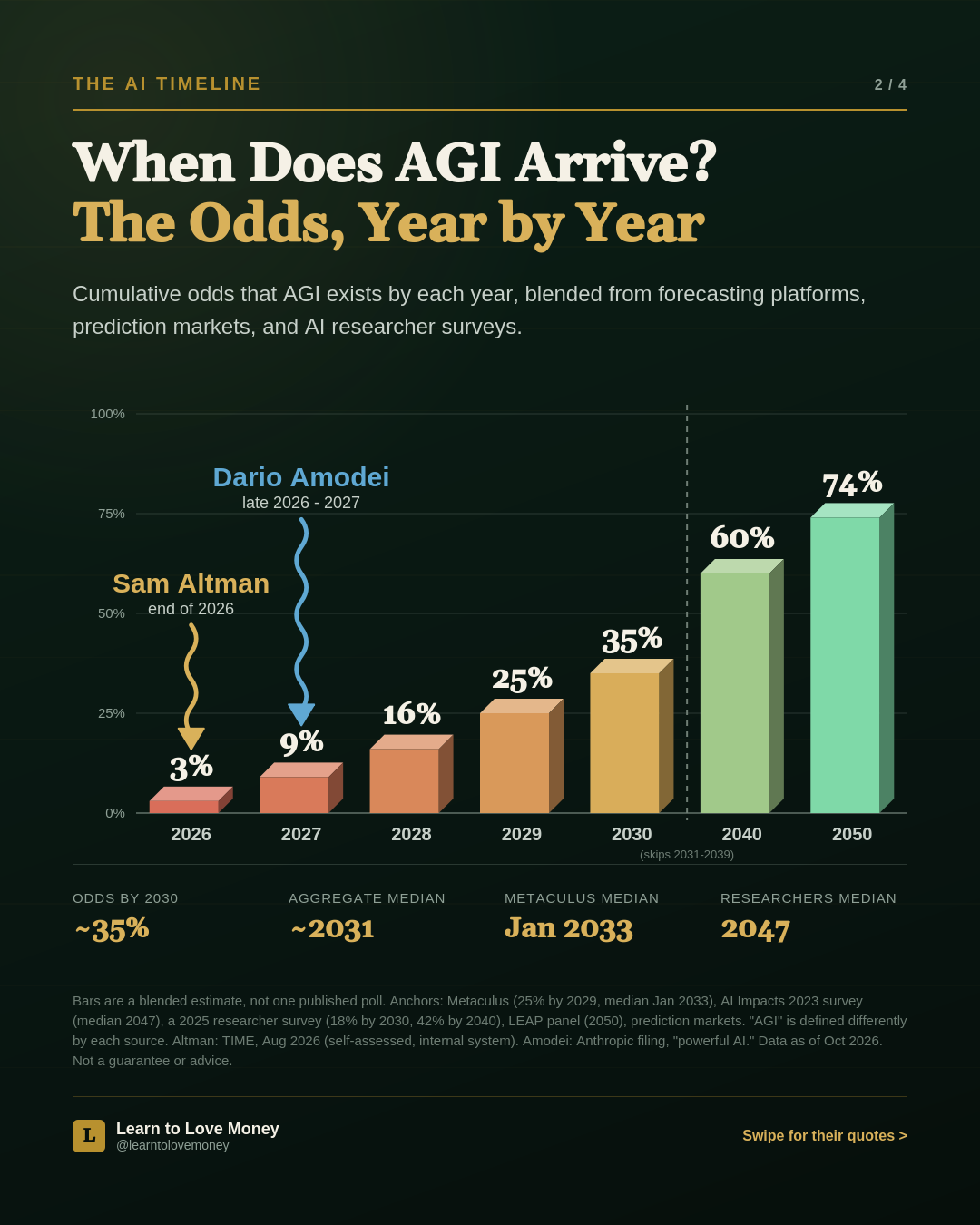
On this blend, the odds of AGI by the end of 2026 are about 3%, about 9% by 2027, and roughly 35% by 2030. The aggregate median lands around 2031. Notice that the researchers who were surveyed in 2023 had a much later median, 2047. Forecasts have been moving earlier as AI has improved, but they remain well behind the lab leaders.
Sam Altman: AGI by the end of 2026
In an August 26 interview with TIME ("Inside OpenAI's Reboot"), Altman said OpenAI isn't at AGI yet, but expects to have an internal system by the end of the year that he would call AGI. Earlier, in a January 2025 blog post, he wrote that OpenAI was confident it knows how to build AGI as it has traditionally understood it.
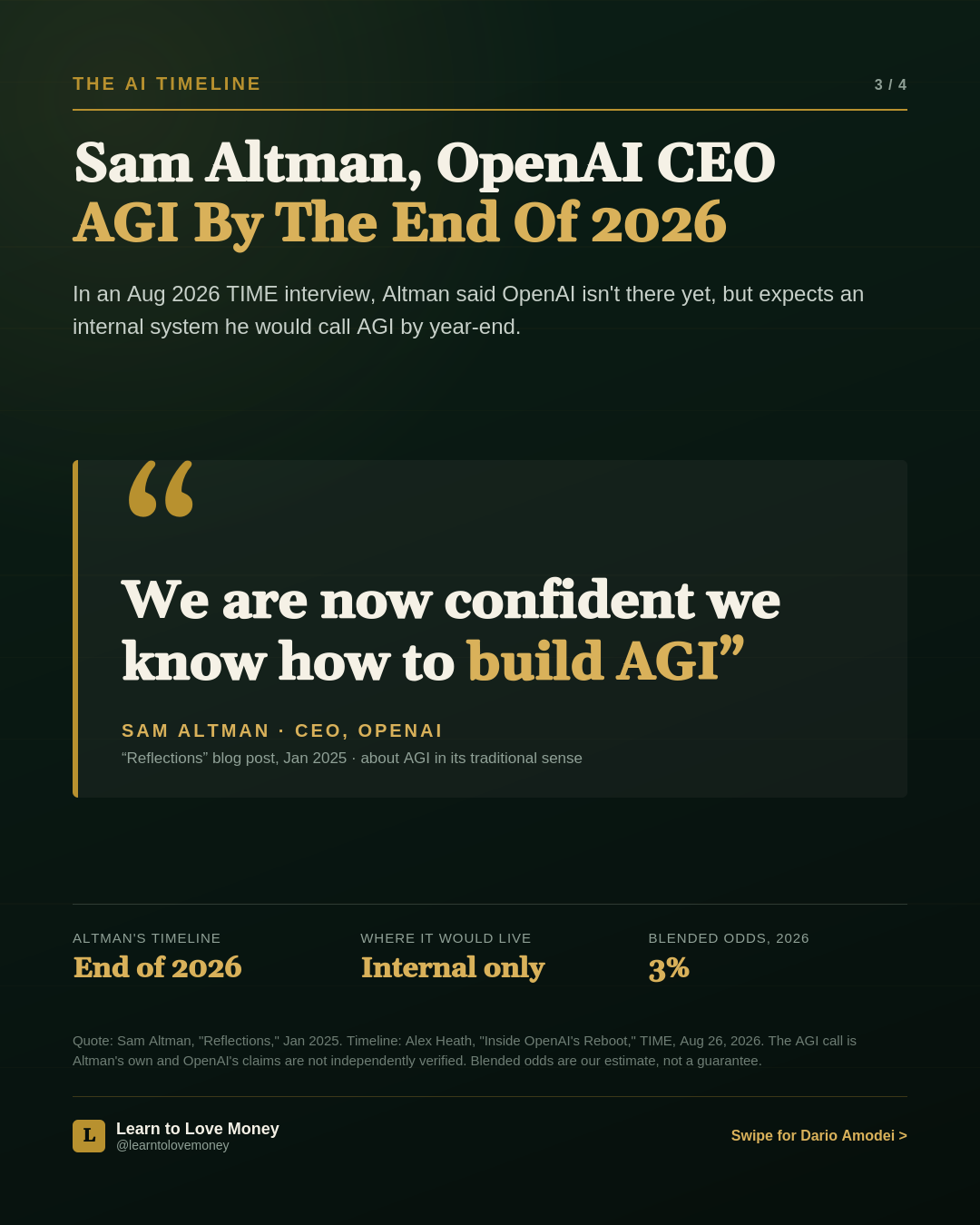
Two caveats are worth keeping in mind. First, the system would be internal, so outsiders couldn't test it. Second, whether it counts as AGI is Altman's own call, and OpenAI's claims aren't independently verified.
Dario Amodei: "powerful AI" in 2026, maybe 2027
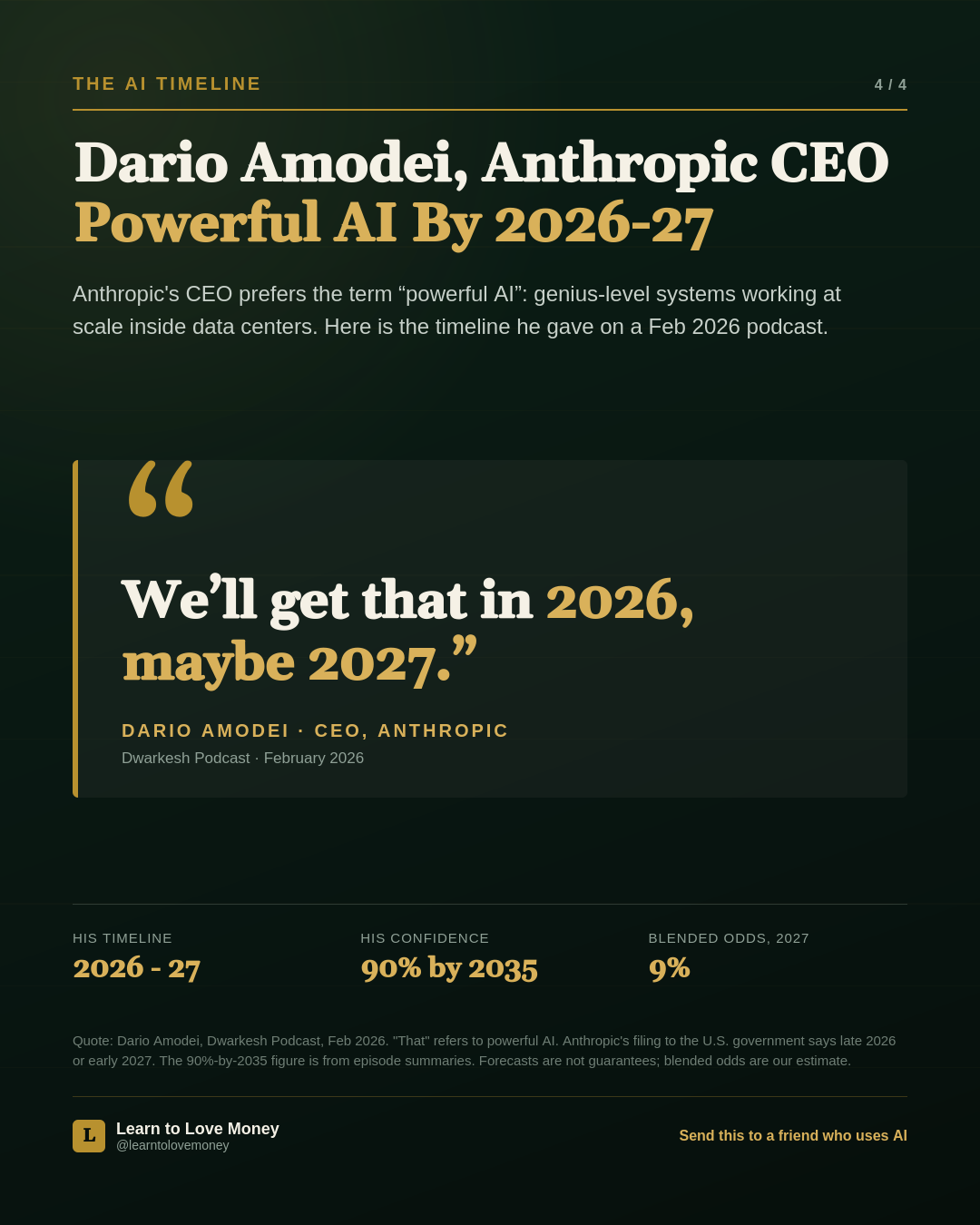
Amodei prefers the term "powerful AI" to AGI. He describes it as something like a country of geniuses in a data center: systems with intellectual abilities matching or exceeding Nobel-level experts, working at scale. On the Dwarkesh Podcast in February 2026 he said the timeline is 2026, maybe 2027, while also acknowledging he wouldn't be surprised to be off by a year or two. Anthropic's own submission to the U.S. government points to late 2026 or early 2027. Summaries of the episode also report that he's about 90% confident of getting there by 2035.
Why the gap?
There are a few honest explanations, and they can all be partly true:
- Insiders see things we don't. People building the systems watch progress up close, including unreleased models.
- Definitions differ. An internal system that does most research tasks isn't the same as "outperforms humans at most economically valuable work" in the real world.
- Incentives exist. Companies raising tens or hundreds of billions of dollars benefit from the idea that transformative AI is close. That doesn't mean they're wrong, but it's a reason to compare claims with outside forecasts.
- Forecasters can lag. Predicting a fast-moving technology is hard, and past surveys have repeatedly been too late.
Why this matters for investors
Valuations are really bets on timelines. When we looked at Anthropic's leaked prospectus, a $2 trillion target price meant assuming extraordinary growth for years. In our P/E post, we showed how pre-profit giants are priced on future earnings instead of current ones. The AGI question sits underneath all of it: the sooner and more capable AI becomes, the easier those prices are to justify, and the later or weaker, the harder.
That's also why it's worth keeping the Industrial Revolution parallel in mind. Big technology shifts tend to arrive more slowly than the loudest predictions and then matter more than the skeptics expected.
What to take from it
- Two CEOs say it's close. Altman says end of 2026 for an internal system, and Amodei says 2026 to 2027 for powerful AI.
- Outside forecasts are much later. Our blend puts 2026 at about 3% and 2030 at about 35%.
- Definitions drive the disagreement. Always ask what "AGI" means in a given claim.
- Don't invest on a date. Forecasts change, and nobody knows. Diversify, and be wary of any price that only works if one timeline comes true.
If you want to understand what these systems can do today, our free AI Explained course is a good starting point.
More soon,
Learn to Love Money
NOT FINANCIAL ADVICE. This post is for education only and is not a recommendation to buy or sell any security. Quotes and timelines come from public interviews and reporting. Forecasts are not guarantees, and the blended odds are our own estimate. Do your own research or talk to a licensed advisor before investing.