
Getting started
When a CEO, director, or other insider buys or sells their own company's stock, they have to tell the SEC. Learn to read that report, line by line, using a real NVIDIA filing.
About 7 minutes to read, 8 minutes for the quiz. For educational purposes only — not investment advice.
Part 1 of 5
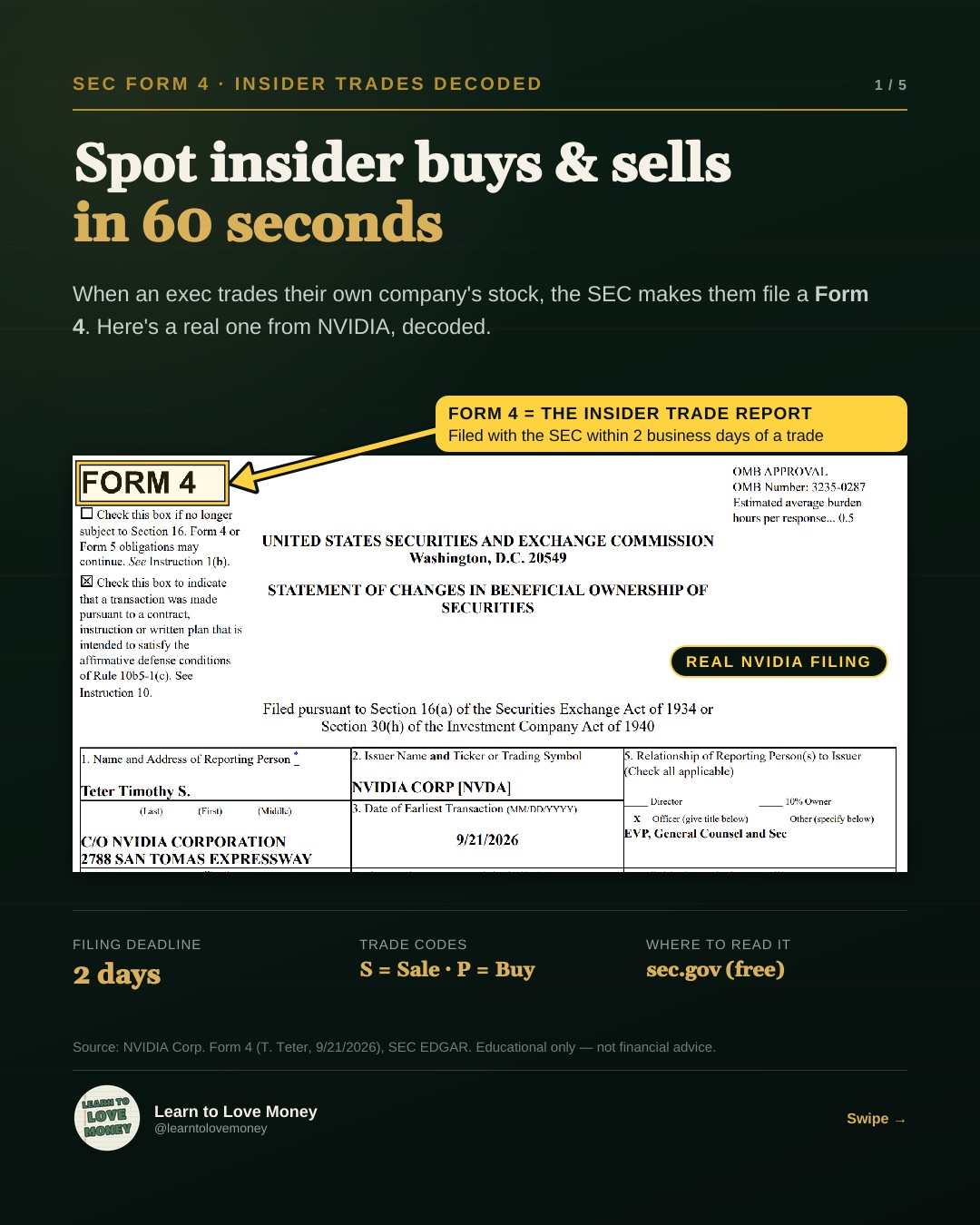
What it is
A Form 4 is the report an insider files with the SEC every time they trade their own company's stock. "Insiders" are officers (like the CEO or general counsel), directors, and anyone who owns more than 10% of the company. The form is due within 2 business days of the trade, and it's free to read on the SEC's EDGAR website.
Legal vs. illegal insider trading
Most insider trading is completely legal: executives buy and sell their company's shares all the time, and the Form 4 is how they disclose it. What's illegal is trading on material, nonpublic information — facts that would move the stock and that the public doesn't know yet. A Form 4 shows you what insiders did; it can't tell you why they did it.
Why it matters
Insiders know their company better than anyone. A pattern of insider buying can be a vote of confidence. Insider selling is much noisier: people sell to pay taxes, diversify, buy a house, or follow a schedule they set months ago. Learning to read the form helps you tell a meaningful signal from routine noise.
Quick reference
S = open-market sale · P = open-market purchase
Other common codes: A = grant or award · M = option exercise · F = shares withheld for taxes · G = gift
To find filings, search a company or ticker on sec.gov/edgar and filter the filing type to "4".
Part 2 of 5
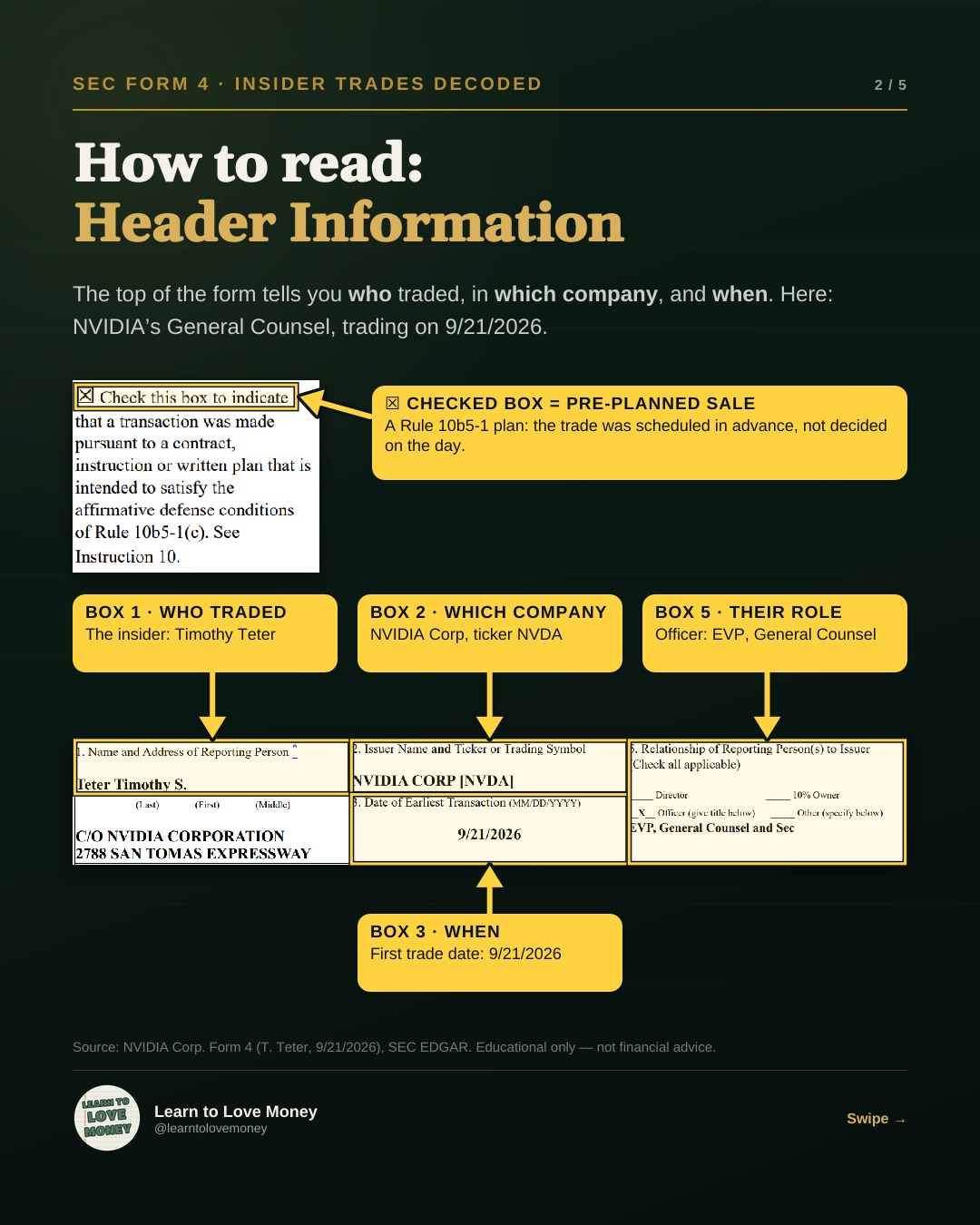
The four boxes to read first
Box 1 is the insider (here, Timothy Teter). Box 2 is the company and ticker (NVIDIA, NVDA). Box 3 is the date of the earliest transaction on the form (9/21/2026). Box 5 is their relationship to the company: director, officer (with title), or 10% owner. Teter is NVIDIA's EVP and General Counsel.
Why the role matters
A CEO or CFO trade usually says more than a trade by a director who sees the business a few times a year. A 10% owner is often a fund, and its trades may reflect portfolio decisions rather than inside knowledge.
The checkbox that changes the story
Near the top of the form is a box about Rule 10b5-1. If it's checked, the trade was made under a written plan the insider set up in advance, with the dates and amounts scheduled before the sale happened. Officers and directors must also wait through a cooling-off period (at least 90 days) between adopting a plan and the first trade. A planned sale is much less likely to reflect a last-minute view on the stock.
In this filing
The 10b5-1 box is checked. The sales on this form were scheduled ahead of time, not decided on the day they happened. (The footnotes will tell us exactly when the plan was adopted.)
Part 3 of 5
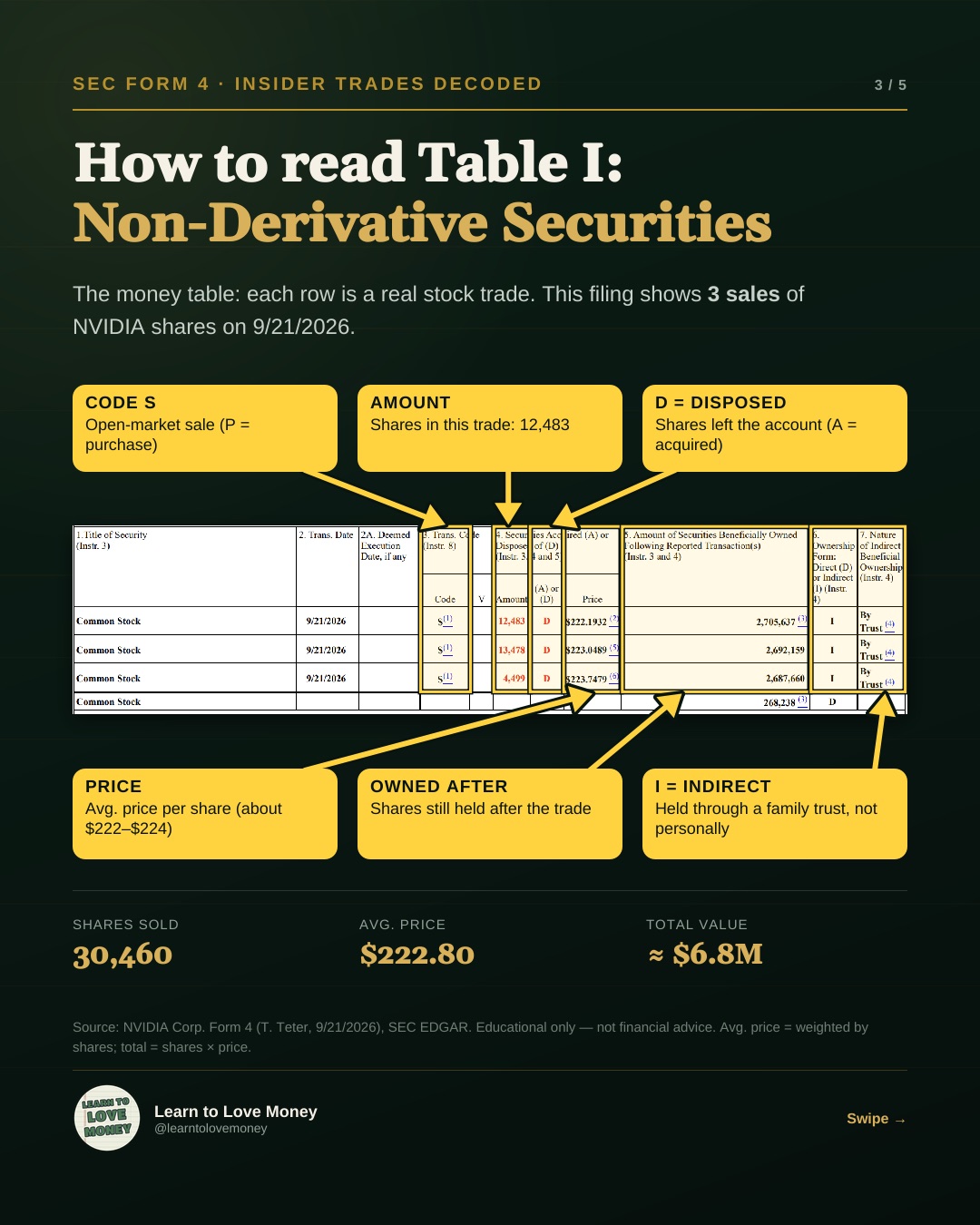
How to read a row
Each row is one trade in common stock. Look at five things, left to right: the code (S = sale, P = purchase), the amount of shares, whether they were acquired (A) or disposed of (D), the price per share, and the shares owned after the trade.
Direct vs. indirect ownership
The last two columns say how the shares are held. D means direct, in the insider's own name. I means indirect: held through something else, like a family trust. The "Nature of Ownership" column tells you what. Here every sale row says "By Trust".
Which trades carry the most signal
An open-market purchase (code P) means an insider spent their own after-tax cash, which is rare enough to be worth noticing. A sale (code S) is far more common and has many innocent explanations, so look at the size relative to total holdings, whether it was planned, and whether several insiders are selling at once.
Worked example
This filing has three sales on 9/21/2026, all code S, all D:
12,483 shares @ ~$222.19
13,478 shares @ ~$223.05
4,499 shares @ ~$223.75
Total: 30,460 shares sold
Average price = total dollars ÷ total shares ≈ $222.80. Total value = 30,460 × $222.80 ≈ $6.8 million. After the trades, 2,687,660 shares were still held through the trust, plus another 268,238 held directly, so this sale is a small slice of the position.
Part 4 of 5
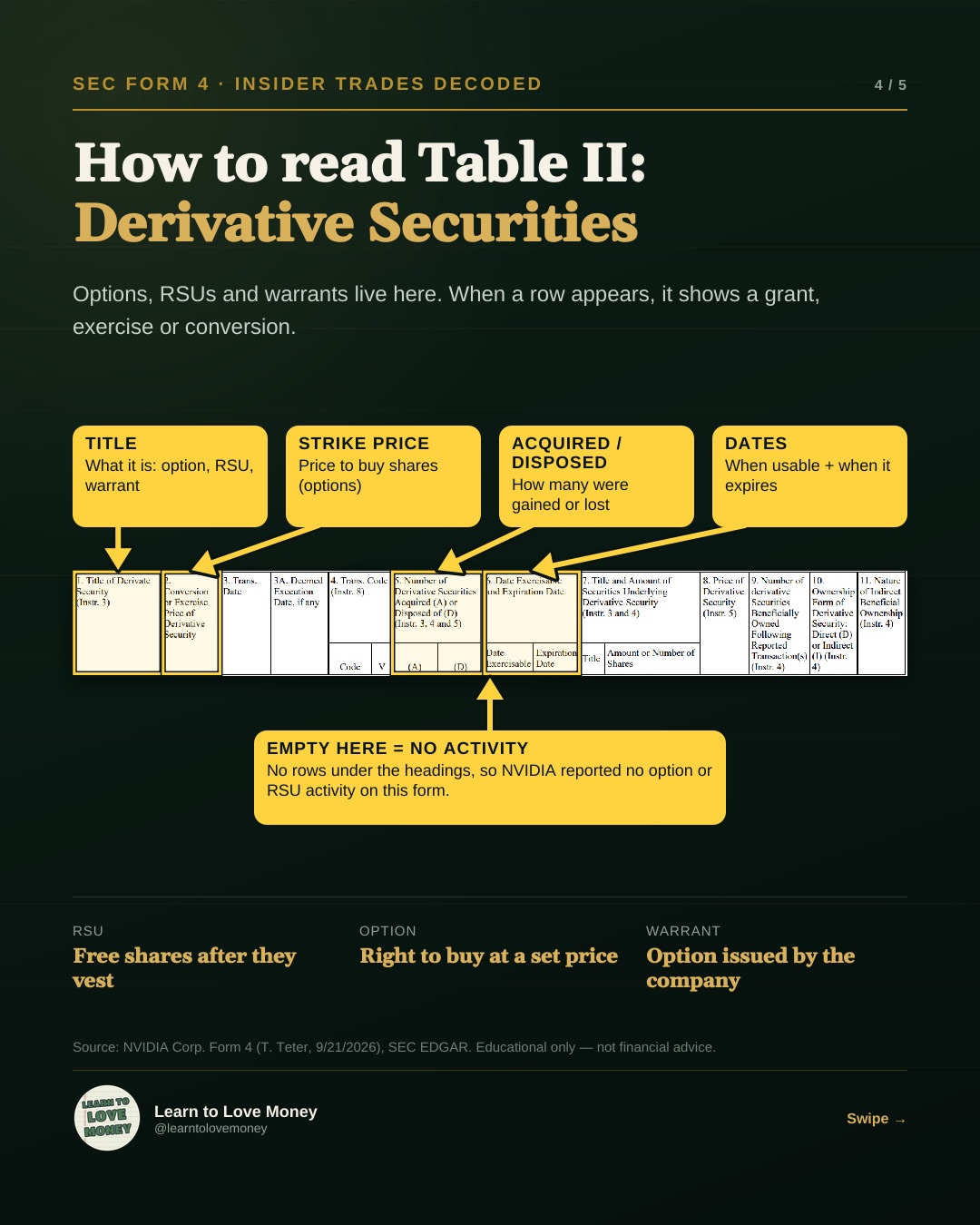
What lives here
Table II covers derivative securities, which are instruments whose value comes from the stock: stock options (the right to buy at a set price), RSUs (restricted stock units, which turn into free shares once they vest), and warrants (options issued by the company itself). When a row appears, it shows a grant, an exercise, or a conversion.
The columns that matter
Title says what it is (option, RSU, warrant). Conversion or exercise price is the strike price for options. Acquired / Disposed shows how many were gained or lost. Dates show when the instrument becomes usable and when it expires.
Why it matters
Many insiders get most of their pay in options and RSUs. When they exercise options and sell the shares the same day, Table II and Table I show two halves of one story. Seeing both tells you whether a sale was simply cashing out pay or a separate decision.
In this filing
Table II is empty: there are no rows under the headings. An empty table means no derivative activity was reported, so there were no option or RSU transactions on this form. All the action is in Table I.
Part 5 of 5
What they are
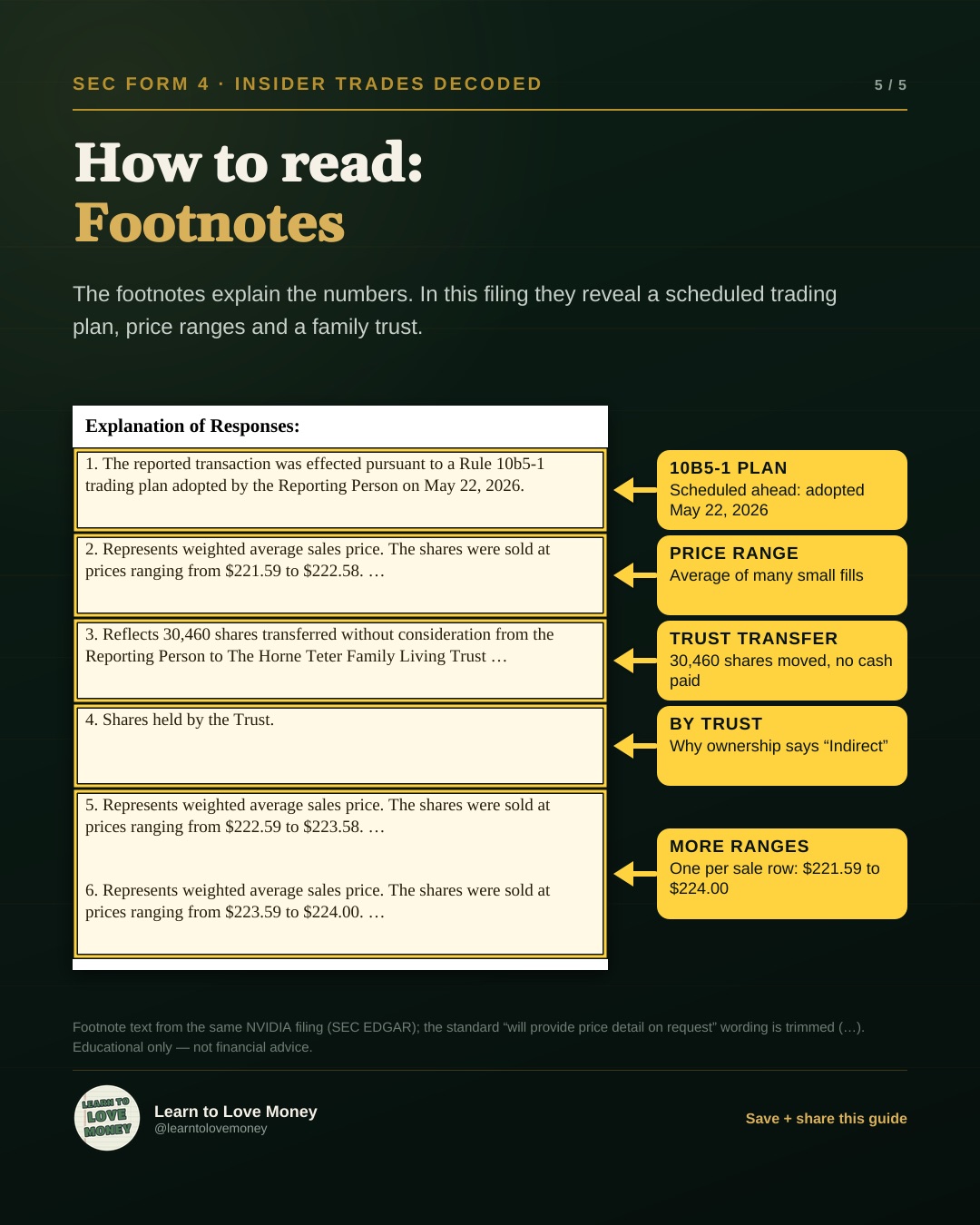
The small numbers in blue next to values in the tables point to the Explanation of Responses at the bottom of the form. This is where the filer adds context that doesn't fit in a box, and it often changes how you read the trade.
Three things footnotes commonly reveal
A trading plan. Footnote 1 says the trades were made under a Rule 10b5-1 plan adopted on May 22, 2026, about four months before the sales, so the schedule was set long before 9/21.
Price ranges. Large orders fill in many small pieces. The price shown is a weighted average, and the footnote gives the range (for example $221.59 to $222.58). That's why prices have four decimals.
Trusts and transfers. Footnote 3 says 30,460 shares were moved to a family living trust without payment, and footnote 4 says the trust holds the shares. That explains why ownership reads "Indirect."
Putting it all together
NVIDIA's General Counsel, through a family trust, sold about 30,460 shares (≈ $6.8M) on 9/21/2026 under a plan set up on May 22. A scheduled sale of a small share of a very large holding, with no option activity. That is routine, and not a red flag on its own.
A Form 4 is one piece of the picture, not a reason to buy or sell by itself.
Correct!
You just finished the Insider Trading course — you can now open a Form 4 and tell who traded, what they did, and whether it was planned.
Certificate of Completion
Insider Trading Course
Awarded to
A Smart Investor
Learn to Love Money
@learntolovemoney
Screenshot this and post it to your story — tag @learntolovemoney so we can see it.
Drop your email and we'll let you know when new courses and quizzes drop.
No spam. Unsubscribe anytime.
You're on the list — we'll let you know.
Learn to Love Money is for educational purposes only and does not provide personalized financial, investment, tax, or legal advice. The NVIDIA Form 4 shown is a public SEC filing used to illustrate how to read the form; it is not a recommendation about NVIDIA or any security, and an insider's trade, planned or not, does not predict a stock's future price. Nothing on this page is a recommendation to buy, sell, or hold any security. Always do your own research and consult a licensed professional before making financial decisions.