
Getting started
When something big happens at a public company, like buying another company, a CEO leaving, or a bankruptcy, it files an 8-K. Learn to read one in three stops, using a real NVIDIA filing.
About 6 minutes to read, 6 minutes for the quiz. For educational purposes only — not investment advice.
Part 1 of 4
What it is
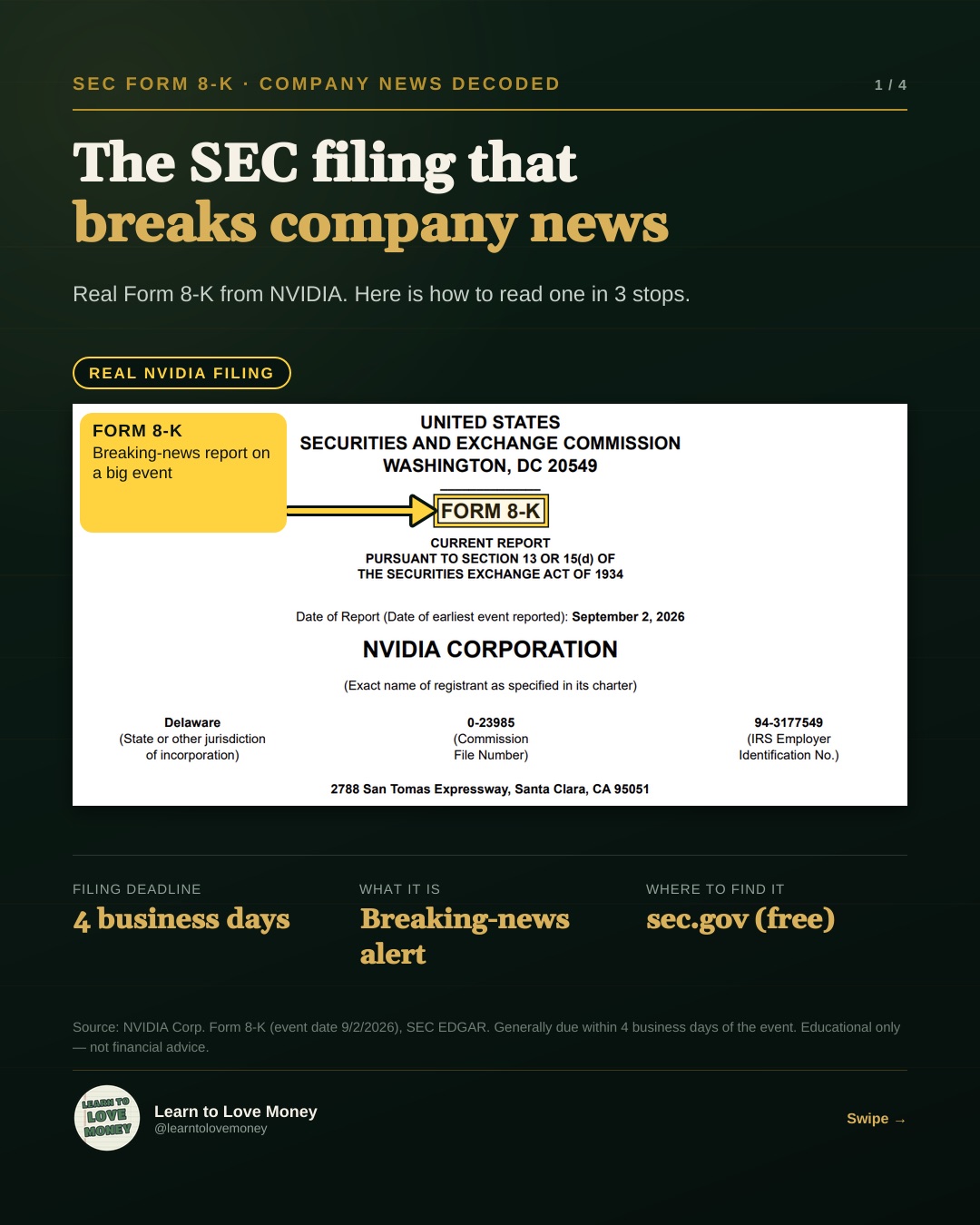
A Form 8-K is the "current report" a public company files with the SEC when something important happens between its regular reports. Think of it as a breaking-news alert straight from the company. It is generally due within 4 business days of the event, and it's free on the SEC's EDGAR website.
How it differs from the 10-K and 10-Q
The 10-K (yearly) and 10-Q (quarterly) arrive on a schedule and cover the whole business. An 8-K is event-driven: it shows up when something happens, and it covers just that one thing.
Items tell you what kind of news it is
Every 8-K is organized into numbered Items. A few common ones:
1.01 = signed a major agreement · 2.02 = earnings results
5.02 = officer or director leaves or joins · 8.01 = other events
9.01 = financial statements and exhibits
Scan the item numbers first and you'll know the type of news in seconds.
Why it matters
8-Ks often reach the public before the news coverage does, and they use the company's own wording. Reading the source filing means you see what was actually disclosed, not someone's summary of it.
Part 2 of 4
The company and the date
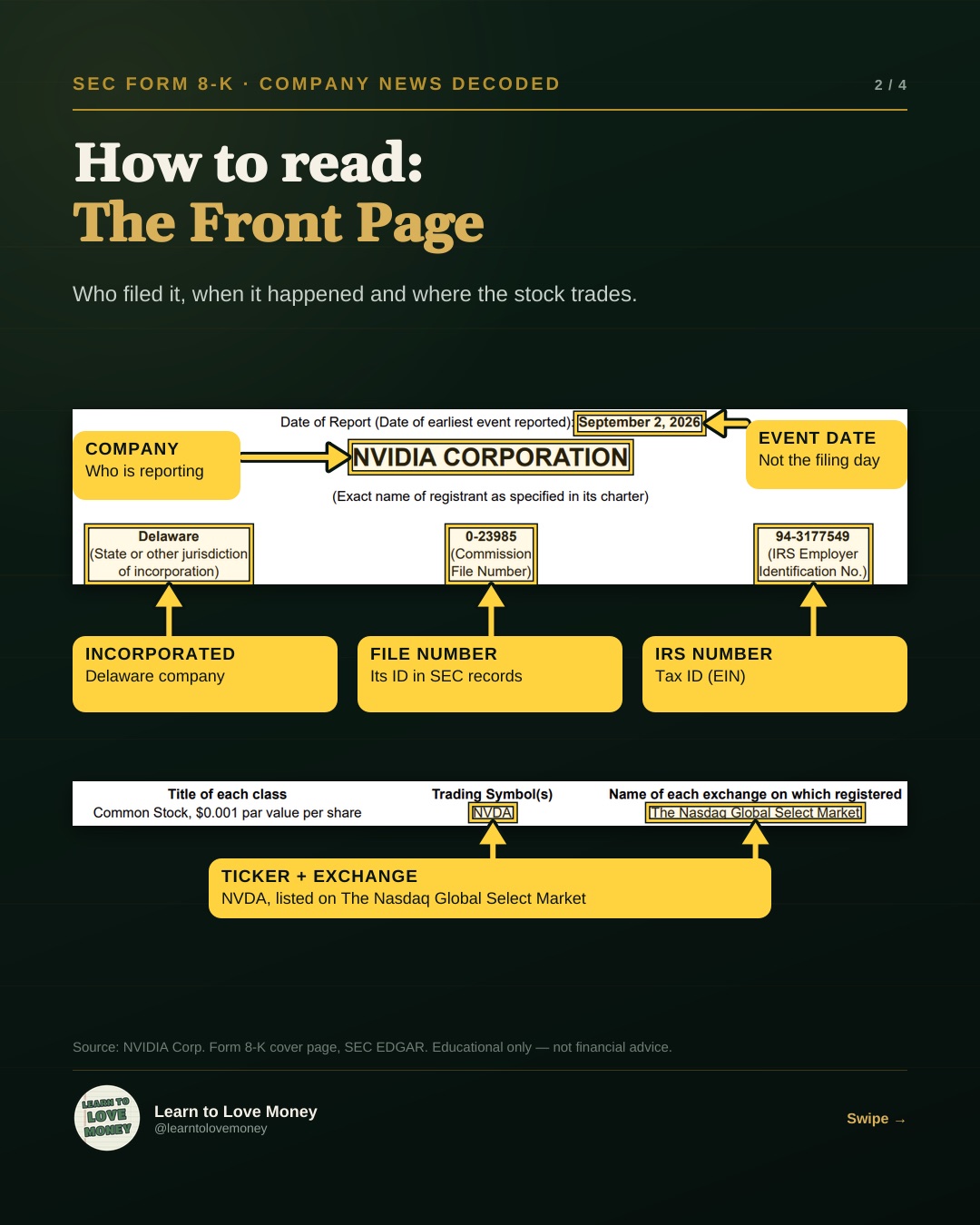
The big name in the middle is the company that's reporting. Just above it is the Date of Report, the date of the earliest event covered. That is the day the news happened, not the day the filing went out. Here, the event date is September 2, 2026.
The ID numbers
State of incorporation is the state where the company is legally registered (Delaware, for NVIDIA). The Commission File Number (0-23985) is the company's ID in SEC records, handy for finding all its filings. The IRS Employer Identification No. is its tax ID.
Ticker and exchange
Near the bottom, the filing lists each class of stock, its trading symbol, and the exchange it's registered on. For NVIDIA that's NVDA on The Nasdaq Global Select Market. Use it to confirm you're reading about the right company and the right share class.
Quick check
If the Date of Report is days before the date the filing appeared on EDGAR, that's normal: companies have up to 4 business days. Always use the Date of Report to line the news up with stock-price moves.
Part 3 of 4
Where the story lives
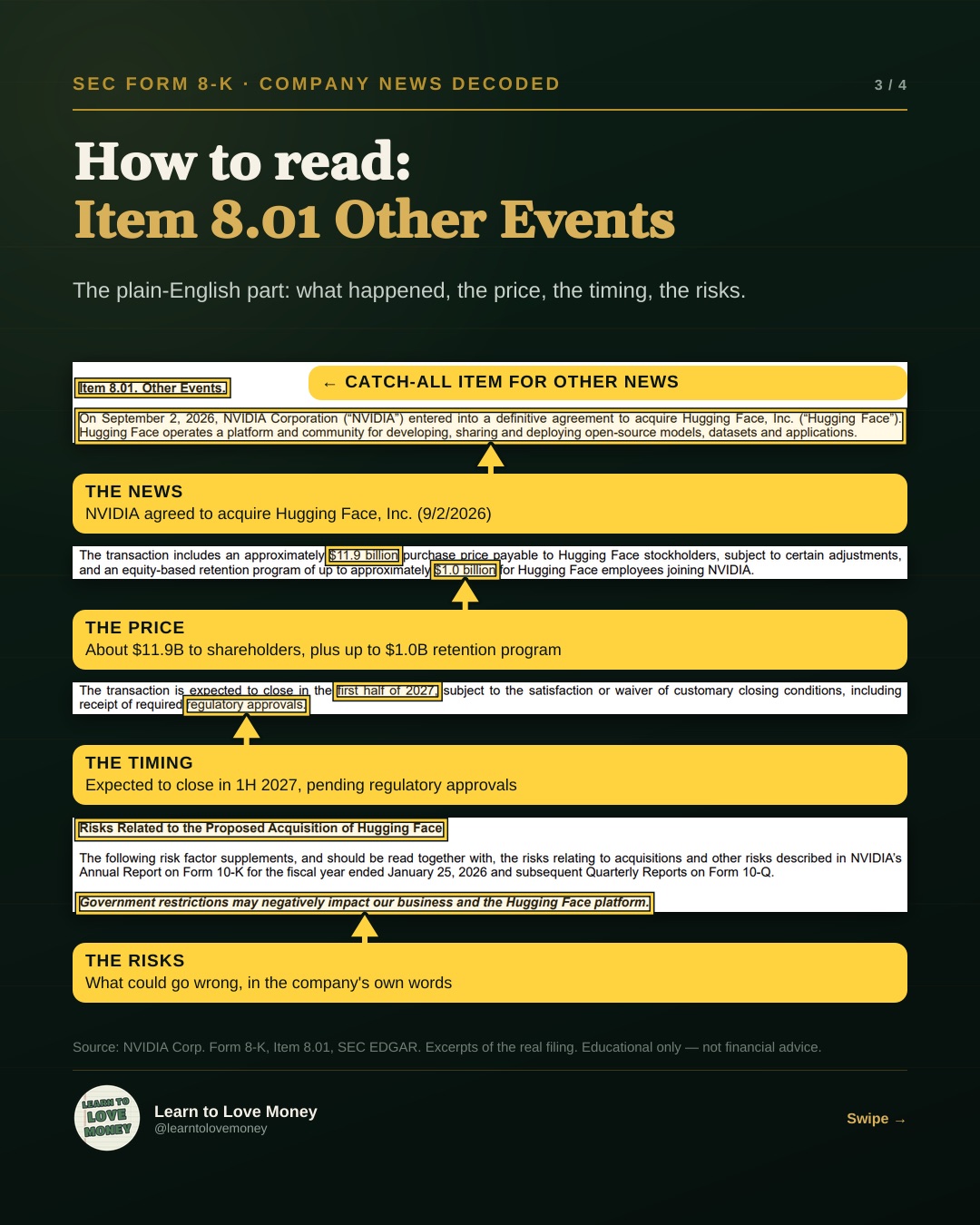
The body of the 8-K is one or more Items. Item 8.01, "Other Events," is a catch-all that companies use for news that doesn't fit a more specific item. This is usually the most readable section, so start here.
The four things to pull out
The news: what happened and to whom. The price: what's being paid, and any extras. The timing: when it's expected to finish, and what has to happen first. The risks: what the company says could go wrong, in its own words.
In this filing
News: on September 2, 2026, NVIDIA entered a definitive agreement to acquire Hugging Face, Inc., which runs a platform for sharing open-source models, datasets, and applications.
Price: about $11.9 billion payable to Hugging Face stockholders (subject to adjustments), plus an equity-based retention program of up to about $1.0 billion for employees joining NVIDIA.
Timing: expected to close in the first half of 2027, subject to closing conditions including regulatory approvals.
Risks: a risk section that includes "Government restrictions may negatively impact our business and the Hugging Face platform."
A "definitive agreement" is not a done deal
It means both sides have signed, but the deal can still fail if approvals don't come or conditions aren't met. Pay attention to the words "expected" and "subject to."
Part 4 of 4
What it is
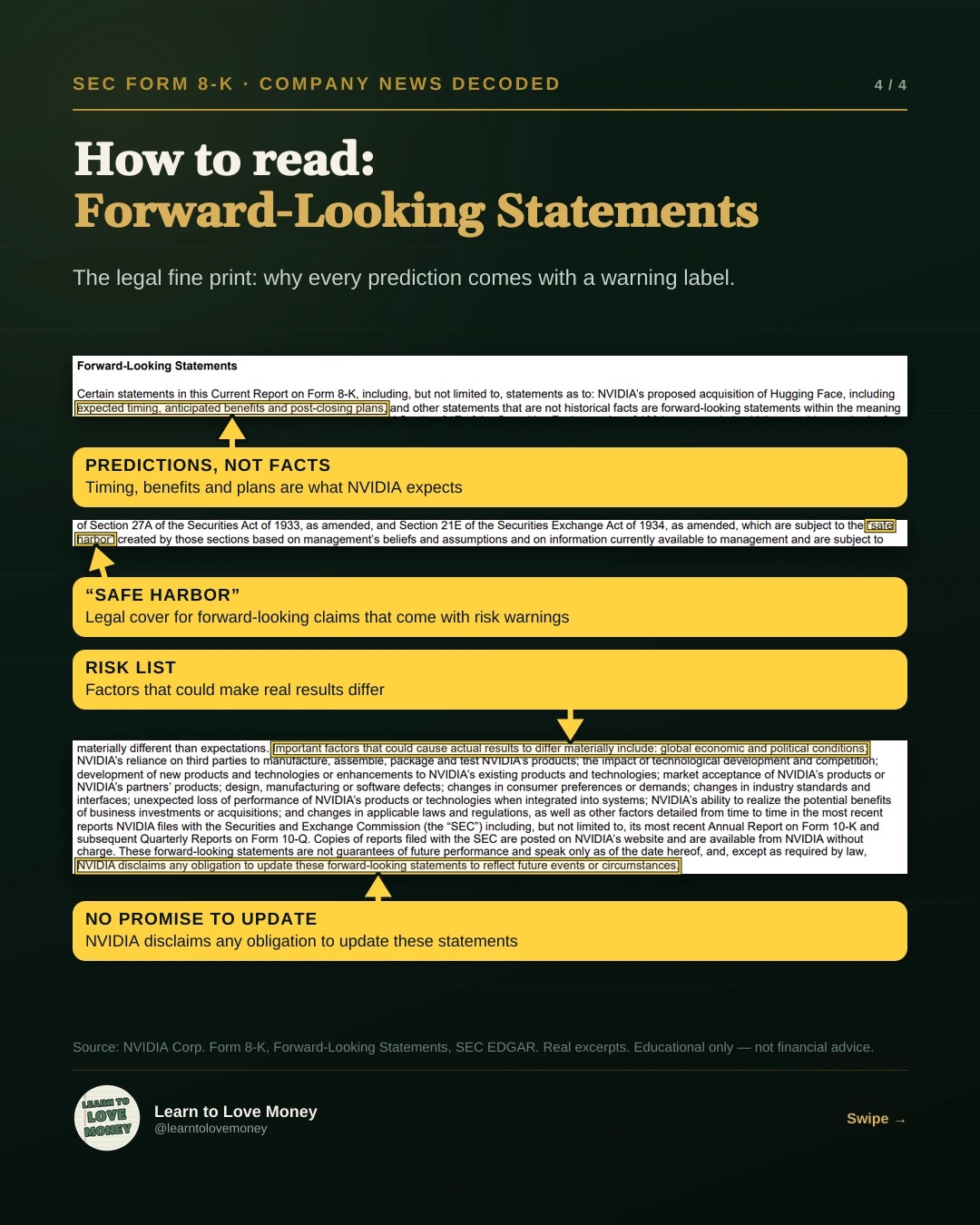
Near the end of nearly every 8-K is a paragraph titled "Forward-Looking Statements." It says that anything about the future, like expected timing, benefits, or plans, is a prediction, not a fact.
The safe harbor
U.S. securities law gives companies a "safe harbor": they have legal cover for forward-looking claims as long as they clearly warn that results may differ. The section cites the specific laws that create it (Section 27A of the Securities Act and Section 21E of the Exchange Act).
The risk list
The warning includes a list of factors that could make real results differ from expectations, such as economic conditions, supply-chain dependence, competition, and regulation. It also points you to the company's 10-K and 10-Q for the full risk factors.
No promise to update
The company says its statements speak only as of the filing date and that it has no obligation to update them, except as required by law. So a prediction in an 8-K can go stale quickly.
Putting it all together
When you open an 8-K: check the Item numbers to see what kind of news it is, the Date of Report for when it happened, the Item text for the news, price, timing, and risks, and treat anything about the future as an expectation, not a guarantee.
A filing tells you what the company said, not whether the stock is a good buy.
Correct!
You just finished the Form 8-K course — you can now open a company's breaking-news filing and pull out what happened, the price, the timing, and the risks.
Certificate of Completion
Form 8-K Course
Awarded to
A Smart Investor
Learn to Love Money
@learntolovemoney
Screenshot this and post it to your story — tag @learntolovemoney so we can see it.
Drop your email and we'll let you know when new courses and quizzes drop.
No spam. Unsubscribe anytime.
You're on the list — we'll let you know.
Learn to Love Money is for educational purposes only and does not provide personalized financial, investment, tax, or legal advice. The NVIDIA Form 8-K shown is a public SEC filing used to illustrate how to read the form; it is not a recommendation about NVIDIA, Hugging Face, or any security, and a company announcement does not predict a stock's future price. Nothing on this page is a recommendation to buy, sell, or hold any security. Always do your own research and consult a licensed professional before making financial decisions.